
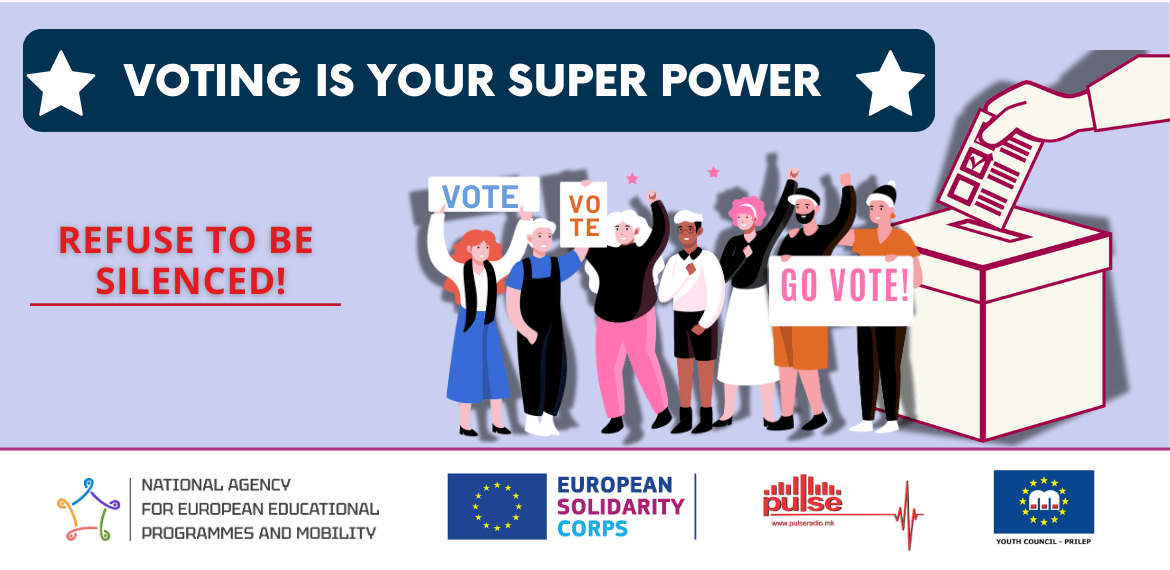
Youth Participation in Democratic Life in Türkiye
Our ESC Volunteer Betul Unal wrote a blog about “Youth Participation in Democratic Life in Türkiye”.
Turkish youth are not able to participate in the social and political life of the country enough to make a significant contribution to the national human development. The main reasons for this phenomenon include purely political factors, but also economic, attitudinal and cultural factors. All these factors interact with each other to different degrees, leading to very complex consequences. Given this complexity, it is worth mentioning several arguments. One is the dynamic impact that early childhood socialization has on the lives of adolescents. If children grow up in an environment that encourages active participation in social life, actively seeks responsibility in public administration, and requires them to also be responsible for the creation of public goods, these children are most likely to become supporters of a democratic system and grow up to be active participants in the development of their community. Another argument is the role that open, responsive, responsible and accountable institutions play in a quality democracy. If individuals are not provided with such an institutional environment, active citizenship may not always bear the fruits that are expected, which may undermine democratic participation. Political socialization and quality institutions are mutually supporting and dependent.
As long as children receive inappropriate or conflicting messages from their social environment and schools, they may grow up into a pilitcal culture and a general worldview that does not support a well-functioning, quality democracy. As highlighted in various sections of this report, education systems need to ensure that children receive clear signals about what is required to operate quality democratic institutions. The protection of freedoms, civil rights and responsibilities should be an integral part of the curriculum at all levels with different levels of complexity. Of great importance in this process is the recognition and tolerance of differences in religious, ethnic and cultural characteristics among different groups in society as an integral part of the curriculum, educational practices and experiences. What children hear and learn at school should not be in total contradiction with their everyday experience in the family. In this respect, it is particularly important that fathers do not infringe on the rights of mothers and daughters and that women’s rights are actively protected. Women’s equality in the family should be protected and promoted as part of the country’s active policy. Otherwise, children who grow up in a family environment where women have little say and are often verbally and physically abused will send conflicting signals, violating women’s fundamental rights and freedoms. Women’s empowerment is also necessary to break closed and insular social structures and ensure future generations’ participation in society. Girls who grow up believing that their main role in social life is to raise children and take care of the household will not be easily prepared to take on the full responsibilities of social life. Clearly, a non-participatory environment creates a negative loop, leaving individuals inactive and isolated, and the country’s human development in a suboptimal balance. To break out of this vicious cycle, a conscious effort is needed in the education system. In Turkey, the younger generation does not find an environment conducive to the development of independence and self-confidence in their closest social circles and families during childhood. Their families have inherited the cultural traits of previous generations and do not support their active participation in the social life of the country.
As a result, they lack the necessary qualities to participate in social life from their late teens onwards. A key factor behind these problems in the early stages of child development could be the lack of economic resources. Given the lack of public funds, only well-off families can afford to invest in their children’s early education, which would give them a head start in life, allowing them to enter better schools and better prepare them for the subsequent stages of selection, i.e.
higher levels of education. Even in the early stages of life, children grow up with deep-rooted inequalities that prevent them from participating properly in social life. Only through the provision of public resources can these children be provided with an adequate early education, which would provide them with the opportunity for adequate schooling and, in turn, better opportunities in the economic sphere. Equally important in this respect is the fact that their subsequent worldview and culture are likely to change in predictable ways as a result of their education in childhood and adolescence. If they continue to remain in substandard schools where socialization to the rights and responsibilities of full citizenship falls short of modern needs, these children will inevitably be integrated into community life without the recognition of difference, the protection of social differences, the free expression of differing opinions, etc.
being tolerated and encouraged. The inadequate education of these students keeps them trapped in a circle of ideological tendencies opposed to democratic reforms and the promotion and extension of democratic freedoms and civic responsibilities. They are not prepared to pay their due taxes, nor are they prepared to support the recognition and protection of religious and ethnic differences. Thus, they tend to distrust the trustworthiness of their fellow citizens and not participate in civic activities that promote human development in their communities and the country as a whole. Institutions are also dynamically designed and reshaped by individual citizens. If public institutions at various levels of government simply do not meet the demands and expectations of the people, then citizens’ taxes will not provide sufficient funding. Why should individuals pay taxes if they believe that these funds will simply be squandered by bureaucrats to line their pockets or simply distributed to cronies for political gain?
Therefore, to ensure proper participation at all levels, citizens need assurance that public administrations act responsibly and are accountable for the policies promoted, the funds spent, and the taxes collected. No education system can provide the younger generation with sufficient educational and moral support for democratic socialization in public life as long as corruption, unresponsiveness and lack of accountability are rampant within the system. Therefore, school administrators, as an example of what should exist in the real world outside schools, must ensure that students at all educational levels are actively accountable for the money spent and the policies followed, and are held accountable for unsatisfactory performance. At the forefront of this proper socialization are political parties. In Turkey, political parties have 4,444 weak grassroots organizations. Women, younger generations, ethnic and religious minorities are not represented as citizens with a strong political identity. For a long time, this was due to the military junta’s seizure of power in 1980. But the situation was the same before 1980 and almost 25 years later. It is therefore time for the civil administration to take responsibility for the current situation. A premature step on this issue, which is on Turkey’s public agenda, would be to introduce a unified organizational structure and require all parties to adhere to a unified organizational framework. However, parties will in response find ways to avoid or circumvent such requirements, as their survival does not depend on them. Rather, political parties should be given various incentives to actively engage with diverse social groups, ensure transparency of their financial accounts to party members and the general public, and actively seek to understand and meet the demands and expectations of party members. Thus, public funds given to political parties should come with responsibility. Political parties should be deprived of public funding if they do not maintain transparent membership lists, do not protect the rights of their members from interference or repression by party leadership, and do not actively seek participation in political decision-making processes. Women and youth participation can also easily translate into increased access to public funding.
Lowering the minimum age for voting and party membership is a step in the right direction. However, if these institutions are not complemented by financial incentive structures, the situation is likely to remain as it is, with seemingly model partied fort he younger generation having not real impact on how politics are conducted within parties. Equally important, these incentive systems can strengthen the financial transparency of the parties and reduce their links to clientelism. Oligarchic control of party leadership can also be regulated by more active participation of different citizen groups in these parties.
ESC VOLUNTEER BETUL UNAL
Оваа вест изворно е објавена на веб-страната на Здружение МЛАДИНСКИ СОВЕТ Прилеп
![[Aggregator] Downloaded image for imported item #51760](https://civicamobilitas.mk/wp-content/uploads/2026/10/viber_image_2026-10-01_17-18-23-732-e1791386995528_mcms-768x512.jpg)

![[Aggregator] Downloaded image for imported item #51688](https://civicamobilitas.mk/wp-content/uploads/2026/10/840133774_17959130763235552_502814887244435070_n-768x512.jpg)
![[Aggregator] Downloaded image for imported item #51690](https://civicamobilitas.mk/wp-content/uploads/2026/10/835640454_10243132301386325_6319941414456541047_n-768x358.jpg)