
![[Aggregator] Downloaded image for imported item #43795](https://civicamobilitas.mk/wp-content/uploads/2026/01/611149509_1571871173934400_3927165331577291092_n-2.jpg)
FROM CLASSROOMS TO NEWSROOMS: HOW CHINESE “SOFT POWER” OPERATES IN NORTH MACEDONIA
Note: This is the second article in a two-part series. To follow the full investigation, read the first part at B-IRC.ORG
BY: ENIS SHAQIRI
Influence through the media
Beyond education, China’s presence in North Macedonia is also visible across the Western Balkans’ media space.
For part of the Macedonian audience, narratives about China travel via China Radio International (CRI), which maintains editorial services in Serbian, Bulgarian, Croatian and Albanian. Because of linguistic similarities and regional distribution networks, CRI content is easily republished by local outlets and amplified across North Macedonia, and in other countries, such as Montenegro and Bosnia-Herzegovina.
Meanwhile, among Albanian audiences in North Macedonia, narratives about China are shaped not only through CRI but also largely via media outlets based in Albania – a country that maintained close ideological alignment with China during the communist period (1960–1978).
One concrete example is Radio “Ejani”, a Chinese state-controlled outlet operating as the Albanian-language service of China Media Group. Headquartered in Tirana and Durrës, it functions as an editorial office and digital platform producing news, analysis, interviews and cultural features, and serves as a visible channel for transmitting China-related narratives to Albanian audiences in North Macedonia.
How does this type of media influence work?
Many of the materials distributed by Radio “Ejani” contain content produced by the Xinhua news agency, with media outputs labelled as “China state-controlled media.” A significant portion of this content is disseminated through sponsored posts on Facebook, which Meta records in the Meta Ad Library, where data on timing, spending and demographic targeting parameters are publicly available.
These sponsorships allow media operators to target specific audiences – by age, gender and geographic region – thereby amplifying selected content within clearly defined segments of the population.
A concrete example identified by BIRC is the sponsored article “From Tetovo to Kunming – the taste of the Balkans meets Chinese coffee,” a feature story about the experience of a young person from Tetovo who lives and works in China.
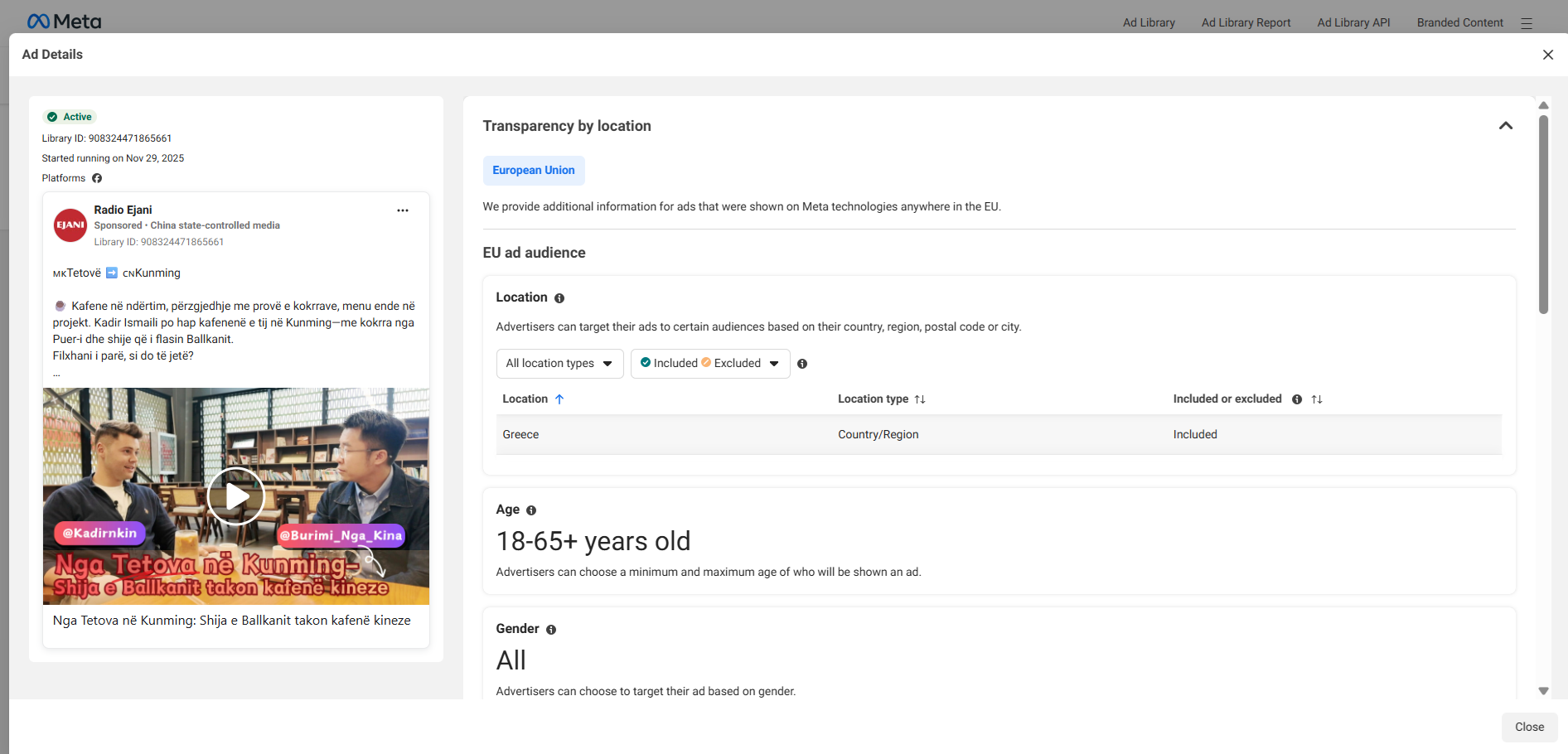
When accompanied by repeated sponsorships, this type of content expands the reach and impact of pro-China messaging without readers necessarily being aware of the origin or intent behind its distribution.
The period analysed by BIRC for sponsored advertisements covers part of December 2025.
Concerns about Radio “Ejani” have also been raised by numerous journalists in Albania, who view it as a Chinese “propaganda tool” disseminating anti-Western messages across the Balkans.
In research conducted by BIRN Balkan, they argue that the station’s high production quality and substantial financial investment make it a “potential risk” to Albania’s information environment. These concerns are linked to the lack of transparency regarding the radio’s funding and editorial control – patterns also observed in similar cases elsewhere in the region.
![[Aggregator] Downloaded image for imported item #51393](https://civicamobilitas.mk/wp-content/uploads/2026/10/share-default-768x403.jpg)
![[Aggregator] Downloaded image for imported item #52261](https://civicamobilitas.mk/wp-content/uploads/2026/10/regional-comparative-analysis-on-ppp-concessions.png)
![[Aggregator] Downloaded image for imported item #52259](https://civicamobilitas.mk/wp-content/uploads/2026/10/Quality-Label.png)

![[Aggregator] Downloaded image for imported item #52203](https://civicamobilitas.mk/wp-content/uploads/2026/10/Cover_MM-Albania-600x400-1.jpg)