
Workshop on digital platforms: A new Media Law and regulation of social platforms are needed
The recommendations section, which has been prepared in accordance with UNESCO’s Guidelines for the Governance of Digital Platforms, the Digital Services Act (DSA), and other international documents, is intended for various stakeholders
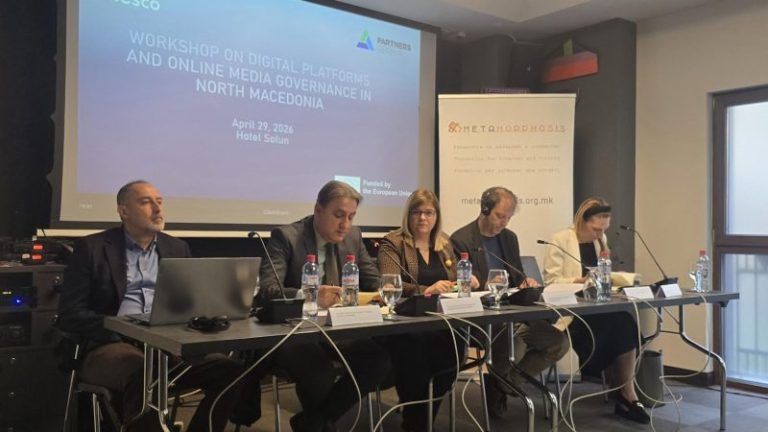
 Photo: Meta.mk
A comprehensive new Media Law, regulation of social media platforms, and protection of small local media are needed, while the competent institutions should ensure that all stages of drafting new legislation on online media are transparent, inclusive, and carried out in cooperation with all relevant stakeholders. These are just some of the recommendations highlighted at today’s workshop on digital platforms and online media governance, held at Hotel Solun.
The event was opened by Zoran Trajchevski, Director of the Agency for Audio and Audiovisual Media Services (AVMU). Addresses were also delivered by Joshua Masserenti, Regional Project Coordinator from UNESCO’s Office in Sarajevo, Ana Toskić Cvetinović, Executive Director of Partners Serbia and Danche Danilovska Bajdevska, Program Director at the Metamorphosis Foundation.
The annex to the study and the recommendations on regulating social media platforms and online media in North Macedonia were presented by Mihajlo Lahtov, national researcher at the Macedonian Institute for Media (MIM).
“North Macedonia is making efforts to align with the digital environment, as illustrated by the law on the registration of online media. This is an opportunity to demonstrate that the digital ecosystem is managed in a way that protects journalism and trust in institutions. Media freedom is a fundamental prerequisite for development and peace. UNESCO’s report shows that freedom has declined by 10 percent since 2012, while censorship has increased by 60 percent. These issues in North Macedonia are specific,” Masserenti emphasized in his address.
Toskić Cvetinović noted that when discussing regulation, digital services have evolved.
“They provide an institutional framework when it comes to digital rights. What the Digital Services Act (DSA) offers is a specific form of trust in regulation, enabling stakeholders to engage in these processes,” she said.
The recommendations section, prepared in accordance with UNESCO’s Guidelines for the Governance of Digital Platforms, the EU Digital Services Act (DSA), and other international documents, is intended for various stakeholders, including competent institutions, online media, and social media platforms.
“With regard to institutions, they should ensure that all stages of drafting new legislation on online media are transparent, inclusive, and conducted in cooperation with all relevant stakeholders. This includes the participation of professional organizations, media representatives, civil society, and the academic community. Institutions should adopt a comprehensive new Media Law aligned with European standards and initiate multi-stakeholder discussions on regulating social media platforms. These should be harmonized with the Digital Services Act (DSA) and the European Media Freedom Act (EMFA), as well as with international human rights standards, as set out in UNESCO’s Guidelines for the Governance of Digital Platforms,” the recommendations state.
Regarding recommendations for the media, it is noted that, in order to ensure the integrity and professionalism of platforms, it is essential for media outlets to develop and implement effective systems for reviewing and moderating user-generated content on their websites and social media platforms, especially in comment sections. This includes actively monitoring, filtering, and removing comments containing hate speech, discriminatory language, or harmful rhetoric.
“Media outlets should work in partnership with fact-checkers, civil society organizations, and other media outlets to share best practices and develop joint initiatives aimed at countering misinformation and enhancing content credibility. A comprehensive social media plan is also needed. Media should establish a clear and documented strategy for their social media presence, integrating editorial standards with platform-specific practices,” the recommendations conclude.
![[Aggregator] Downloaded image for imported item #51694](https://civicamobilitas.mk/wp-content/uploads/2026/10/1_cover-600x400-1.jpg)

![[Aggregator] Downloaded image for imported item #51442](https://civicamobilitas.mk/wp-content/uploads/2026/10/VACANCY_Comms-officer-600x400-1.png)
![[Aggregator] Downloaded image for imported item #51393](https://civicamobilitas.mk/wp-content/uploads/2026/10/share-default-768x403.jpg)