

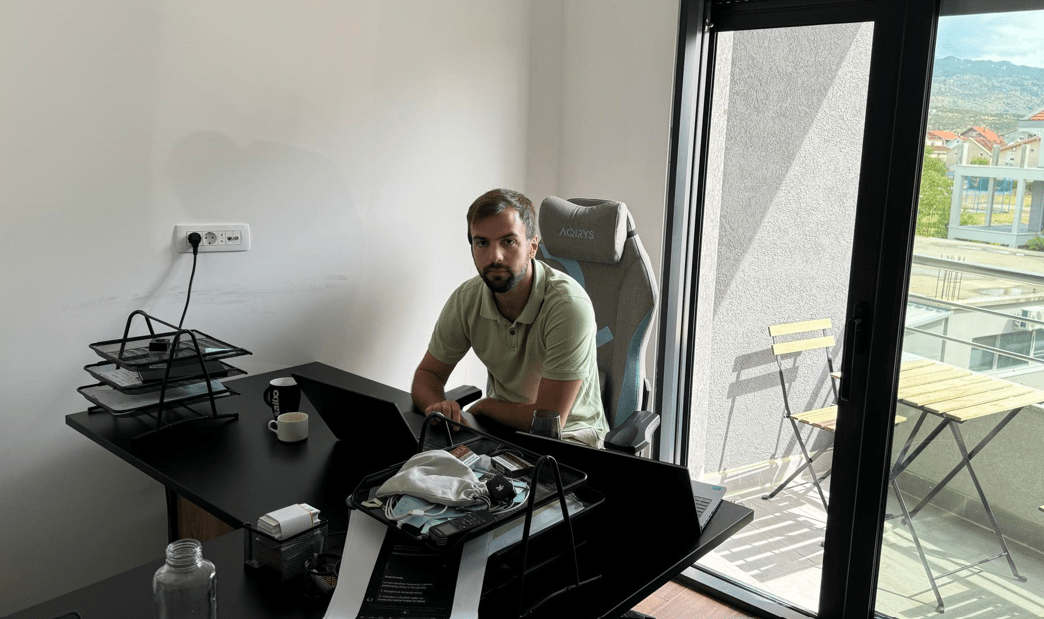
IVAN IVANOVIC: CORRUPTION HAS BECOME A NORM BECAUSE IT OFTEN GOES UNPUNISHED
Interviewed by: Lorik Idrizi
“The main reason corruption has become a new norm is that it often goes unpunished in many Balkan countries. When people in power, from local officials to national leaders, engage in corrupt practices without facing significant consequences from courts and prosecutions, it sends a signal that these behaviors are acceptable. Young people, especially those growing up in this environment, might not have any frame of reference to understand that these practices are illegal or unethical because they see them as ‘how things are done’.”
In an exclusive interview, Ivan Ivanoviç (investigative journalist at BIRN) talks about the causes preventing quality education in Montenegro and the Western Balkans, and the connection between corruption and the shift of societal models away from universal values.
- Do you think that corruption in the Western Balkans has become a new normality to the point where young people can’t recognize it?
IVAN IVANOVIÇ: I agree and the main reason it’s that corruption often goes unpunished in many Balkan countries. When people in power, from local officials to national leaders, engage in corrupt practices without facing significant consequences from courts and prosecutions, it sends a signal that these behaviors are acceptable. Young people, especially those growing up in this environment, might not have any frame of reference to understand that these practices are illegal or unethical because they see them as “how things are done.”
Also, corrupt practices may be presented to the younger generation in a way that doesn’t seem inherently wrong. For example, bribery might be framed as a necessary means of getting ahead, whether it’s securing a job, expediting a bureaucratic process, or gaining access to higher education.
Media also plays a role. While investigative journalism is critical in exposing corrupt activities, many mainstream media outlets in the region are controlled or influenced by political elites, which limits the coverage of corruption scandals. As a result, young people may not be exposed to stories that critically examine corruption or challenge the status quo. This further contributes to a cultural environment where corruption becomes normalized and, in many cases, not even seen as a problem.
- What are the main reasons in your opinion that model has shifted the social model a lot from conventional values to a wrong social model?
IVAN IVANOVIÇ: In societies where organized crime has close links with political and economic elites, the idea that one can achieve success through honest means becomes difficult to sustain. For many young people, seeing criminals or corrupt officials enjoying wealth and influence fosters a belief that bending or breaking the rules is the only viable path to success.
The decline in trust in institutions has been a significant factor in this shift. People lose faith in systems of governance, the rule of law, and educational institutions when they are repeatedly failed by them. This erodes social cohesion and shifts societal values away from collective well-being towards self-preservation and opportunism.
Globalization and the rapid spread of consumerist values have also played a role. Many young people aspire to achieve the same levels of wealth and material success that they see in more prosperous countries, but they often do not have access to the same opportunities.
- Do you think that the low quality of education affects the creation of the wrong social model that is often related to corruption?
IVAN IVANOVIÇ: Absolutely. When young people do not receive a strong education grounded in critical thinking, ethics, and civic responsibility, they are more susceptible to adopting the norms of a corrupt society. Without the ability to critically analyze the systems around them, they are less likely to question authority or recognize when corrupt practices are undermining their future.
Moreover, low-quality education often fails to equip young people with the skills necessary to compete in the global economy. Faced with few employment prospects, they might turn to corrupt practices or the shadow economy to survive, reinforcing the cycle of corruption. Education is supposed to be a path out of poverty and a way to empower individuals to build a just and equitable society. However, when education systems are weak, they can reinforce existing inequalities and contribute to the normalization of unethical behavior.
- Do you think that the wrong social model is related to corruption and organized crime? How?
IVAN IVANOVIÇ: In many Western Balkan countries, organized crime has become integrated into political and economic systems. Criminal organizations often wield significant influence over political elites, law enforcement, and even judicial systems, allowing them to operate with relative impunity. This creates a culture in which power and success are closely tied to illicit activities rather than merit or legality. The wrong social model, as you describe it, often glorifies wealth and power, regardless of how it is obtained. Organized crime thrives in such environments because it offers an alternative pathway to success. When legitimate avenues are blocked by corruption or inefficiency, many people, particularly those in economically disadvantaged areas, turn to criminal activities as a means of survival or advancement. In these communities, organized crime can provide employment, social services, and a sense of belonging that the state fails to offer.
- How can the networks of this model related to corruptions and organized crime be deconstructed?
IVAN IVANOVIÇ: First and foremost, there must be a genuine will among all societal actors for this change to happen. This includes the three branches of government—starting with politicians, and extending to the courts and the prosecution. It is essential that independent institutions exist to carry out such reforms, which unfortunately is not always the case. The civil sector also needs to play an active role in this process. However, it seems that the political will to take such action is still lacking, and as a result, the current state of affairs suits everyone involved.
This means that without the unified will of the entire system, including the political, judicial, and civil components, meaningful change cannot occur. Politicians often benefit from the current system, where corruption and a lack of accountability allow them to maintain power without facing significant consequences. The judiciary, when it is not independent, can be manipulated by political elites to either protect corrupt individuals or ensure their opponents are prosecuted. And without independent prosecutorial bodies, even those caught in corruption scandals often escape justice due to lack of effective legal action.
The role of independent institutions is crucial. These institutions should act as checks on the abuses of power, ensuring transparency and accountability. Unfortunately, in many cases, such institutions are either co-opted by political elites or lack the necessary autonomy to function effectively. When the rule of law is weak, and independent bodies are undermined, it becomes extremely difficult to combat entrenched corruption.
- How can civil society and journalism help in deconstructing this wrong model?
IVAN IVANOVIÇ: Civil society and journalism are key pillars in this fight.
Together, civil society and journalism serve as watchdogs, ensuring that those in power cannot operate unchecked. By promoting transparency, challenging corrupt practices, and mobilizing citizens, they can help shift society away from a corrupt, unjust model towards one grounded in integrity and fairness. Of course, in order to do their job well, greater media freedom is necessary, which unfortunately is not the case in the Western Balkans.
The interview was realised as part of the ‘MOVE GRANTS’ program supported by the Western Balkans Fund.
![[Aggregator] Downloaded image for imported item #51694](https://civicamobilitas.mk/wp-content/uploads/2026/10/1_cover-600x400-1.jpg)
![[Aggregator] Downloaded image for imported item #51442](https://civicamobilitas.mk/wp-content/uploads/2026/10/VACANCY_Comms-officer-600x400-1.png)
![[Aggregator] Downloaded image for imported item #51393](https://civicamobilitas.mk/wp-content/uploads/2026/10/share-default-768x403.jpg)