
DDI Hackathon – From Ideas to Action: How Digital Tools Are Strengthening Civic Engagement and Resilience
Across diverse countries and civic realities, one pattern consistently emerges: people want to engage, respond, and contribute, but too often, they lack the structure, tools, or confidence to do so effectively.
The five initiatives developed as part of the DDI Hackathon highlighted here demonstrate a powerful shift. By designing practical, user-centered digital solutions, they are not only addressing immediate gaps, but fundamentally changing how individuals and organizations participate in civic life-making action more accessible, coordinated, and impactful.

Unlocking Civic Potential: From Passive Interest to Active Participation
A central barrier to civic engagement is not apathy, but uncertainty. Many young people, volunteers, and community actors have ideas and motivation, yet struggle with where to begin or how to translate intention into action.
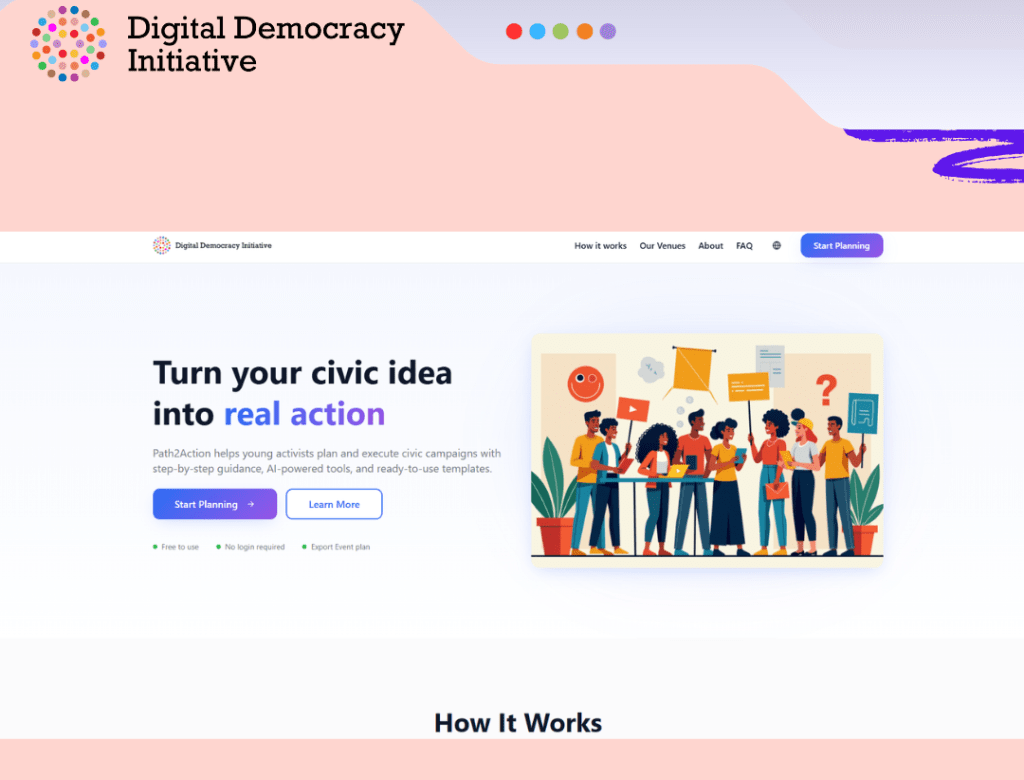
Solutions like Path2Action and ActiVibe directly tackle this challenge by providing structured, step-by-step guidance and curated pathways for engagement. By simplifying planning processes and offering practical tools, these platforms reduce the intimidation of getting started.
The impact is tangible. Users are no longer limited to supporting roles, they become organizers, contributors, and initiators of civic activities. In testing phases, participants not only used the platforms but began independently contributing content, exploring new initiatives, and engaging more proactively.
Crucially, this transformation is happening even in restrictive environments. ActiVibe demonstrates that when young people are given safe, thoughtfully designed digital spaces, they continue to engage in meaningful, non-violent civic action despite legal and political constraints. The result is not only increased participation, but sustained engagement, creativity, and resilience.

Simplifying Complexity: Making Critical Processes Usable for Everyone
In parallel, several initiatives address another key barrier: complexity.
Responding to misinformation or verifying online content often requires navigating fragmented tools, multiple languages, and unclear sources. This creates delays and discourages action at the very moment when speed and accuracy matter most.
CrossCheck and Disbunk transform this experience. By integrating workflows, bringing together intake, analysis, verification, and coordination into single, intuitive platforms, they dramatically reduce the effort required to act responsibly. What once required scattered searches, manual tracking, and advanced skills is now accessible within a unified system. Users can verify claims, organize evidence, and coordinate responses more efficiently and with greater confidence.
This has a broader impact beyond efficiency. By lowering the barrier to entry, these tools expand who can participate in countering misinformation. Students, journalists, and civil society actors alike are better equipped to engage critically with information and contribute to a healthier digital ecosystem.

From Reaction to Preparedness: Strengthening Organizational Capacity
While individual empowerment is a key outcome, these innovations also significantly strengthen organizational readiness.
The development of the Maira Crisis Co-Pilot reflects a shift from fragmented expertise to structured, real-time support. Organizations facing coordinated online attacks, reputational risks, or disinformation campaigns often lack immediate, actionable guidance in high-pressure situations.
By translating crisis-response knowledge into an AI-assisted, workflow-based tool, the project provides organizations with the ability to navigate uncertainty more effectively. Even before full deployment, the creation of a functional MVP represents a critical change: moving from conceptual understanding to operational readiness.
Similarly, Disbunk enhances how teams collaborate in responding to disinformation. By centralizing incident tracking, evidence management, and communication, it enables organizations to move beyond reactive responses toward coordinated, strategic action.
Together, these tools strengthen not only individual capacity, but the broader ecosystem of actors working to protect democratic processes.

Designing for Impact: What Makes These Solutions Work
Despite their different contexts and focus areas, all five initiatives share a common approach: they prioritize usability, clarity, and real-world relevance over complexity.
Key design principles underpinning their impact include: focusing on clear, guided user journeys rather than overwhelming functionality; building around real user needs identified through testing and feedback; simplifying access and reducing friction (e.g. optional logins, intuitive interfaces); delivering practical, action-oriented features instead of abstract information.
These choices are not incidental, they are central to impact. In multiple cases, small design decisions, such as improving navigation, refining filters, or clarifying steps, significantly increased engagement and usability.
Another critical lesson is the importance of focus. Rather than attempting to solve everything at once, successful solutions concentrated on key moments, whether it is the “first step” of verification or the immediate response during a crisis. This clarity made the tools more effective and easier to adopt.

A Shared Outcome: Expanding the Capacity to Act
Taken together, these initiatives illustrate a broader transformation in civic and digital engagement. They show that when people are equipped with the right tools, tools that are accessible, structured, and designed with their realities in mind, they are far more likely to take action. The impact goes beyond individual use cases: more young people are initiating and leading civic activities; more users are engaging critically with information before sharing; more organizations are responding to crises with structure and confidence; more actors are able to collaborate and coordinate effectively. In essence, these solutions are shifting the landscape from fragmented effort to coordinated action, from uncertainty to clarity, and from intention to impact.
At a time when democratic participation faces increasing challenges, this shift matters. It demonstrates that thoughtfully designed digital innovation can do more than support engagement, it can actively enable it.
And perhaps most importantly, it reinforces a simple but powerful idea: when people are given the tools to act, they do.
With the support of CIVICUS, and in partnership with the Civic Literacy Initiative, Metamorphosis Foundation is implementing the Digital Democracy Initiative Hackathons – which aims to encourage the development of innovative digital solutions to advance democracy and strengthen the civil society sector
![[Aggregator] Downloaded image for imported item #52203](https://civicamobilitas.mk/wp-content/uploads/2026/10/Cover_MM-Albania-600x400-1.jpg)


![[Aggregator] Downloaded image for imported item #52158](https://civicamobilitas.mk/wp-content/uploads/2026/10/Is-Political-Interference-Addressed-in-the-Frameworks-of-the-Prosecutorial-Councils-in-North-Macedonia-and-Bosnia-and-Herzegovina-pdf-1-724x1024-1-e1792394173877.webp)
![[Aggregator] Downloaded image for imported item #52160](https://civicamobilitas.mk/wp-content/uploads/2026/10/Raising-the-Bar-on-Integrity_Aligning-North-Macedonia-and-Bosnia-and-Herzegovina-with-the-2026-EU-Anti-Corruption-Directive-pdf-1-724x1024-1-e1792393418465.webp)