

Conference held to launch the co-creation process of the National Action Plan for the Open Government Partnership 2026–2028
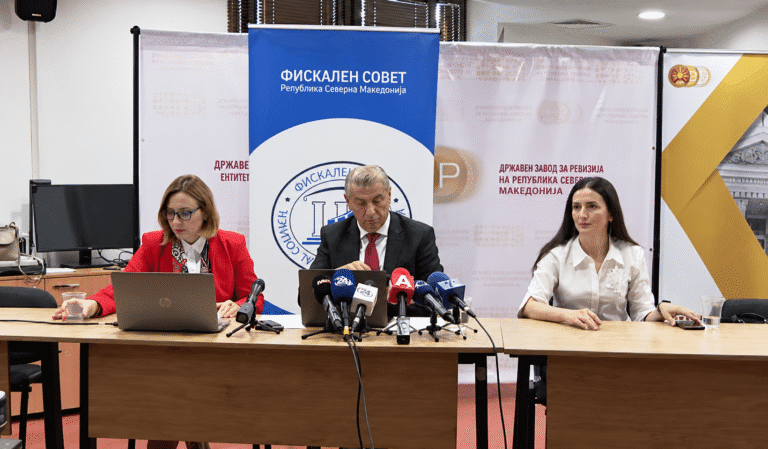
Today, organized by the Ministry of Public Administration, in cooperation with the Metamorphosis Foundation and the Center for Civil Communications, a conference was held to launch the process of co-creation of the National Action Plan for Open Government Partnership 2026 – 2028. The conference was attended by the Program Director of the Metamorphosis Foundation, Dance Danilovska-Bajdevska, the Minister of Public Administration, Goran Minchev, the Secretary General of the Assembly, Marina Dimovska, the National Coordinator for Open Government Partnership, Gordana Gapikj Dimitrovska, and representatives of several institutions and civil society organizations.
“The Open Government Partnership is not just a process, it is a model of work that shows that when institutions and civil society collaborate, the results are better, more concrete and more beneficial for citizens. I can say that, over the years, this process has proven to be one of the rare mechanisms in which there is a truly equal partnership where civil society and institutions sit at the same table, with an equal number of representatives, with an equal voice and with shared responsibility for achieving results,” said Danilovska-Bajdevska.
She pointed out that the partnership approach delivers tangible results, including increased proactive transparency of institutions, which contributed to increasing the publication of data and information of public interest, establishing standards for open data, improving access to public information and developing digital services.
According to the Minister of Public Administration, Goran Minchev, the Open Government Partnership is an important instrument for promoting transparency, accountability, and public participation in policymaking, and what makes it particularly significant is the fact that it is not an initiative of a single institution, but a joint commitment that unites the executive branch, parliament, judiciary and civil society.
For Minchev, the success of the process depends on the institutions and their commitment to implementing the commitments undertaken, but the positive pressure from civil society organizations represents an added value, which contributes to greater ambition, transparency, and accountability in the implementation of reforms.
Gordana Gapikj Dimitrovska, the National Coordinator for the Open Government Partnership (OGP), emphasized that the co-creation of the new National Action Plan provides an opportunity to create new commitments and priorities.
“The Open Government Partnership is more than an initiative, it is a platform where institutions and civil society jointly define reforms, and the added value is that they work together on their implementation. We have worked on advancing the already established reforms, we have institutions that have been working from the beginning to change the culture of work and to make more information available to the public. We have worked on open data, increasing the consultation process, access to justice, transparency at the local level, and we have examples that the process is making changes in our society,” said Gapikj Dimitrovska.
German Filkov from the Center for Civil Communications emphasized the institutions that have always acted as partners in the process and pointed out the concrete results of that cooperation.
“The significance of the Open Government Partnership is seen through the government website data.gov.mk, which is a commitment from an action plan. The website ener.gov.mk, which was just launched, had a commitment to optimize it and make it a consultation tool for adopting regulations, which exists today. The Council for Cooperation of the Government with Civil Society is also one of the commitments, the Government Strategy is developed with the participation of the civil society sector, and data on all civil society organizations is publicly available in the Central Register. Initiatives from Action Plans include the whistleblower law, the integrity system of institutions, the register of elected and appointed officials, the electronic submission of asset declarations, and others,” Filkov pointed out.

He emphasized that, thanks to this process, information on all companies in the Central Registry is now publicly available, all health programs and their implementation have been publicly announced, and, as one of the most important changes resulting from the partnership, he highlighted the Open Treasury and the public disclosure of the names of the real owners who conclude contracts through the Public Procurement Bureau.

![[Aggregator] Downloaded image for imported item #51694](https://civicamobilitas.mk/wp-content/uploads/2026/10/1_cover-600x400-1.jpg)

![[Aggregator] Downloaded image for imported item #51442](https://civicamobilitas.mk/wp-content/uploads/2026/10/VACANCY_Comms-officer-600x400-1.png)
![[Aggregator] Downloaded image for imported item #51393](https://civicamobilitas.mk/wp-content/uploads/2026/10/share-default-768x403.jpg)