
Challenges and Opportu-nities for Fiscal Discipline in North Macedonia: Insights from the Latest Study

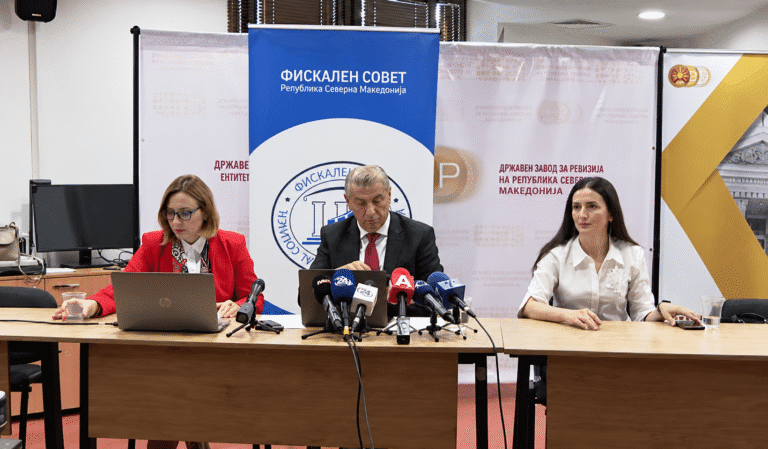
The Fiscal Council of the Republic of North Macedonia and Finance Think – Economic Research and Policy Institute organized a debate where the findings of the study “Fiscal Discipline and the Efficiency of Fiscal Rules in North Macedonia: The Path to Sustainability” were presented. The analysis covers the period from 2008 to 2024. Data on public debt, budget revenues, and expenditures are sourced from finalized accounts, while projections for 2024 and the period up to 2029 are based on the Fiscal Strategy for 2025-2029.
Key findings of the study:
- Fiscal Rules: Introduced through the Budget Law of 2022, these rules limit the budget deficit to 3% of GDP and public debt to 60% of GDP. The rules are self-imposed restrictions by policymakers aimed at ensuring fiscal stability, maintaining optimal levels of public debt, contributing to macroeconomic stability, and promoting long-term sustainable economic growth. Although these rules were not applied during the analyzed period, the authors evaluated how fiscal policy might be assessed if these rules were enforced, providing valid insights into the management of public finances in the future.
The implementation of fiscal rules encountered certain challenges. During the analyzed period, total public debt (excluding overdue unpaid obligations) increased at an average annual rate of 7%, surpassing the threshold of 60% of GDP by the end of 2023. By the end of 2024, the debt is projected to reach 66.4% of GDP and 70.8% when including overdue unpaid obligations. Additionally, in more than half of the analyzed years, the deficit exceeded the fiscal rule of 3% of GDP. Frequent revisions of initial targets highlight weaknesses in accurate planning, overly optimistic revenue projections, and difficulties in expenditure management. This narrows the space for countercyclical policy and medium-term crisis buffers.
- Medium-term Fiscal Strategy: Although fiscal strategies set targets for budget deficits and public debt, frequent revisions undermine the credibility of these goals, making consistent achievement of fiscal objectives impossible. Consequently, annual planning focuses on short-term measures, rendering budget projections vulnerable.
- Pro-cyclical Policy: The analysis revealed that expansionary fiscal policy was applied throughout the analyzed period. In this context, fiscal policy was not used solely for countercyclical purposes to stabilize economic cycles but also to maintain high aggregate demand. This led to increased expenditures in the form of budget deficits and higher public debt. Expansionary fiscal measures during periods of economic growth further increased public debt, reducing budget flexibility during economic crises.
Short-term fiscal policy fluctuations were also identified, correlated with the political election cycle.
- Long-term Expenditure Growth: The growth of fixed expenditures, particularly current ones such as salaries and pensions, outpaced revenue growth and real GDP growth. This poses a risk of increasing the structural budget deficit and necessitating further borrowing.
Event Details:
Managing these risks was the focus of the event, which was organized into two panels.
- In the first panel, Minister of Finance Dimitar Kovachevski, through a presentation of policies in the Fiscal Strategy 2025-2029, highlighted the mechanisms and tools for addressing these risks, the dynamics of fiscal consolidation, and alignment with fiscal rules.
- Members of the Fiscal Council emphasized the need for policies and reforms in public finance aimed at managing the structural budget deficit and restructuring public expenditures.
- Representatives of Finance Think stressed the importance of applying the rule of countercyclical fiscal policy.
- A representative from the EU Delegation shared experiences with fiscal rules in the EU, recommending that North Macedonia, as a future EU member, prepare for their implementation.
- A World Bank representative shared insights on fiscal rules in the Western Balkans and emphasized the need to create fiscal space during periods of economic growth to build buffers for crisis periods.
- A representative from the Macedonia 2025 business community stressed the need for predictable fiscal policies and effective application of medium-term fiscal strategies.
![[Aggregator] Downloaded image for imported item #51694](https://civicamobilitas.mk/wp-content/uploads/2026/10/1_cover-600x400-1.jpg)

![[Aggregator] Downloaded image for imported item #51442](https://civicamobilitas.mk/wp-content/uploads/2026/10/VACANCY_Comms-officer-600x400-1.png)
![[Aggregator] Downloaded image for imported item #51393](https://civicamobilitas.mk/wp-content/uploads/2026/10/share-default-768x403.jpg)