
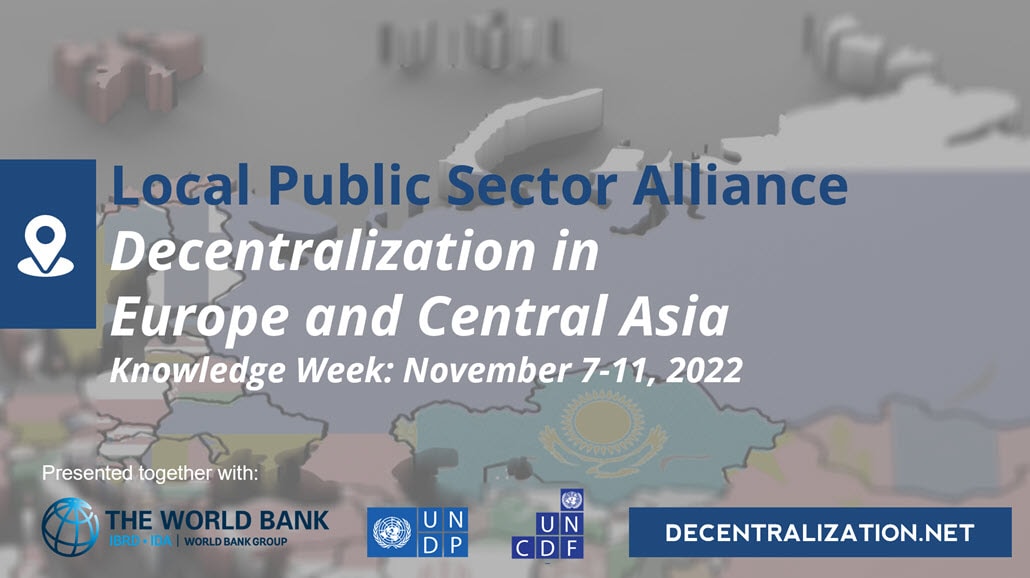
CEA participated in the Webinar on the Direction of decentralisation in Eastern Europe&Central Asia
Marjan Nikolov and Vesna Garvanlieva from CEA, presented at the webinar organized by the Local Public Sector Alliance. The session was focused on the Financial linkages between local budgets and businesses for local economic development, held on November 10, 2022
Webinar: Direction of decentralization in Eastern Europe and Central Asia – Decentralization Net
Session background:
Sub-national governments in the region have overall mandate of promoting local economic development. Yet, there are questions about fiscal and administrative powers and capacities of local governments to promote local economic development in their jurisdiction. An important tool for promoting local economic development is local government budgets. In the region, local budgets are financed through revenues sources that are mainly controlled by the central government such as revenue-sharing arrangements and direct local business levies. The critical elements of revenue sharing are (i) how the total amount of shared taxes is defined (rule based or negotiated), (ii) what are the forms of actual revenue sharing (formula or origin based; local surcharges) and the (iii) scope of local autonomy in using the shared revenues (earmarked or general-purpose revenues). Municipal own revenues on businesses may operate also as regulatory instrument, if local governments have sufficient autonomy in setting rates and exemptions.
After a brief discussion on the role of sub-national governments in local economic development, this session specifically focused on incentives for increasing employment and local economic development and how local governments can effectively use fiscal resources at their disposal for economic development. Panelists were invited to (i) evaluate national laws and legislations on the role of subnational governments and local economic development; and (ii) present the significance and evolution of fiscal revenues for local governments in their countries, to assess the local impact of the various schemes on local budgets and businesses.
Moderator: Gabor Peteri
Panelists:
“North Macedonia: VAT sharing by formula, performance grant”, Aleksandar Stojkov & Adrian Ionescu
“Structure of local taxes and fees in North Macedonia: Local businesses, land development fees, tax behavior”, Vesna Garvanlieva & Marjan Nikolov
“Comparative analysis of PIT sharing system and of the regimes of local taxes charging local business in Romania and Republic Moldova”, Victor Giosan
“Tax sharing mechanisms in Armenia”, Abraham Artashesyan
“Challenges of fiscal equalisation in Croatia: further tax sharing steps“, Sasa Drezgic
“Natural Resource Revenue Sharing in Kazakhstan and Kyrgyzstan for Local Development”, Meruert Makhmutova
The post CEA participated in the Webinar on the Direction of decentralisation in Eastern Europe&Central Asia appeared first on CEA – Center for Economic Analyses.
![[Aggregator] Downloaded image for imported item #51393](https://civicamobilitas.mk/wp-content/uploads/2026/10/share-default-768x403.jpg)
![[Aggregator] Downloaded image for imported item #49973](https://civicamobilitas.mk/wp-content/uploads/2026/08/Enis-Shaqiri-768x389.jpg)
![[Aggregator] Downloaded image for imported item #51387](https://civicamobilitas.mk/wp-content/uploads/2026/09/Краток-документ-за-политики_eng-1-pdf-1-724x1024-1.webp)
![[Aggregator] Downloaded image for imported item #51265](https://civicamobilitas.mk/wp-content/uploads/2026/09/ich-1-768x1024-1.jpg)
![[Aggregator] Downloaded image for imported item #51459](https://civicamobilitas.mk/wp-content/uploads/2026/09/825329974_5155401651274491_2155681169352553897_n-1-768x512.webp)
![[Aggregator] Downloaded image for imported item #51461](https://civicamobilitas.mk/wp-content/uploads/2026/09/819207924_5152804251534231_1144901816227016216_n-2-768x576.webp)