
Learning Together in the Digital Age: A Story by Srebra Gjorgjievska
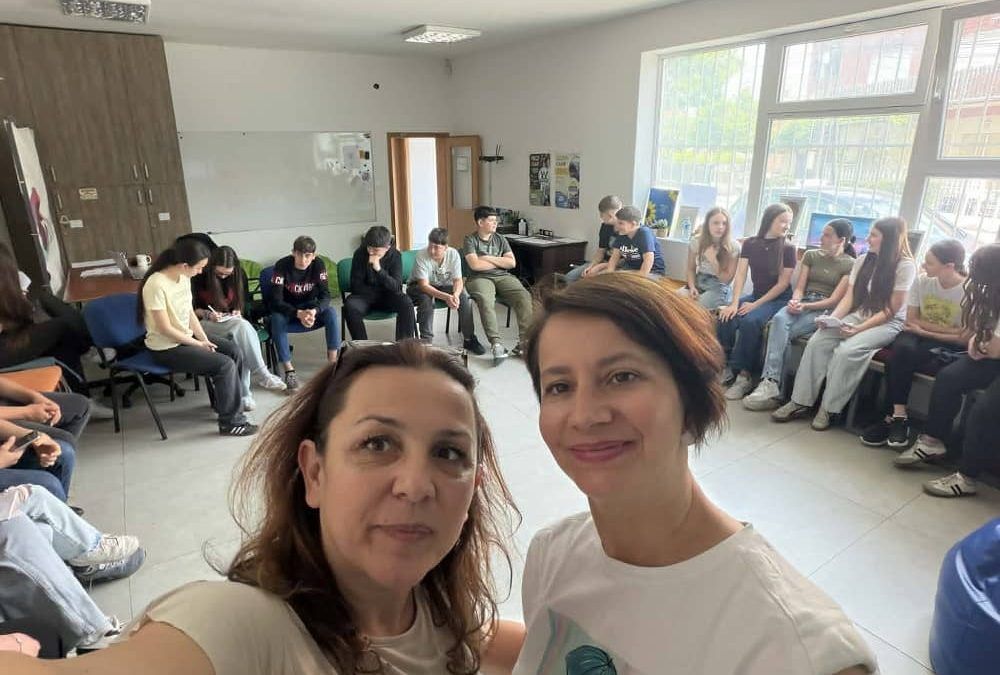
As part of the “From Awareness to Action (A2A)” project, young people from primary and secondary schools took part in media literacy workshops designed to strengthen their critical thinking and help them navigate today’s complex information environment.
Through interactive exercises, discussions, and practical examples, participants explored how to recognize fake news and misinformation, question the content they encounter online, and make more informed choices in the digital space.
The workshops were facilitated by experienced journalists Srebra Gjorgjievska and Vesna Ivanovska-Ilievska as well as an IT expert Anastasija Jakimovska, who brought their professional experience into the classroom while creating space for young people to share their own perspectives and experiences.
In the story below, Srebra Gjorgjievska reflects on her experience as a trainer, the process of building trust with young participants, and what adults can learn from young people when discussing media, information, and the digital world.
The activity was implemented within the project “From Awareness to Action (A2A)”, supported by GCERF and implemented by MCEC in partnership with the Center for Intercultural Dialogue (CID) and LOJA.
Working with young people today, in an era of communication, information, and widespread access to content, is not only an obligation for adults, but also a great responsibility. It is very likely that a group of children you intend to speak to about news, fake news, misinformation, and similar topics already has much more information on the subject than you might expect. Therefore, it is very important to choose the right approach and use appropriate language when addressing them.
As journalists with more than two decades of experience in the fields of education, science, and culture, Vesna Ivanovska-Ilievska and I have had the opportunity to work with young people, share our knowledge with them, and also learn from them. We gladly accepted the task and invitation from the Center for Intercultural Dialogue, with which we had previously had a short but productive cooperation on a topic related to culture and the independent scene in Kumanovo. We believe that the workshops held in May with primary and secondary school students were useful for them, and certainly for us as well.
Although today’s generations of children, especially adolescents, are not always very open to speaking and need some time to relax and build trust with the person addressing them, with every new exercise and slide in our presentations, we could feel their trust growing. They gradually became more comfortable speaking openly, sharing their opinions, and asking questions. These generations of young people are growing up in a time full of challenges, and we, as adults, should show as much understanding as possible when they encounter topics such as truth and lies, news and fake news. Growing up in a time of cameras, recordings, and constant digital exposure, it is natural for them to feel fear and initial distrust when they are asked to express their views or opinions. However, we remained patient and succeeded in gaining their attention.
Through different exercises and games, students from different ethnic backgrounds learned how fake news developed throughout history and what types of fake news exist. Through practical examples, they learned how to recognize fake news, how false information can create real-life problems, what emotional manipulation means in the digital era, and other related issues. At the same time, we were reminded that young people are eager to engage with these topics when they are approached in an interactive and respectful way, and that they can offer valuable perspectives that enrich the learning process for everyone involved.
We hope that we encouraged them to think more carefully about what they click on, how they spend their time online, and how they can develop critical thinking.
Srebra Gjorgjievska
![[Aggregator] Downloaded image for imported item #52203](https://civicamobilitas.mk/wp-content/uploads/2026/10/Cover_MM-Albania-600x400-1.jpg)
![[Aggregator] Downloaded image for imported item #52158](https://civicamobilitas.mk/wp-content/uploads/2026/10/Is-Political-Interference-Addressed-in-the-Frameworks-of-the-Prosecutorial-Councils-in-North-Macedonia-and-Bosnia-and-Herzegovina-pdf-1-724x1024-1-e1792394173877.webp)
![[Aggregator] Downloaded image for imported item #52160](https://civicamobilitas.mk/wp-content/uploads/2026/10/Raising-the-Bar-on-Integrity_Aligning-North-Macedonia-and-Bosnia-and-Herzegovina-with-the-2026-EU-Anti-Corruption-Directive-pdf-1-724x1024-1-e1792393418465.webp)