Author: Здружение "Центар за Меѓукултурен Дијалог"

  • Promotion of Minorities’ Participation in Multilevel Governance

    The PACT project officially started in Brussels with a 2-day international conference and workshop
    On 10 and 11 March 2026, Brussels hosted an International Conference and Workshop entitled “Promotion of Minorities’ Participation in Multilevel Governance”.
    It brought together experts coming from different realities, with a common goal: sharing good practices on how to promote inclusive participation of under-represented minorities, people with migratory background, refugees, Roma and other marginalised communities in local decision-making processes.
    The Conference
    The event opened on the morning of Tuesday 10 March with 2 panels.
    The first one – entitled “Minority Participation in Multilevel Governance: EU perspectives” – was moderated by Mohammed Mustafa (ALDA – European Association for Local Democracy) who introduced the main EU policy developments in the areas of anti-poverty and anti-discrimination, and migration, setting the tune of the conversation with the speakers:
    Julie Pascoet (European Network Against Racism – ENAR) focused on the European Anti-Discrimination Strategy,  highlighting how much this tool is necessary (but also how far it is to address the needs of the moment), and how civil society networks  play a crucial role to bridge the gap between EU policy intentions and the lived experiences of marginalised communities.
    Fernando Vasco Chironda (European Anti Poverty Network – EAPN) tackled the EU Anti-Poverty Strategy, underlying that – by excluding migrant people from vulnerability frameworks – the strategy risks deepening marginalisation of those most affected, and that local authorities are those with the responsibility to ensure inclusive participation spaces and adequate resources for people.
    Mojib Atal (Migration Policy Group – MPG) focused on the Migrant Integration Policy Index, reporting a concerning stagnation in political participation across the EU, and highlighting how multilingual education could serve as a democratic tool by recognising linguistic diversity rather than privileging a single dominant language.
     

    The second panel – “From Welcoming to Active Participation: Challenges, Practices and Power” – was moderated by Maddalena Alberti (ADL Zavidovici) and had the goal to hear from experts who exchanged ideas, perspectives and best practices for the inclusion of underrepresented minorities at a local level.
    Anna Coulibaly (International Catholic Migration Commission – ICMC Europe) introduced the Community Sponsorship, a community‑led integration model where volunteers, supported by civil society and approved by governments, commit to hosting and supporting refugees for at least a year.
    Loubna Reguig (European Forum for Youth with Lived Migration Experience – VOICIFY) urged how self‑led organisations are essential to defend the political participation rights of young people with migrant backgrounds, since they create spaces where youth feel included, exchange knowledge and pool resources.
    Queenie Kessie (IOM Diaspora Advisory Board – DAB) showed how diaspora advisory structures can move beyond consultation and concretely ensure fair policies are good for migrant people and societies.
    Ismail Alkhateeb (PLACE Network) brought the organisation’s extensive experience to show that the inclusion of migrant people in local participatory processes can happen only when institutions and local communities jointly define problems, design solutions and test them at micro‑level.

    Conclusion
    Hosted by Amazone asbl (Brussels) and co-organised by ALDA (France), ADL Zavidovici (Italy), KMOP (Greece), Center for Intercultural Dialogue (North Macedonia), PLACE Network (France), Fons Català (Spain) and Konkáv Alapítvány (Hungary), the event saw the participation of public authorities, policy makers, organisations, media, underrepresented minorities united by the wish to learn on how working together is possible for a fair and equal European policy system.
    The initiative was part of the European-funded project PACT (Participatory Action for Transforming Communities) whose aim is empowering under-represented minorities in local communities in Europe.
  • Open call for an expert to develop the strategic plan for CID (2027 – 2031)

    Center for intercultural dialogue is looking for a qualified expert to submit proposal for the development of a comprehensive, actionable, and dynamic strategic plan for Center for intercultural dialogue. The plan will outline the organization’s vision, mission, goals, and key actions for the next 5 years (2027 – 2031) to strengthen our impact, sustainability, and […]

  • PACT project kicks off WP1 coordination, paving the way for inclusive governance and minority participation in Europe

    The PACT – Participatory Action for Community Transformation project has officially launched its first phase with the WP1 Coordination Meeting, held online on 28 January 2026, bringing together partners from across Europe to align strategies, exchange perspectives, and co-design the foundations of upcoming activities.
    Funded under the CERV – Networks of Towns programme, PACT is a 24-month European initiative that aims to contribute to the recognition, empowerment and inclusion of underrepresented ethnic and national minorities in local communities. By strengthening cooperation between municipalities, civil society organisations and minority-led actors, the project promotes inclusive governance, participatory democracy and social cohesion across Europe.
    The project is led by ADL Zavidovići (Italy) and implemented by a transnational partnership including Fons Català de Cooperació al Desenvolupment (Spain), KMOP – Social Action and Innovation Centre (Greece), Center for Intercultural Dialogue – CID (North Macedonia), PLACE Network (France) and KONKÁV (Hungary).
    ALDA – the European Association for Local Democracy leads the coordination of events at European level, strengthening the link between the project’s transnational scope and its communication and advocacy actions.
    A collaborative start: WP1 Coordination Meeting
    The WP1 kick-off meeting marked an important first step in translating the project’s vision into concrete actions. The session created space for partners to present their organisations, target groups and local contexts, while identifying shared challenges and opportunities related to minority participation.
    Partners highlighted experiences from working with migrant-led organisations, Muslim communities, Roma youth and families, as well as municipalities committed to anti-racism and inclusion policies. Across different national contexts, a common concern emerged: the difficulty in reaching underrepresented minorities, compounded by barriers to participation and the persistence of misleading or exclusionary narratives.
    The meeting focused on the core principles guiding WP1 activities: cooperation, co-design and co-creation. 
    Throughout the meeting, partners reaffirmed the project’s commitment to a human-rights-based and participatory approach, placing minorities at the centre of decision-making processes as active contributors and rights-holders.
    Looking ahead: WP1 International Conference and Workshops in Brussels
    Preparations are now underway for the WP1 International Conference and Workshop on the Promotion of Minorities’ Participation in Multi-level Governance, which will take place on 10–11 March 2026 in Brussels, at Amazone – House of Associations for Gender Equality.
    The two-day event will gather 76 participants from 10 European countries, including representatives of municipalities, civil society organisations, minority-led groups, experts and practitioners.
    By fostering dialogue between local and European actors, the event will represent a key milestone in advancing inclusive governance models and democratic participation across Europe.
    With WP1 officially underway, PACT is setting the foundations for a shared European effort to reshape narratives, enhance participation and build more cohesive and inclusive communities.

  • New Video Encourages Young People to Think Critically Before Sharing Information Online

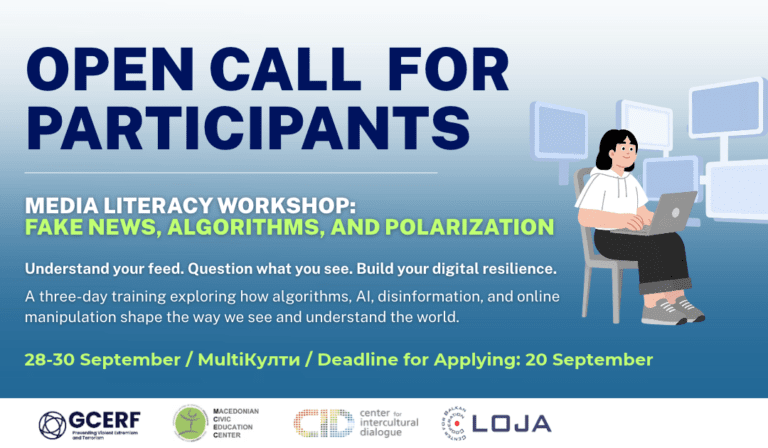
    A new educational video released within the MEDIActive Youth project highlights the importance of critical thinking and responsible behaviour in today’s digital information environment, encouraging young people to reflect on how they consume and share online content.
    The video focuses on one of the key challenges of the digital age — the rapid spread of misinformation through social media and online platforms. With information constantly appearing in news feeds, young users are often exposed to content that may be misleading, incomplete, or intentionally manipulative. Through relatable examples and clear explanations, the video reminds viewers that not everything seen online should be accepted at face value.
    By presenting practical tips and everyday situations, the video encourages viewers to pause before reacting or sharing information, check sources, and question the credibility of online content. These skills are increasingly recognised as essential competencies for young people navigating digital spaces, where misinformation can influence opinions, social relationships, and public discussions.
    The video forms part of broader educational efforts under the MEDIActive Youth initiative, which promotes media literacy, digital awareness, and active citizenship among young people across the Balkans. Educational resources developed within the project aim to strengthen young people’s ability to analyse media messages, understand how online algorithms shape information exposure, and become responsible digital citizens. Media literacy education initiatives worldwide similarly emphasise evaluating sources and understanding context as key skills for safely navigating online information environments.
    Through accessible visual storytelling, the video invites young audiences to reflect on their online habits and take a more conscious role in creating healthier digital communities.
    Watch the video below and learn how to recognise reliable information online.


  • No Label Movers & Shakers Hackathon — Kumanovo

    Empowering Young Changemakers Through Innovation and Collaboration
    From 29 October to 1 November, the Center for Intercultural Dialogue (CID) proudly hosted the No Label Movers & Shakers Hackathon in Kumanovo, in close collaboration with SOU “Pero Nakov”, who generously provided their creative and modern school space for the event.
    Over the course of four dynamic days, young changemakers from six countries came together in Kumanovo to learn, create, and innovate. This inspiring group included motivated local youth from SOU “Pero Nakov”, whose energy, creativity, and curiosity helped shape the vibrant atmosphere of the hackathon.
    A Space for Innovation, Dialogue, and Action
    The hackathon was designed as a safe and empowering environment where young people could explore ideas, challenge stereotypes, and design solutions that promote inclusion, equality, and social impact. Through interactive workshops, team challenges, and hands-on mentoring, participants:

    Worked in multicultural teams
    Exchanged experiences, perspectives, and talents
    Explored creative tools for problem-solving
    Used technology and design thinking to tackle real social issues
    Built long-lasting friendships and networks

    The programme not only fostered technical skills but also encouraged critical thinking, collaboration, and leadership—key elements for building more resilient and inclusive communities.
    A Diverse Group of Future Leaders
    Young participants joined us from six different countries, making Kumanovo a temporary hub of innovation and intercultural dialogue. Their diverse backgrounds contributed to a rich exchange of ideas and cultures, allowing everyone to learn from one another while co-creating meaningful solutions.
    Local students from SOU “Pero Nakov” played an important role, showing exceptional initiative and enthusiasm. Their active involvement highlighted the potential of youth in Kumanovo to drive positive change.
    CID extends its sincere gratitude to SOU “Pero Nakov” for their unwavering support, hospitality, and commitment to youth empowerment. By opening their creative space to international young innovators, they helped transform this hackathon into a memorable and impactful experience.
    The No Label Movers & Shakers Hackathon once again proved that when young minds come together in the right environment, incredible things happen. Their ideas, solutions, and teamwork demonstrated that youth are not just the leaders of tomorrow—they are the changemakers of today.
    CID remains committed to providing young people with opportunities to learn, grow, and lead. We look forward to continuing this journey of innovation, collaboration, and positive impact.

Нема повеќе содржини

Нема повеќе содржини