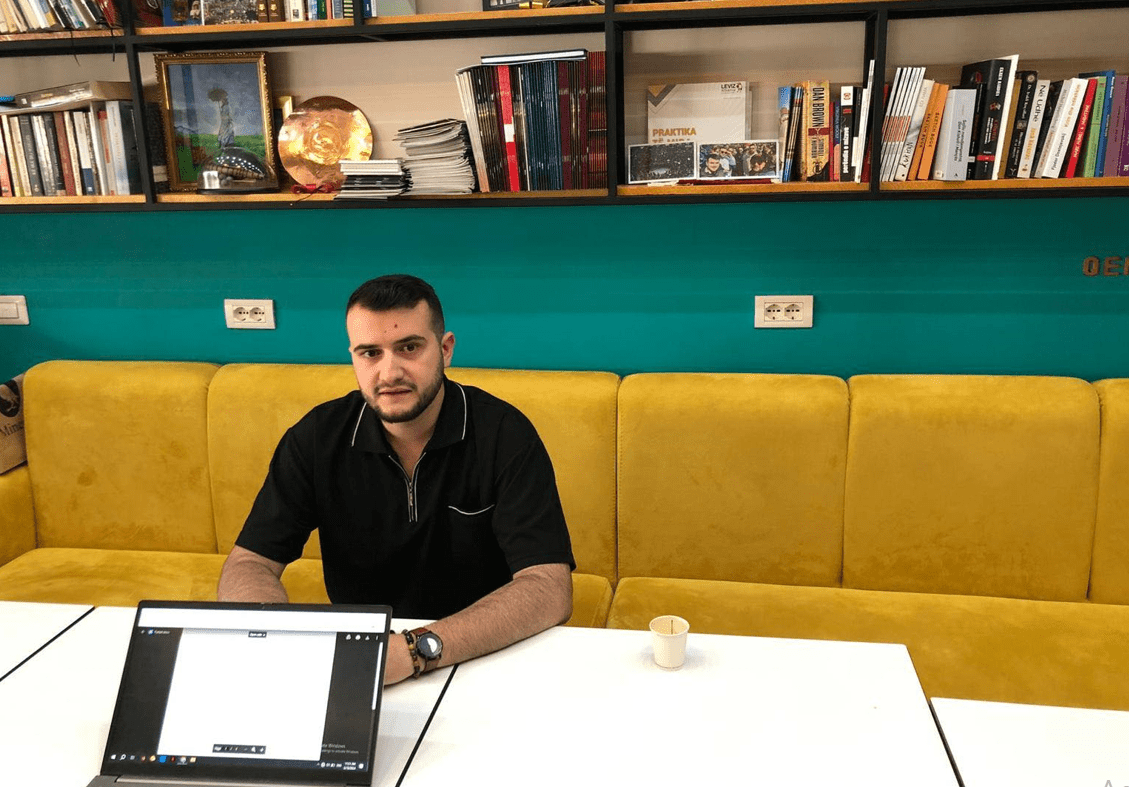
KOLINDO VJERDHA: LACK OF TRAINING AND FAILURE TO ADAPT TO NEW TECHNOLOGIES, A FUNDAMENTAL PROBLEM
Interviewed by: Lorik Idrizi
“The problems related to teachers and teaching staff are ongoing and concern the lack of training and qualifications over the years, which do not bring adaptation to new methodologies required by today’s market or for quality education that certainly aligns with the times we live in and technological developments.”
In an exclusive interview, Kolindo Vjerdha (Researcher at “Citizen Stand”) talks about the PISA test results, the causes preventing quality education in Albania and the Western Balkans, and the link between education and the shift in societal models with universal values.
What are the main defects, in your opinion, that prevent a quality education system?
Kolindo Vjerdha: We can see this from multiple perspectives, including the student’s perspective within the educational institution. The main problems can start from the outdated literature. Today in the higher education system, we do not have a permanent development of the literature. Another problem is related to reforms. We have truncated reforms in the education system, especially reforming pre-university education texts, but this has not translated into a continuous reform in higher or university education. Creating a gap between pre-university and university education in what students receive or their knowledge. We have managed to improve pre-university education texts, but adapting to new methods has not translated into results in PISA tests. The problems related to teachers, the teaching staff, are ongoing, related to the lack of training and qualifications over the years, which do not bring adaptation to new methodologies required by today’s market or for quality education that certainly aligns with the times we live in and technological developments. For example, we are talking about IT students still learning on blackboards without having access to computers, programming, or closer access to technology and its development to bring it to the benefit of educational development or educational processes. Therefore, the developments we live in today or education advances are precisely those elements that have left us truncated in terms of technological development, digital development, or even a student who goes and experiences an educational quality that you can get in European countries, which we are closer to but remaining far from this standard and seeing a lack of efforts to change it.
Why can’t we get out of this vicious circle of recurring defects?
Kolindo Vjerdha: I think we are dealing with a lack of political will. I see the lack of development in education and continuous educational policies very much linked to the lack of continuous political will to delve into these issues. We saw this very clearly in the PISA test results, where there was total indifference, especially from the responsible institutions, including ministries and related institutions. They did not express themselves, tried to hide, and were indifferent to avoid the responsibility they were placed in, and in the end, they tried to delegate all the responsibility to the teachers for a system that produced these results. What we have seen continuously is a pronounced lack of undertaking reforms that bring continuity. The education system itself has faced a series of continuous reforms that have changed the methodology not only in terms of literature, educational processes, and evaluation but also in the way we build the teaching hour in both pre-university and higher education. But these are reforms that have contradicted each other and with continuous changes that do not create stability, which then affects the quality and the entire process and continuity to achieve standard results. So, the lack of clarity regarding the goals or those presented, we have also moved with the model of creating strategic policies. When strategic policies are not based on concrete goals or specific objectives that then lead to achieving concrete or desirable results that can realistically be measurable. At this moment, both higher and pre-university education are regulated through a strategic document that until 2026 has a series of policies that need to be implemented. But what we can say is that we are halfway through the realization of this strategic document. What we can say is that we have found that we are dealing with a document that is not based on concrete objectives regarding the goals it aims to achieve by the end of 2026, which then creates uncertainty about what we expect education to be in 2026. We saw this very well in the university rankings, in all the indices related to the education situation, where there is always a lack of reaction and a lack of undertaking reactive policies that can positively impact the situation.
How can we move from political reforms to reforms based on expertise?
Kolindo Vjerdha: This is an approach that we can mention as an approach that goes beyond our country, it also goes to the region. But what we can see as a solution, or a bridge between what the university is. The university itself is an institution that undoubtedly creates scientific research, it should create scientific research, which we are very far from, according to all data, not only in the support given to the university as an institution related to scientific research. These kinds of problems that the system or governance itself has, if we base them on scientific research data precisely from these institutions that should be the basis with which real scientific research bases will be created. We could then have more sustainable policies, policies that could come from thorough studies and would show a real situation we talk about in all social aspects and the problems that the community itself may have, not only in education but in all its spectrums. What we have seen over the years are policies that are sensitive, policies whose decisions go beyond interest groups, so we do not have an undertaking of these policies that pass all the stages of public consultation. Policies that may start with consultation with interest groups, then presentation in an open public discussion about these policies, given that these effects often have a broad impact on society and effects that include the entire society, but groups that are interested or groups that should have been part of this decision-making are mostly ignored. So, if we manage to create bridges between those who today are the ones who touch the problem at its genesis or those who are closer to the problems and if we link these with those who will be the solution makers or those who will be the policy makers, if we create a bridge between these two links, I think we will move towards more sustainable, more effective, and more result-oriented policies than those we have seen so far.
You mentioned earlier the PISA tests. Do you think that not only in Albania but throughout the region, after several very poor results in the last 3 or 4 times, this warning is not understood, this diagnosis is not understood? Where is the problem that the tests show us how weak we are, and we still cannot recover?
Kolindo Vjerdha: In Albania, the PISA test, especially the latest results, showed a real state, to be honest, a very difficult situation regarding the quality of education. It is understood that through these results, you understand better the learning process that happens in pre-university education institutions. The fact that today we have, and they tried to have total indifference from the institutions, I think this is one of the main problems that, as you mentioned, goes beyond Albania but also throughout the region. What we saw in the examples in European countries were ministers who were dismissed, there were ministers who took this kind of responsibility, but we are very far from this standard. The Balkan countries, especially Albania, are very far from this standard. In Albania, what happened was that this responsibility was tried to be passed on to the teachers, delegating all the responsibility of a system that shows it has problems, and problems that always come in decline, even in the PISA test results, especially in the recent years’ results, a continuous decline that in itself cannot be passed with institutional indifference. Today, I believe it is time to hold accountable for those fundamental problems that affect the education of future generations. If we want to have a well-educated generation, if we aim to have high results tomorrow
#movegrants #WesternBalkansFund #WesternBalkans #opportunity #grants #mobility #scholarships
This post was originally published on this site
![[Aggregator] Downloaded image for imported item #43795](https://civicamobilitas.mk/wp-content/uploads/2026/01/611149509_1571871173934400_3927165331577291092_n-2-768x512.jpg)