
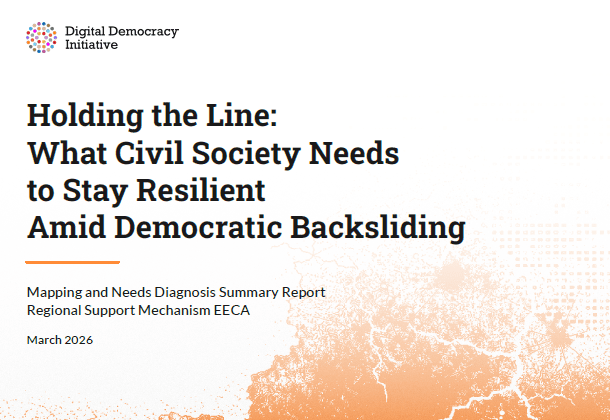
Holding the Line: What Civil Society Needs to Stay Resilient Amid Democratic Backsliding – Mapping and Needs Diagnosis in Eastern Europe and Central Asia
Across Eastern Europe and Central Asia, civil society organizations (CSOs) are working in increasingly difficult conditions. Shrinking civic space, financial instability, disinformation, digital security risks, and a fast-changing technology landscape are putting pressure on organizations, activists, and informal initiatives.
The Mapping and Needs Diagnosis Summary Report, Holding the Line: What Civil Society Needs to Stay Resilient Amid Democratic Backsliding, takes a closer look at these realities. It explores what civil society actors need to continue their work, strengthen their organizations, and respond to today’s challenges in practical and sustainable ways.
The report was developed as part of the Regional Support Mechanism EECA project, implemented by Metamorphosis Foundation and TechSoup, in partnership with CIVICUS and under the Digital Democracy Initiative (DDI) that covers the Global South.
The Mapping and Needs Diagnosis focused on civic space, organizational sustainability, communication capacity, digital inclusion, digital security, countering disinformation, AI adoption, and emerging opportunities for civic resilience.
The findings are based on desk research and semi-structured interviews with civil society actors, including CSO staff, activists, researchers, experts, and practitioners across 13 countries in the region. The publication brings together insights from country reports across the Western Balkans, the Black Sea region, Central Asia, and the Caucasus. It covers Albania, Armenia, Bosnia and Herzegovina, Georgia, Kazakhstan, Kyrgyzstan, Kosovo, Moldova, Montenegro, North Macedonia, Serbia, Türkiye, and Ukraine.
It highlights shared challenges, local differences, and the kinds of support civil society actors say they need most. It also points to areas where resilience is already taking shape, from youth-led civic action and informal networks to cross-regional collaboration, digital practices, and new approaches to communication and community engagement.
These findings will inform and support the next activities within the Regional Support Mechanism EECA project.
Read the report HERE.
![[Aggregator] Downloaded image for imported item #51393](https://civicamobilitas.mk/wp-content/uploads/2026/10/share-default-768x403.jpg)
![[Aggregator] Downloaded image for imported item #49973](https://civicamobilitas.mk/wp-content/uploads/2026/08/Enis-Shaqiri-768x389.jpg)
![[Aggregator] Downloaded image for imported item #51387](https://civicamobilitas.mk/wp-content/uploads/2026/09/Краток-документ-за-политики_eng-1-pdf-1-724x1024-1.webp)
![[Aggregator] Downloaded image for imported item #51265](https://civicamobilitas.mk/wp-content/uploads/2026/09/ich-1-768x1024-1.jpg)
![[Aggregator] Downloaded image for imported item #51459](https://civicamobilitas.mk/wp-content/uploads/2026/09/825329974_5155401651274491_2155681169352553897_n-1-768x512.webp)
![[Aggregator] Downloaded image for imported item #51461](https://civicamobilitas.mk/wp-content/uploads/2026/09/819207924_5152804251534231_1144901816227016216_n-2-768x576.webp)