

Half of the code violations in 2025 related to inaccurate reporting
The Council of Media Ethics of Macedonia (CMEM) presented statistical data on the complaints received and processed during 2025, with a focus on the main trends reflected in the figures.
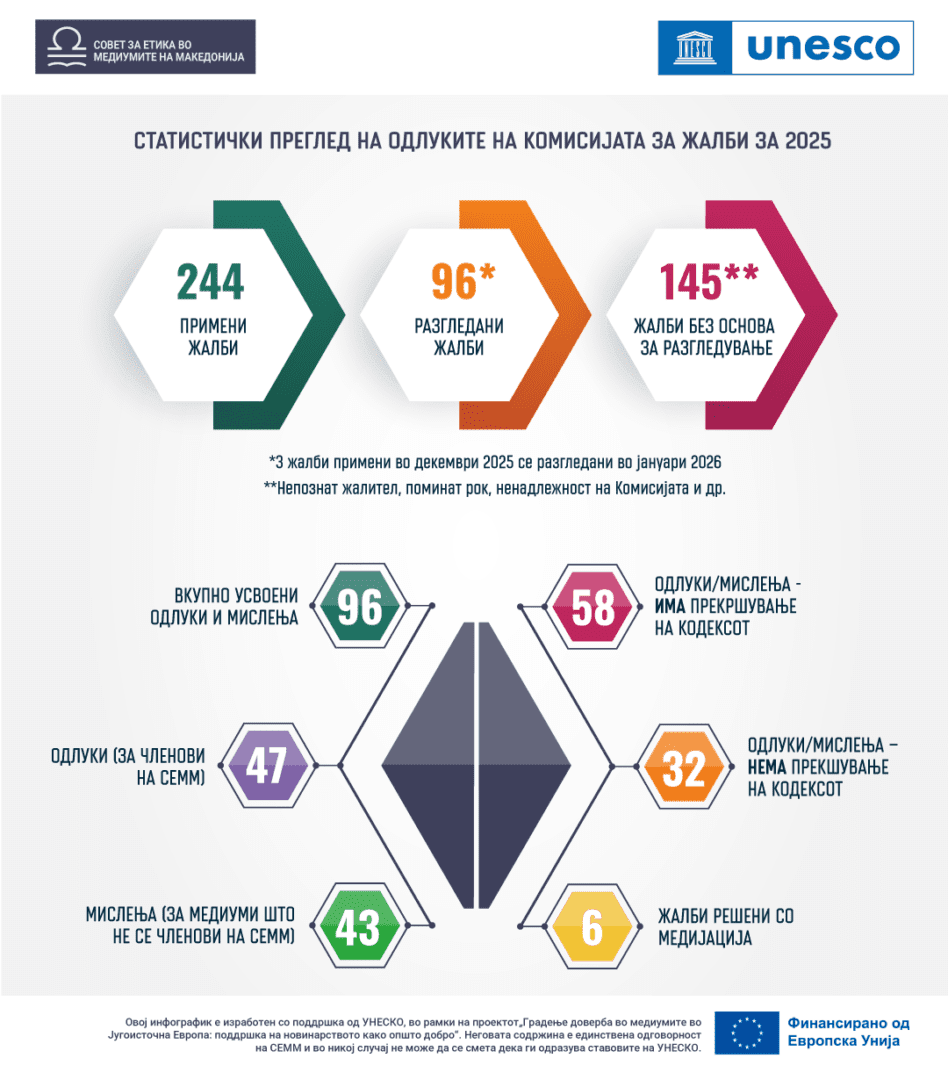
Last year, 244 complaints concerning media content were submitted to CMEM, marking a record number of complaints in a single year. Of these, 96 were reviewed by the Complaints Commission, resulting in 47 decisions (for CMEM members) and 43 opinions (for media outlets that are not members of CMEM).
For 145 complaints, it was determined that they lacked grounds for consideration, for various reasons: the deadline from the time of publication to the submission of the complaint had expired, the information provided in the complaint did not allow its authenticity to be verified, or the complaints referred to foreign media, for which the Commission within the The Council of Media Ethics of Macedonia is not the competent body, and other reasons.
The largest number of complaints that were deemed unfounded for consideration related to media content connected to the fire in Kochani, mainly involving foreign portals and television outlets, and were submitted within a interval of just a few hours on March 21, 2025, one day after the funeral of the victims.
Most complaints against online portals
Last year, as in previous years, complainants mostly objected to content published on online portals, in fact, 78 of the 96 complaints reviewed concerned online media outlets.
One reason online media dominate as alleged violators of the Code of Journalists is that it is probably easier for the public to provide this content as evidence when filing a complaint.
Another reason is that many online portals are often run by just one or two individuals, with no journalistic experience, while portals with well-organized and professional teams are fewer in number.
By contrast, violations of ethical standards occur less often in traditional media (national TV stations), because these are larger newsrooms where journalists generally have more experience in the profession and greater editorial capacity.
Of the complaints reviewed, 11 concerned print publications and their online editions, 6 concerned the websites of television stations, and one complaint concerned television content.
A violation of the Code of Journalists was found in 58 complaints, while in 32 complaints it was determined that there had been no violations of professional or ethical journalistic standards. Six complaints were resolved through mediation or through a so-called “amicable settlement” between the complainant and the media outlet. CMEM encourages media outlets to pursue mediation more actively in the future, in order to avoid decisions of the Complaints Commission being used as evidence in potential court proceedings.
Politicians and public officials – the most frequent complainants
The most frequent complainants, whose complaints had grounds to be reviewed, were those in the group of “politicians, public officials, and public institutions” (36). Another 25 complaints were submitted by citizens, 22 by organizations and associations from the civic sector, 6 by media outlets or journalists, 6 by political parties, while complainants from other categories submitted 4 complaints.
Half of the violations concern Article 1 of the Code
As a constant in the statistics, the most frequently violated article of the Code of Journalists of Macedonia remains Article 1, which requires journalists to publish accurate and verified information from at least two independent sources. In 2025, this violation was recorded in as many as 46 complaints, accounting for almost half of all violations.
This is followed by Article 3, which states that “the journalist shall strive to publish a correction, denial, or response when an inaccuracy in the information has been established”.
In third place by number of violations is Article 10 of the Code, which requires journalists not to create or process hate speech or discrimination on any basis.
Decisions matter to professionals
Communication between CMEM and journalists confirms that the decisions and opinions adopted by the Complaints Commission are important to the majority of journalists. This suggests that, in general, self-regulation is increasingly accepted by media outlets as a significant corrective mechanism originating within the profession itself.
For this reason, CMEM, as self-regulatory body, requires support not only from the profession but also from institutions. The work of the Council of Media Ethics is just as vital as that of the regulatory body, to prevent an overly restrictive approach in the media sector”.
From this perspective, it is important for the profession itself to understand and respect the rules, thereby reducing the need for legal sanctions. At the same time, it is crucial to establish good cooperation between the regulatory and self-regulatory bodies so that these two key bodies can complement each other in their work.
The Complaints Commission at CMEM strives to be maximally objective and impartial when making decisions, setting aside considerations of who the complainant is or which media outlet the complaint concerns.
At the same time, the Commission always seeks, in its assessments, to protect media outlets and, especially in cases of minor errors, to give them the opportunity to correct their mistakes, because sometimes even the most experienced journalists or the most professional media outlets, under pressure and racing against time, can make a mistake.
However, when it comes to intentional and serious violations, such as biased or one-sided reporting in favor of a political actor, which is common in our politically polarized journalism, the Commission is firmest and clearest in presenting the reasoning behind its decisions.
This post was originally published on this site
![[Aggregator] Downloaded image for imported item #48830](https://civicamobilitas.mk/wp-content/uploads/2026/06/mno-1024x532-1-768x399.png)
![[Aggregator] Downloaded image for imported item #50483](https://civicamobilitas.mk/wp-content/uploads/2026/09/Lorik.jpg)