642a3086.jpg

Access to safe abortion is а health right for every woman

Access to safe abortion is a fundamental health right and crucial for achieving reproductive freedom. This was one of the key messages shared in observance of the International Day for Access to Safe and Legal Abortion, celebrated annually on September 28th.

Although the 2019 Law on Termination of Pregnancy grants women greater reproductive freedom, significant challenges remain. There is still no contraceptive included on the country’s positive list of approved drugs, and medical abortion services are available only in Skopje, which excludes women from rural areas. Additionally, the medications used for medical abortion have yet to be registered.

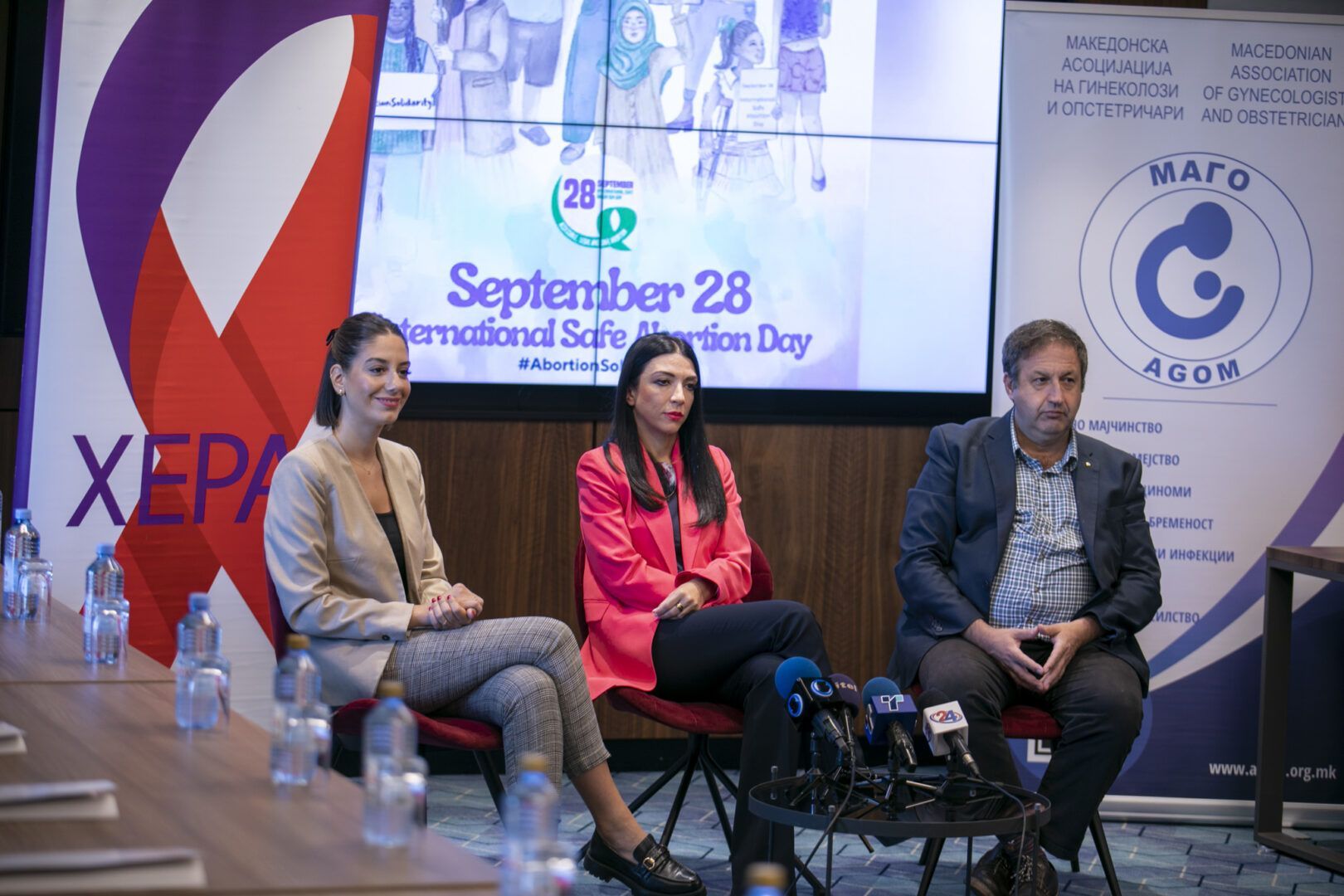
At a press conference dedicated to the International Day of Access to Safe and Legal Abortion, several experts in the country shared important messages. Prof. Dr. Irena Aleksioska-Papestiev, Director of the University Clinic for Gynecology and Obstetrics (UGAC) in Skopje, emphasized that for the fourth consecutive year, the clinic has been successfully implementing and using medical abortion as the safest method for terminating a pregnancy, in line with World Health Organization standards.

She highlighted that the clinic, with support from the Ministry of Health and HERA, prioritizes a woman’s inviolable right to make her own choice. They provide quality resources and conditions, enabling medical abortion to be the choice for over 80% of women seeking pregnancy termination at the clinic

Dr. Aleksioska-Papestiev also noted that complications from unsafe, illegal procedures to stop pregnancy remain one of the leading causes of maternal death globally. For this reason, she stressed the importance of making medical abortion widely accessible and ensuring that it is performed according.

Prof. Dr. Gligor Tofoski, gynecology specialist at the PHI University Clinic for Gynecology and Obstetrics and President of the Macedonian Association of Gynecologists and Obstetricians (MAGO), emphasized that the legality of abortion is one of the most crucial factors. He highlighted that since 2019, the Republic of North Macedonia has had a Termination of Pregnancy Act that advances women’s rights.

As of 2020, North Macedonia also has Clinical Guidelines for Termination of Pregnancy, prepared by experts in gynecology and obstetrics, outlining the proper application of the procedure. Dr. Tofoski added that safety is another key aspect—knowing how to apply the method effectively to achieve positive outcomes. However, what remains missing is the formal registration of drugs for medical abortion, which is necessary to fully implement the advanced legal framework on this matter.

Eva Spasevska, program manager for sexual and reproductive care at HERA, emphasized that although abortion is legal and accessible in North Macedonia, abortions requested for social and economic reasons are still not covered by the state health protection system. High costs pose a barrier to safe abortion access, which is why illegal procedures continue to occur.

International recommendations indicate that the state should ensure universal coverage for all sexual and reproductive health services, including modern contraceptive methods, as outlined in the Government Program 2022-2024. However, no contraceptives are currently covered by the Health Insurance Fund, and the country has one of the lowest rates of modern contraception usage in Europe, at only 14%. Reproductive justice extends beyond the right to choose—it includes equal access to health protection services, information, and support, as well as every woman’s right to make informed decisions about her body, free from fear or discrimination.

HERA, as an organization dedicated to health education, has been actively working for years to raise public awareness, improve services, and advocate for women’s right to access modern contraception in North Macedonia. In line with this mission, and in observance of the International Day for Access to Safe and Legal Abortion, HERA organized training for gynecologists from primary health protection on the topic of “Medical Abortion and Modern Contraception.”

This is the second accredited training this year for primary care gynecologists on the topic of “Medical Abortion and Modern Contraception,” conducted in cooperation with MAGO and accredited by the Medical Chamber. During this training, gynecologists had the opportunity to familiarize themselves in greater detail with the legal framework surrounding medical abortion in the country, learn about its implementation methods, and review practical examples from the lecturers’ experiences. Additionally, they received key information regarding psycho-social counseling during this procedure.

This post was originally published on this site

Продолжи со читање

  • Promotion of Minorities’ Participation in Multilevel Governance

    The PACT project officially started in Brussels with a 2-day international conference and workshop
    On 10 and 11 March 2026, Brussels hosted an International Conference and Workshop entitled “Promotion of Minorities’ Participation in Multilevel Governance”.
    It brought together experts coming from different realities, with a common goal: sharing good practices on how to promote inclusive participation of under-represented minorities, people with migratory background, refugees, Roma and other marginalised communities in local decision-making processes.
    The Conference
    The event opened on the morning of Tuesday 10 March with 2 panels.
    The first one – entitled “Minority Participation in Multilevel Governance: EU perspectives” – was moderated by Mohammed Mustafa (ALDA – European Association for Local Democracy) who introduced the main EU policy developments in the areas of anti-poverty and anti-discrimination, and migration, setting the tune of the conversation with the speakers:
    Julie Pascoet (European Network Against Racism – ENAR) focused on the European Anti-Discrimination Strategy,  highlighting how much this tool is necessary (but also how far it is to address the needs of the moment), and how civil society networks  play a crucial role to bridge the gap between EU policy intentions and the lived experiences of marginalised communities.
    Fernando Vasco Chironda (European Anti Poverty Network – EAPN) tackled the EU Anti-Poverty Strategy, underlying that – by excluding migrant people from vulnerability frameworks – the strategy risks deepening marginalisation of those most affected, and that local authorities are those with the responsibility to ensure inclusive participation spaces and adequate resources for people.
    Mojib Atal (Migration Policy Group – MPG) focused on the Migrant Integration Policy Index, reporting a concerning stagnation in political participation across the EU, and highlighting how multilingual education could serve as a democratic tool by recognising linguistic diversity rather than privileging a single dominant language.
     

    The second panel – “From Welcoming to Active Participation: Challenges, Practices and Power” – was moderated by Maddalena Alberti (ADL Zavidovici) and had the goal to hear from experts who exchanged ideas, perspectives and best practices for the inclusion of underrepresented minorities at a local level.
    Anna Coulibaly (International Catholic Migration Commission – ICMC Europe) introduced the Community Sponsorship, a community‑led integration model where volunteers, supported by civil society and approved by governments, commit to hosting and supporting refugees for at least a year.
    Loubna Reguig (European Forum for Youth with Lived Migration Experience – VOICIFY) urged how self‑led organisations are essential to defend the political participation rights of young people with migrant backgrounds, since they create spaces where youth feel included, exchange knowledge and pool resources.
    Queenie Kessie (IOM Diaspora Advisory Board – DAB) showed how diaspora advisory structures can move beyond consultation and concretely ensure fair policies are good for migrant people and societies.
    Ismail Alkhateeb (PLACE Network) brought the organisation’s extensive experience to show that the inclusion of migrant people in local participatory processes can happen only when institutions and local communities jointly define problems, design solutions and test them at micro‑level.

    Conclusion
    Hosted by Amazone asbl (Brussels) and co-organised by ALDA (France), ADL Zavidovici (Italy), KMOP (Greece), Center for Intercultural Dialogue (North Macedonia), PLACE Network (France), Fons Català (Spain) and Konkáv Alapítvány (Hungary), the event saw the participation of public authorities, policy makers, organisations, media, underrepresented minorities united by the wish to learn on how working together is possible for a fair and equal European policy system.
    The initiative was part of the European-funded project PACT (Participatory Action for Transforming Communities) whose aim is empowering under-represented minorities in local communities in Europe.

  • Metamorphosis publishes research on the effects of disinformation and foreign influence on democratic processes

    The Metamorphosis Foundation has published the research “The Effect of Disinformation and Foreign Influences on Democratic Processes in North Macedonia in 2025,” which analyzes how disinformation and propaganda narratives affect public debate, trust in institutions, and citizen participation in democratic processes. The research combines an analysis of disinformation narratives and a survey of a nationally representative […]

  • On current economic topics, Blagica Petreski in Win-Win

    https://www.facebook.com/TVTelma/videos/2347874929012206
    The post On current economic topics, Blagica Petreski in Win-Win first appeared on Finance Think.
    The post On current economic topics, Blagica Petreski in Win-Win appeared first on Finance Think.

  • AJM Calls for Measured and Professional Communication with Journalists

    The Association of Journalists of Macedonia (AJM) is monitoring the public reaction following the communication between the Minister of Interior Panče Toškovski and journalist Frosina Fakova Serafinović from the media outlet Sloboden Pechat, during yesterday’s press conference, which was also …

  • Public call for participation in the co-creation of the National Action Plan for the Open Government Partnership 2026-2028

    Based on Article 3, paragraph (2), subparagraphs (5) and (6) of the Decision on the Establishment of the Council for Coordination and Monitoring of the 2024-2026 Open Government Partnership Process, No. 16-1662/1 of 02.05.2024, and the Decision on the Amendment of the Decision on the Establishment of the Council for Coordination and Monitoring of the […]
    The post Public call for participation in the co-creation of the National Action Plan for the Open Government Partnership 2026-2028 first appeared on Metamorphosis.

  • AJM and UNDP: Awards for Best Stories on Air Pollution

    The Association of Journalists of Macedonia (AJM), in cooperation with the United Nations Development Programme (UNDP) and with financial support from Sweden, today presented the awards for the best journalistic stories of 2025 on the theme: “Tackling Air Pollution – …