институт за европска политика скопје

The European Commission published its third annual Rule of Law Report

The European Commission published its third annual Rule of Law Report. This year, emphasis was placed on the importance of respecting democratic values, human rights and the rule of law, in the context of the developments during the ongoing Russian invasion of Ukraine.

Same as the previous years, four critical areas for the rule of law are monitored: justice systems, the anti-corruption framework, media pluralism and freedom, and other institutional issues linked to checks and balances, while this year’s report for the first time contains specific recommendations addressed to each Member State, intended to encourage countries to continue with planned reforms and identify the problems that must be addressed.

Reforms in the justice systems related to strengthening judicial independence, efficiency and quality of justice, further digitalising justice systems and facilitating access to justice, have been implemented by the many Member States, however, there are still some concerns persisting in a few states regarding judicial independence and the autonomy of prosecution services.

The European Union remains one of the least corrupt regions in the world, albeit corruption remains a serious concern for EU citizens since 68% of them believe that corruption is widespread in their country.

A novelty in this year’s report is that it looks into public service media and their meaningful role in society and democracy, which raises the need to protect their independence, ensure adequate public funding and relieve them from political pressure.

Another novelty is that for the first time, the report also looks at Member States’ implementation of judgements by the European Court of Human Rights.

For the rest of the findings from the Report, see the following link:

https://ec.europa.eu/info/sites/default/files/1_1_194062_communication_rol_en.pdf

These and many more issues will be addressed within the Czech Presidency of the EU Council that began on July 1, and which will be focused on the following five priority areas:

  • Managing the refugee crisis and post-war reconstruction of Ukraine
  • Energy security
  • Strengthening European defence capabilities and cybersecurity
  • Strategic resilience of the European economy
  • The resilience of democratic institutions

Продолжи со читање

  • Journalists Decode EU Institutions, Acquis, and Enlargement Policies

    On 16–17 October 2026, the European Policy Institute (EPI) organized the first training module under the project “Decode the EU – Communicating EU policies together” in Strumica. The two-day workshop brought together 10 journalists from diverse media outlets, aiming to strengthen analytical, evidence-based reporting on North Macedonia’s EU accession journey.The…

  • MoU with the British Business Association in North Macedonia

    🤝 Strong economies are built on strong partnerships. Finance Think and the British Business Association in North Macedonia signed a Memorandum of Understanding yesterday, laying the foundation for closer cooperation on issues of importance to the business community, policymakers and society. The partnership brings together the British Business Association’s extensive business network and Finance Think’s […]
    The post MoU with the British Business Association in North Macedonia first appeared on Finance Think.
    The post MoU with the British Business Association in North Macedonia appeared first on Finance Think.

  • On pension matters, participation in Bloomberg

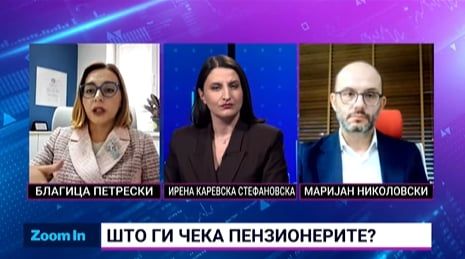
    🔴 What awaits future pensioners? 🟥 What kind of pension model do we need, and who will bear the burden of future reforms? 📌 Without measures, the deficit in the Pension and Disability Insurance Fund will continue to grow, and by the mid-2040s there will be fewer insured persons than pensioners, according to a study […]
    The post On pension matters, participation in Bloomberg first appeared on Finance Think.
    The post On pension matters, participation in Bloomberg appeared first on Finance Think.

  • Is Political Interference Addressed in the Frameworks of the Prosecutorial Councils in North Macedonia and Bosnia and Herzegovina?

    This policy brief examines the frameworks governing prosecutorial councils in North Macedonia and Bosnia and Herzegovina to assess whether their laws ensure adequate independence in line with European standards. The rule of law and an independent justice system are fundamental to the European Union’s enlargement process, particularly within the crucial Chapter 23. A cornerstone of […]
    The post Is Political Interference Addressed in the Frameworks of the Prosecutorial Councils in North Macedonia and Bosnia and Herzegovina? appeared first on EPI.

  • Raising the Bar on Integrity: Aligning North Macedonia and Bosnia and Herzegovina with the 2026 EU Anti-Corruption Directive

    This policy brief evaluates anti-corruption alignment and structural vulnerabilities in North Macedonia and Bosnia and Herzegovina against the EU’s Directive (EU) 2026/1021 on Combatting Corruption. Within the European Union’s “Fundamentals First” enlargement methodology, establishing an accountable administration, an independent judiciary, and robust anti-corruption enforcement is a primary condition for membership. Despite significant differences in their […]
    The post Raising the Bar on Integrity: Aligning North Macedonia and Bosnia and Herzegovina with the 2026 EU Anti-Corruption Directive appeared first on EPI.