
Monitoring Matrix Albania 2025: Legislative Reforms Outpace Implementation and Civil Society Participation
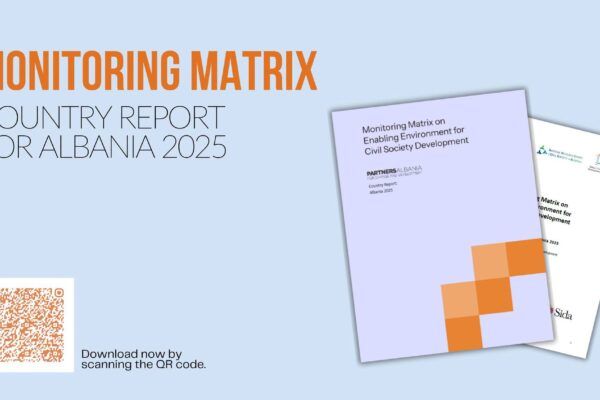
BCSDN member Partners Albania for Change and Development has published the Monitoring Matrix on Enabling Environment for Civil Society Development – Country Report for Albania 2025.
During 2025–2026, Albania adopted a large number of legislative acts driven by its EU accession process. However, public consultation, follow-up on recommendations received, and institutional action to implement legislation have not kept pace with its adoption. The legal environment for freedom of association remained characterised by delays in legislative amendments, while financial sustainability challenges intensified with declining foreign assistance. Strategic cooperation between government and civil society remained largely absent or stalled, and meaningful participation in policymaking continued to face significant challenges. The report also highlights concerns regarding freedom of expression and intensified smear campaigns against NPOs, while recognising progress in clarifying VAT exemption procedures for foreign-funded grants.
Key Findings
1. The electronic NPO registry remains nonfunctional. Despite the December 2023 legal deadline, only a partial web-based listing was available as of February 2026. Average registration time in 2025 was 90 days against a 15-day legal limit.
2. Public funding remains fragmented and largely project-based. There is no consolidated reporting on total public funding to NPOs, while dedicated institutional or core funding is absent. State funding for NPO-delivered social services remains almost nonexistent, increasing dependence on declining foreign donor support.
3. No current government strategy for NPO development exists. The 2019–2023 Road Map expired with low achievement, and no successor strategy has been adopted. No public evaluation report is available for the related Roadmap for the Functioning of Democratic Institutions.
4. Public consultation faces significant practical challenges. Consultations often take place too late to influence legislation, while consultation reports are inconsistently published and frequently fail to explain whether civil society recommendations were accepted or rejected.
Key Recommendations
The report puts forward four priority recommendations:
- Make the electronic NPO registry fully functional, with a published timeline and interim reporting on progress.
- Consolidate public funding reporting for NPOs and introduce a dedicated core or institutional funding mechanism to reduce dependence on project-based and foreign funding.
- Adopt a successor strategy to the 2019–2023 Road Map and ensure that reported achievements are supported by published, methodologically transparent evidence.
- Ensure meaningful participation by involving stakeholders from the beginning of consultation processes and requiring institutions to provide substantive responses to consultation inputs.
About the Monitoring Matrix
Developed by BCSDN in 2013 in cooperation with its members and partners, the Monitoring Matrix provides a framework for assessing the legal and practical conditions for civil society development across the Western Balkans and Türkiye. Its findings support evidence-based advocacy and inform national reforms and EU enlargement policies.
The Albania 2025 Country Report was prepared by Partners Albania as part of the Western Balkans Civil Society Development Hub, financed by Sida and implemented by BCSDN in cooperation with its member organisations.
Read the full report HERE.
This post was originally published on this site