

Debate: The lack of a clear strategy exacerbated the economic crisis caused by COVID-19 pandemic
The COVID-19 pandemic caused a wave that no one could have predicted. At the forefront of the pandemic were small businesses, people who were self-employed and creating jobs. Although this was an unpredictable crisis, the lack of cooperation, planning and clear strategy led to even greater setbacks. The first reaction regarding the measures to be taken was to maintain continuity that will provide security and the opportunity to plan in time. Failure to provide that security has led to a further decline. Thousands lost their jobs because of poor focus.
The discussion “The economy in North Macedonia and the effects of the COVD-19 pandemic” aimed to involve citizens in a debate discussion through which they could express their views on the consequences of the health crisis over the economy. The first part of the discussion was left entirely to the participating citizens, who had the opportunity to express and oppose their views. In the second part, the citizens had the opportunity to ask questions for which they have added interest to an expert in the field.
As part of the discussion, in addition to the participants from the Skopje region, were the professor from the Faculty of economy at University “St. Cyril and Methodius ”, Borche Trenovski, and the professor from American College in Skopje, Nikica Mojsoska Blazhevski, as experts in the second part of the discussion who directly gave an additional explanation to the questions of the citizens. The discussion was moderated by Vlora Rechica, from the Institute for Democracy “Societas Civilis” – Skopje.
Although the pandemic is now in decline, the economic crisis is not recovering in the same direction. Citizens believe that the primary plan should not be to increase taxes that will cause additional terrain, but the focus should be shifted to the grey economy.
In addition to the effects on the business sector, the pandemic also affected individuals. With the closure of kindergartens and schools, parents of children under the age of 10 were released to be home teachers. This action caused a great burden, especially to women, because they had to provide the child with all the materials on their own, which caused additional burden in the household. The employer, on the other hand, had to cover the entire gross salary for the parents who were released without them doing their job. Second, toxic to the economy was the reduced purchasing power as well as increased levels of unproductive spending. In addition to the economic effect, the pandemic has caused a psychological burden that is thought to be difficult to overcome. However, the mistakes we made in the pandemic have now come to light, but with hope that in the future we will learn to eliminate these mistakes.
When it comes to the Government, and how it dealt with the pandemic, the participants had a rather negative attitude. Despite the fact that the Government enabled involvement and received proposals, in reality it had no effect on the measures they took in the end. The measures from the first packages were marginal and no continuity was maintained. The measures were relative and not proactive. The Government’s response was delayed, with some progress made after the fourth and fifth sets of measures. The fact that the government was late in reacting and procuring vaccines is reducing the trust and level of security among the citizens. Only consistent measures, good planning and timely response could contribute to some way out of this crisis.
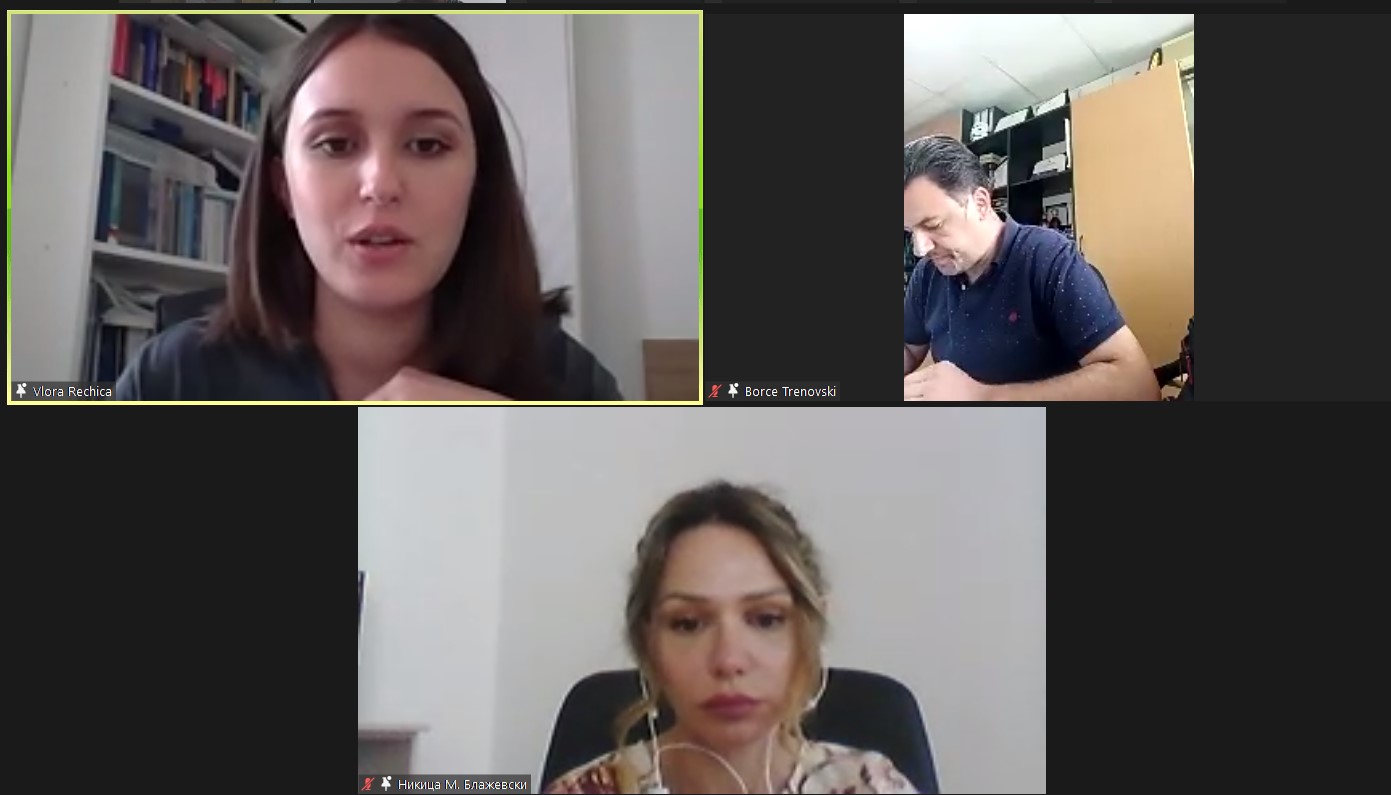
According to professor Borce Trenovski, everything that was a problem before the crisis is now escalating. There were some announcements and pressure from the citizens about the participation, but they did not receive any feedback. Tax measures as a way out of the crisis could be effective if introduced from the start, but now their function and effect will not be the same. Now we need to focus on recovery, we need to stimulate activity, we need to get out of the crisis and not focus on taxes. On the other hand, the debt has exceeded over a billion, we are now 62% of GDP and we are in a difficult time returning to that zone below 60%. We are in a situation where fiscal funds must be provided. The efficiency that increases through cost reduction has been realized but is very modest. Increasing efficiency is not easy.
According to the analysis they made, the informal economy ranges from 23-27% and has decreased moderately in the last 5-6 years. The vulnerable part (informal sector) was not sufficiently targeted with the measures, leaving some of them without any income. However, the focus should not be on whether and how much we owe, but on whether and how much we use the available resources to improve the situation. In terms of the psychological effect, major shifts in efficiency and profitability, as well as changes in work effects, are envisaged.
Professor Nikica Mosjovska Blazevska claims that an economic council and a fiscal council were formed with the former Minister of Finance who had the opportunity to propose ideas, but in the end, it was left to the policymakers. When creating measures it is necessary to think about what will affect in the long run, not just to take the easiest measure that will make a short-term change. What has failed is to take measures that will provide balance and target with all businesses equally, but the measures have been more focused on helping the most affected, believing that the large companies could get out of the crises on their own. Many of the mistakes during the crisis are based on uncertainty, which did not allow them to be planned in a timely manner.
There is an action plan for the shadow economy and measures, but policymakers are constantly delaying it. Regarding the most vulnerable categories, the biggest problem is unemployment (poverty rate for employed persons is 8.5%, for unemployed 41.7%), and the basis to reduce this poverty is for people to have access to work. A change in the system of monetary compensation and social protection is also needed, especially in such crisis periods. We are the first to write action plans and strategies, but none of them has been implemented. The Government has a number of mechanisms at its disposal that it does not take into account. The lack of political will to implement the measures is the biggest problem.
The event was organized as part of the project “ACT-Active Civic Action 2.0”, implemented by the European Policy Institute-Skopje with the support of the Center for Deliberative Democracy at Stanford University in the United States. The project is funded by theNational Endowment for Democracy from the United States. This discussion, together with 4 other debate discussions with citizens on various topics across the country, will contribute to the development of the National Debate Survey that is planned in 2022.
![[Aggregator] Downloaded image for imported item #50243](https://civicamobilitas.mk/wp-content/uploads/2026/08/b7a00eda-ad42-4e3a-b5e8-2e58ee9417b9-1-768x576.webp)
![[Aggregator] Downloaded image for imported item #50225](https://civicamobilitas.mk/wp-content/uploads/2026/08/7cd56d55-05e0-4b0a-a252-685e337872dd-1-768x432.webp)
![[Aggregator] Downloaded image for imported item #50127](https://civicamobilitas.mk/wp-content/uploads/2026/08/Post-Platforma-723x1024-1.png)
![[Aggregator] Downloaded image for imported item #50119](https://civicamobilitas.mk/wp-content/uploads/2026/08/Phone-focused-Finger-Removal-Edit-819x1024-1-768x960.png)
![[Aggregator] Downloaded image for imported item #49973](https://civicamobilitas.mk/wp-content/uploads/2026/08/Enis-Shaqiri-768x389.jpg)