• Civil Society Organizations developed sustainable financing strategies

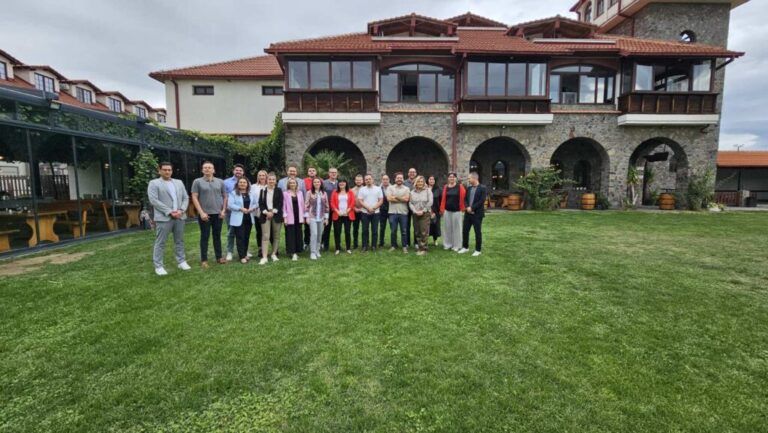
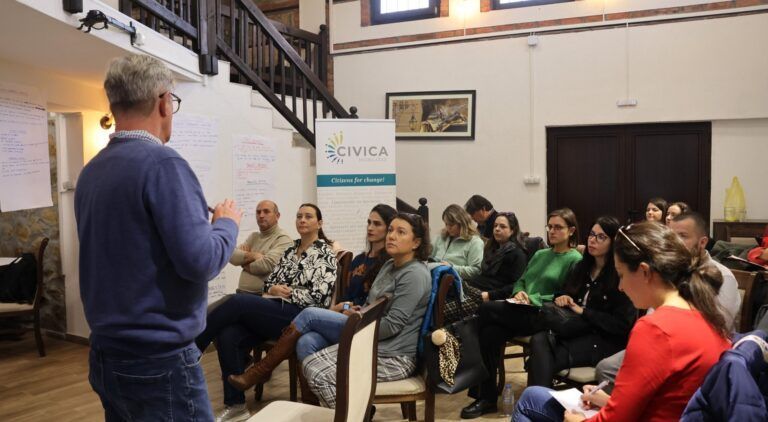
    What does sustainability of civil society organizations mean? How does one think visionary? How to assess sustainability? What are the good practices in this field? These were some of the questions discussed by participants at the workshop “Good Practices for Civil Society Organizations’ Sustainability” led by Simon Forester, Civica Mobilitas’…

  • New guide published to enhance minority rights via inclusive education

    Inclusive educational environment recognising diversity, promoting a spirit of tolerance and mutual respect, addressing discrimination and segregation is crucial for enhancing the rights of persons belonging to national minorities. What should be done in practice by European states, civil society and the academic community to foster such an environment is the focus of the…

  • Cool Down. Elections are over

    On 28 and 29 September, 2024 in Popova Kula, FRP gathered 12 MPs in their first mandate for a highly intensive two days seminar that guided the MPs through the secrets of the parliamentary debate, the art of compromise and specifically the benefits of a compromise, how to deal with their senior peers from other […]

  • International Conference: Money, Media, and Elections in North Macedonia

    We are pleased to inform you that the International Foundation for Electoral Systems (IFES) is organizing the international conference titled “Money, Media, and Elections in North Macedonia,” taking place on 28-29 October 2024 at the Hotel Holiday Inn, Skopje. This two-day event will bring together experts and stakeholders to discuss critical findings and actionable recommendations […]
    The post International Conference: Money, Media, and Elections in North Macedonia first appeared on Metamorphosis.

  • Policy Paper: Combating Corruption and Reconstructing Social Models through Education and Accountability in the Western Balkans

    The Western Balkans face a corruption crisis that has eroded the trust in institutions and normalized corrupt practices. The shift from conventional values to a corrupted social model is evident, particularly among young people, who grow up in environments where bribery, nepotism, and organized crime are not only tolerated but seen as necessary paths to success. The consequences of corruption extend to organized crime, which often infiltrates political and economic systems. This paper investigates how low-quality education and institutional failures contribute to this issue, and how civil society, journalism, and governance reforms can serve as tools for deconstructing these corrupt networksThis paper aims to address the ways in which corruption is entrenched within the social fabric, its linkages to organized crime, and the role of education in perpetuating a corrupt social model. Drawing from interviews with experts in the region, the paper explores the roots of this problem and offers policy recommendations to deconstruct corruption networks, reform educational systems, and empower civil society and journalism to challenge the status quo.
    Read the full policy paper here:
    This paper was realised as part of the ‘MOVE GRANTS’ program supported by the Western Balkans Fund.

  • Share your successes with citizens through the ePlatform of Civica Mobilitas!

    Did you know that this year, the content from Civica Mobilitas reached over 12,000 citizens from 80 different countries? In 2024, we published more than 300 news articles from over 30 civil society organisations in three languages: Macedonian, Albanian, and English. Don’t miss the opportunity to increase the visibility of…

  • Round Table: “Encouraging Unity: Municipal Approaches to Interfaith Dialogue and Interethnic Co-existence”

    On 16th of October, in the Great Hall in the Municipality of Prilep, LET Station, together with the National Democratic Institute North Macedonia, organized a Roundtable: “Encouraging Unity: Municipal Approaches to Interfaith Dialogue and Interethnic Co-existence”. The event focused on advocacy for the creation of municipal measures and policies that will include aspects of interfaith…

  • JOVANA DAMJANOVIC: IT’S NOT THAT PEOPLE DON’T RECOGNIZE CORRUPTION, THE DANGER IS THAT IT’S OFTEN TOLERATED AS SOMETHING INEVITABLE

    Interviewed by: Lorik Idrizi
     
    “Many of us see corruption embedded in everyday life—from bribery for public services to nepotism in job opportunities—but we’ve grown up in a system where it’s so normalized that it feels like there’s no alternative. The dangerous part isn’t that people don’t recognize corruption; it’s that it’s often tolerated or shrugged off as something inevitable. This resignation can lead to a lack of motivation to engage in politics or demand transparency. In fact, some may even become desensitized to corruption because it feels like it has been institutionalized across all sectors. This doesn’t mean people are blind to it—it just reflects how exhausting it can be to fight against something so entrenched.”
     In an exclusive interview, Jovana Damjanoviç (investigative journalist at BIRN) talks about the causes preventing quality education in Montenegro and the Western Balkans, and the connection between corruption and the shift of societal models away from universal values.
    Do you think that corruption in the Western Balkans has become a new normality to the point where young people can’t recognize it?
    JOVANA DAMJANOVIÇ: Corruption in the Western Balkans, including Montenegro, has undoubtedly become pervasive, but saying that young people can’t recognize it would be an oversimplification. As a person living in Montenegro, I would argue that we are aware of corruption, but the bigger issue is the sense of powerlessness to challenge it or create meaningful change. Many of us see corruption embedded in everyday life—from bribery for public services to nepotism in job opportunities—but we’ve grown up in a system where it’s so normalized that it feels like there’s no alternative.
    The dangerous part isn’t that people don’t recognize corruption; it’s that it’s often tolerated or shrugged off as something inevitable. This resignation can lead to a lack of motivation to engage in politics or demand transparency.
    In fact, some may even become desensitized to corruption because it feels like it has been institutionalized across all sectors. This doesn’t mean people are blind to it—it just reflects how exhausting it can be to fight against something so entrenched.
    What are the main reasons in your opinion that model has shifted the social model a lot from conventional values ​​to a wrong social model?
    JOVANA DAMJANOVIÇ The shift from conventional values to a more problematic social model in Montenegro, and the Western Balkans more broadly, can be attributed to several factors, such as economic instability and inequality, probably being the leading one, but also corruption and clientelism, globalization and consumerism, as well as lack of strong institutions and role models.
    Specifically, economic uncertainty has a significant impact on societal values. With limited job opportunities, high unemployment, and pervasive poverty, many people are forced into survival mode. This leads to prioritizing short-term gains over long-term values. Nepotism, corruption, and “cutting corners” have become normalized because people feel they have no other choice. In this environment, the pursuit of quick financial security often takes precedence over integrity, hard work, or ethical decision-making.
    When people constantly see politicians and elites gaining wealth and power through questionable means, it sends the message that success isn’t about merit but about connections and manipulation. This creates a toxic cycle where citizens begin to mimic the corrupt behaviors of their leaders, further perpetuating the wrong social model.

    The shift away from conventional values in Montenegro isn’t just about individuals making poor choices—it’s a reflection of a larger systemic failure. People feel disillusioned by a lack of opportunity, fairness, and trust in the institutions that should be guiding us.
    Do you think that the low quality of education affects the creation of the wrong social model that is often related to corruption?
    JOVANA DAMJANOVIÇ: Education should be the foundation for critical thinking, ethical behavior, and civic responsibility, but when it is weak, these values are not properly installed. Many educational systems in the region suffer from outdated curricula and a lack of resources. This leads to an environment where students are not encouraged to question authority, think independently, or challenge corrupt practices. Instead, rote learning and a focus on passing exams, rather than truly understanding issues, become the norm, leaving students ill-equipped to navigate the complexities of a corrupt society.
    Do you think that the wrong social model is related to corruption and organized crime? How?
    JOVANA DAMJANOVIÇ: I believe it is. In this flawed model, success is often achieved not through merit, but through illicit means like bribery, nepotism, or connections with criminal networks. Corruption enables organized crime to flourish by weakening institutions that should provide oversight, such as the police, judiciary, and government. When these institutions are compromised, organized crime operates with relative impunity, embedding itself into daily life.
    This creates a dangerous feedback loop: organized crime profits from corruption, while corruption relies on the power and resources of criminal networks to maintain control. As young people observe this, many grow up believing that corruption is the norm and that engaging with organized crime is a viable way to succeed, perpetuating a system where ethics are sidelined, and crime is normalized within society.
    How can the networks of this model related to corruptions and organized crime be deconstructed?
    JOVANA DAMJANOVIÇ: First, strengthening the rule of law is crucial—this means reforming the judiciary and law enforcement to ensure they operate independently and without political interference. Transparent legal processes can deter corrupt practices and weaken organized crime’s grip on institutions.
    Second, financial transparency and oversight must be improved to track and dismantle money-laundering activities that fund organized crime. Lastly, fostering a culture of accountability at all levels, from politics to business, is essential.
    How can civil society and journalism help in deconstructing this wrong model?
    JOVANA DAMJANOVIÇ: Civil society and journalism play critical roles in deconstructing corruption and organized crime networks. Civil society organizations (CSOs) can promote transparency, advocate for stronger laws, and create platforms for citizens to report corruption. By mobilizing public opinion and fostering a culture of accountability, CSOs can pressure governments and institutions to implement reforms and enforce anti-corruption measures.
    Journalism is vital for exposing corruption and organized crime. Investigative reporting can uncover hidden networks, illicit deals, and abuses of power that often remain under the radar. By bringing these issues to light, journalists can hold public figures and institutions accountable, while informing the public and encouraging civic engagement. Together, civil society and journalism act as watchdogs, essential for dismantling corrupt systems and promoting integrity.
    The interview was realised as part of the ‘MOVE GRANTS’ program supported by the Western Balkans Fund.
  • IVAN IVANOVIC: CORRUPTION HAS BECOME A NORM BECAUSE IT OFTEN GOES UNPUNISHED

    Interviewed by: Lorik Idrizi
     
    “The main reason corruption has become a new norm is that it often goes unpunished in many Balkan countries. When people in power, from local officials to national leaders, engage in corrupt practices without facing significant consequences from courts and prosecutions, it sends a signal that these behaviors are acceptable. Young people, especially those growing up in this environment, might not have any frame of reference to understand that these practices are illegal or unethical because they see them as ‘how things are done’.”
     
    In an exclusive interview, Ivan Ivanoviç (investigative journalist at BIRN) talks about the causes preventing quality education in Montenegro and the Western Balkans, and the connection between corruption and the shift of societal models away from universal values.

    Do you think that corruption in the Western Balkans has become a new normality to the point where young people can’t recognize it?

     
    IVAN IVANOVIÇ: I agree and the main reason it’s that corruption often goes unpunished in many Balkan countries. When people in power, from local officials to national leaders, engage in corrupt practices without facing significant consequences from courts and prosecutions, it sends a signal that these behaviors are acceptable. Young people, especially those growing up in this environment, might not have any frame of reference to understand that these practices are illegal or unethical because they see them as “how things are done.”
    Also, corrupt practices may be presented to the younger generation in a way that doesn’t seem inherently wrong. For example, bribery might be framed as a necessary means of getting ahead, whether it’s securing a job, expediting a bureaucratic process, or gaining access to higher education.
    Media also plays a role. While investigative journalism is critical in exposing corrupt activities, many mainstream media outlets in the region are controlled or influenced by political elites, which limits the coverage of corruption scandals. As a result, young people may not be exposed to stories that critically examine corruption or challenge the status quo. This further contributes to a cultural environment where corruption becomes normalized and, in many cases, not even seen as a problem.

    What are the main reasons in your opinion that model has shifted the social model a lot from conventional values ​​to a wrong social model?

     
    IVAN IVANOVIÇ: In societies where organized crime has close links with political and economic elites, the idea that one can achieve success through honest means becomes difficult to sustain. For many young people, seeing criminals or corrupt officials enjoying wealth and influence fosters a belief that bending or breaking the rules is the only viable path to success.
    The decline in trust in institutions has been a significant factor in this shift. People lose faith in systems of governance, the rule of law, and educational institutions when they are repeatedly failed by them. This erodes social cohesion and shifts societal values away from collective well-being towards self-preservation and opportunism.
    Globalization and the rapid spread of consumerist values have also played a role. Many young people aspire to achieve the same levels of wealth and material success that they see in more prosperous countries, but they often do not have access to the same opportunities.

    Do you think that the low quality of education affects the creation of the wrong social model that is often related to corruption?

    IVAN IVANOVIÇ: Absolutely. When young people do not receive a strong education grounded in critical thinking, ethics, and civic responsibility, they are more susceptible to adopting the norms of a corrupt society. Without the ability to critically analyze the systems around them, they are less likely to question authority or recognize when corrupt practices are undermining their future.
    Moreover, low-quality education often fails to equip young people with the skills necessary to compete in the global economy. Faced with few employment prospects, they might turn to corrupt practices or the shadow economy to survive, reinforcing the cycle of corruption. Education is supposed to be a path out of poverty and a way to empower individuals to build a just and equitable society. However, when education systems are weak, they can reinforce existing inequalities and contribute to the normalization of unethical behavior.

    Do you think that the wrong social model is related to corruption and organized crime? How?

    IVAN IVANOVIÇ: In many Western Balkan countries, organized crime has become integrated into political and economic systems. Criminal organizations often wield significant influence over political elites, law enforcement, and even judicial systems, allowing them to operate with relative impunity. This creates a culture in which power and success are closely tied to illicit activities rather than merit or legality. The wrong social model, as you describe it, often glorifies wealth and power, regardless of how it is obtained. Organized crime thrives in such environments because it offers an alternative pathway to success. When legitimate avenues are blocked by corruption or inefficiency, many people, particularly those in economically disadvantaged areas, turn to criminal activities as a means of survival or advancement. In these communities, organized crime can provide employment, social services, and a sense of belonging that the state fails to offer.

    How can the networks of this model related to corruptions and organized crime be deconstructed?

     
    IVAN IVANOVIÇ: First and foremost, there must be a genuine will among all societal actors for this change to happen. This includes the three branches of government—starting with politicians, and extending to the courts and the prosecution. It is essential that independent institutions exist to carry out such reforms, which unfortunately is not always the case. The civil sector also needs to play an active role in this process. However, it seems that the political will to take such action is still lacking, and as a result, the current state of affairs suits everyone involved.
    This means that without the unified will of the entire system, including the political, judicial, and civil components, meaningful change cannot occur. Politicians often benefit from the current system, where corruption and a lack of accountability allow them to maintain power without facing significant consequences. The judiciary, when it is not independent, can be manipulated by political elites to either protect corrupt individuals or ensure their opponents are prosecuted. And without independent prosecutorial bodies, even those caught in corruption scandals often escape justice due to lack of effective legal action.
    The role of independent institutions is crucial. These institutions should act as checks on the abuses of power, ensuring transparency and accountability. Unfortunately, in many cases, such institutions are either co-opted by political elites or lack the necessary autonomy to function effectively. When the rule of law is weak, and independent bodies are undermined, it becomes extremely difficult to combat entrenched corruption.

    How can civil society and journalism help in deconstructing this wrong model?

     
    IVAN IVANOVIÇ: Civil society and journalism are key pillars in this fight.
    Together, civil society and journalism serve as watchdogs, ensuring that those in power cannot operate unchecked. By promoting transparency, challenging corrupt practices, and mobilizing citizens, they can help shift society away from a corrupt, unjust model towards one grounded in integrity and fairness. Of course, in order to do their job well, greater media freedom is necessary, which unfortunately is not the case in the Western Balkans.
    The interview was realised as part of the ‘MOVE GRANTS’ program supported by the Western Balkans Fund.
  • KOLINDO VJERDHA: LACK OF TRAINING AND FAILURE TO ADAPT TO NEW TECHNOLOGIES, A FUNDAMENTAL PROBLEM

    Interviewed by: Lorik Idrizi
     
    “The problems related to teachers and teaching staff are ongoing and concern the lack of training and qualifications over the years, which do not bring adaptation to new methodologies required by today’s market or for quality education that certainly aligns with the times we live in and technological developments.”
     
    In an exclusive interview, Kolindo Vjerdha (Researcher at “Citizen Stand”) talks about the PISA test results, the causes preventing quality education in Albania and the Western Balkans, and the link between education and the shift in societal models with universal values.
     
    What are the main defects, in your opinion, that prevent a quality education system?
     
    Kolindo Vjerdha: We can see this from multiple perspectives, including the student’s perspective within the educational institution. The main problems can start from the outdated literature. Today in the higher education system, we do not have a permanent development of the literature. Another problem is related to reforms. We have truncated reforms in the education system, especially reforming pre-university education texts, but this has not translated into a continuous reform in higher or university education. Creating a gap between pre-university and university education in what students receive or their knowledge. We have managed to improve pre-university education texts, but adapting to new methods has not translated into results in PISA tests. The problems related to teachers, the teaching staff, are ongoing, related to the lack of training and qualifications over the years, which do not bring adaptation to new methodologies required by today’s market or for quality education that certainly aligns with the times we live in and technological developments. For example, we are talking about IT students still learning on blackboards without having access to computers, programming, or closer access to technology and its development to bring it to the benefit of educational development or educational processes. Therefore, the developments we live in today or education advances are precisely those elements that have left us truncated in terms of technological development, digital development, or even a student who goes and experiences an educational quality that you can get in European countries, which we are closer to but remaining far from this standard and seeing a lack of efforts to change it.
    Why can’t we get out of this vicious circle of recurring defects?
     
    Kolindo Vjerdha: I think we are dealing with a lack of political will. I see the lack of development in education and continuous educational policies very much linked to the lack of continuous political will to delve into these issues. We saw this very clearly in the PISA test results, where there was total indifference, especially from the responsible institutions, including ministries and related institutions. They did not express themselves, tried to hide, and were indifferent to avoid the responsibility they were placed in, and in the end, they tried to delegate all the responsibility to the teachers for a system that produced these results. What we have seen continuously is a pronounced lack of undertaking reforms that bring continuity. The education system itself has faced a series of continuous reforms that have changed the methodology not only in terms of literature, educational processes, and evaluation but also in the way we build the teaching hour in both pre-university and higher education. But these are reforms that have contradicted each other and with continuous changes that do not create stability, which then affects the quality and the entire process and continuity to achieve standard results. So, the lack of clarity regarding the goals or those presented, we have also moved with the model of creating strategic policies. When strategic policies are not based on concrete goals or specific objectives that then lead to achieving concrete or desirable results that can realistically be measurable. At this moment, both higher and pre-university education are regulated through a strategic document that until 2026 has a series of policies that need to be implemented. But what we can say is that we are halfway through the realization of this strategic document. What we can say is that we have found that we are dealing with a document that is not based on concrete objectives regarding the goals it aims to achieve by the end of 2026, which then creates uncertainty about what we expect education to be in 2026. We saw this very well in the university rankings, in all the indices related to the education situation, where there is always a lack of reaction and a lack of undertaking reactive policies that can positively impact the situation.
     
    How can we move from political reforms to reforms based on expertise?
     
    Kolindo Vjerdha: This is an approach that we can mention as an approach that goes beyond our country, it also goes to the region. But what we can see as a solution, or a bridge between what the university is. The university itself is an institution that undoubtedly creates scientific research, it should create scientific research, which we are very far from, according to all data, not only in the support given to the university as an institution related to scientific research. These kinds of problems that the system or governance itself has, if we base them on scientific research data precisely from these institutions that should be the basis with which real scientific research bases will be created. We could then have more sustainable policies, policies that could come from thorough studies and would show a real situation we talk about in all social aspects and the problems that the community itself may have, not only in education but in all its spectrums. What we have seen over the years are policies that are sensitive, policies whose decisions go beyond interest groups, so we do not have an undertaking of these policies that pass all the stages of public consultation. Policies that may start with consultation with interest groups, then presentation in an open public discussion about these policies, given that these effects often have a broad impact on society and effects that include the entire society, but groups that are interested or groups that should have been part of this decision-making are mostly ignored. So, if we manage to create bridges between those who today are the ones who touch the problem at its genesis or those who are closer to the problems and if we link these with those who will be the solution makers or those who will be the policy makers, if we create a bridge between these two links, I think we will move towards more sustainable, more effective, and more result-oriented policies than those we have seen so far.
     
    You mentioned earlier the PISA tests. Do you think that not only in Albania but throughout the region, after several very poor results in the last 3 or 4 times, this warning is not understood, this diagnosis is not understood? Where is the problem that the tests show us how weak we are, and we still cannot recover?
     
    Kolindo Vjerdha: In Albania, the PISA test, especially the latest results, showed a real state, to be honest, a very difficult situation regarding the quality of education. It is understood that through these results, you understand better the learning process that happens in pre-university education institutions. The fact that today we have, and they tried to have total indifference from the institutions, I think this is one of the main problems that, as you mentioned, goes beyond Albania but also throughout the region. What we saw in the examples in European countries were ministers who were dismissed, there were ministers who took this kind of responsibility, but we are very far from this standard. The Balkan countries, especially Albania, are very far from this standard. In Albania, what happened was that this responsibility was tried to be passed on to the teachers, delegating all the responsibility of a system that shows it has problems, and problems that always come in decline, even in the PISA test results, especially in the recent years’ results, a continuous decline that in itself cannot be passed with institutional indifference. Today, I believe it is time to hold accountable for those fundamental problems that affect the education of future generations. If we want to have a well-educated generation, if we aim to have high results tomorrow
    #movegrants #WesternBalkansFund #WesternBalkans #opportunity #grants #mobility #scholarships

Нема повеќе содржини

Нема повеќе содржини