
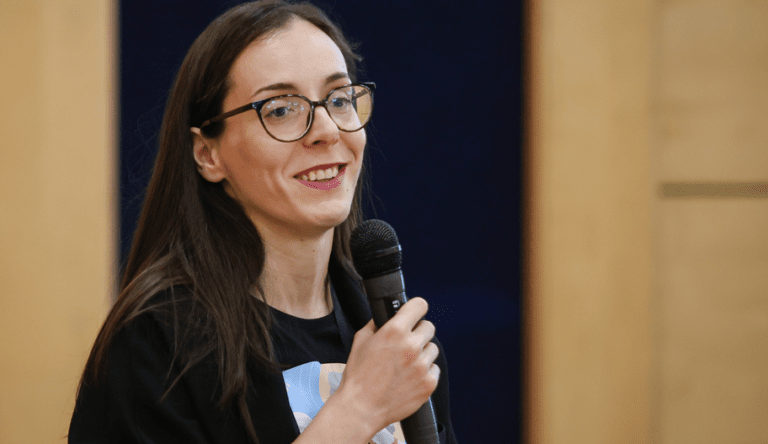
![[aggregator] downloaded image for imported item #39588](https://civicamobilitas.mk/wp-content/uploads/2025/09/simona-scaled-e1757594367368.jpg)
SIMONA SLAVKOVA: YOUNG PEOPLE WANT TO EXPERIENCE THE EU AS A PERSONAL PERSPECTIVE
Interview with Simona Slavkova: Young people want to experience the EU as a personal perspective
Interviewer: Enis Shaqiri
BIRC Institute
Simona Slavkova is a youth activist who actively works with organizations and is currently a grant manager at ALDA for the Balkans. In this interview for the BIRC Institute, she speaks about the role of young people in the process of European integration, the challenges they face, and the ways regional cooperation can be strengthened.
BIRC: Do young people have enough information about the process of European integration?
Simona Slavkova: Young people have some information, but it is mostly fragmented, formal, and not always understandable for them. European integration is a complex process with many technical terms, and communication from institutions is often not adapted to a youth audience. There is interest and curiosity, but there is a lack of clear and transparent information channels. It is crucial that information is transmitted through youth organizations, universities, and non-formal educational platforms, with a visual and interactive approach. If young people experience the EU as close and recognizable in their daily lives, they will understand it not only as a political project but also as a personal perspective for their future.
BIRC: What are the main obstacles preventing young people from engaging in the processes of Europeanization and democratization?
Simona Slavkova: One of the biggest obstacles is the insufficient belief that the voices of young people truly matter. Although youth councils and forums exist, they are often perceived as symbolic rather than essential mechanisms. Additionally, economic insecurity and high unemployment drive young people to focus on their own survival rather than broader social processes. Some young people also perceive Europeanization as something “imposed” from the outside. The solution is to give real power to young people in decision-making processes and to create concrete programs that support their careers, education, and personal development.
BIRC: How can regional cooperation among young people be improved in the context of European integration?
Simona Slavkova: Young people in the region face the same challenges – migration, unemployment, climate change, and lack of trust in institutions. Therefore, it is very important to develop regional youth platforms, joint volunteer programs, and initiatives that connect young people around concrete issues, such as the environment or digital transformation. Existing programs like Erasmus+ are important, but new formats designed specifically for the Balkans are also needed, through which young people can work together on projects and build long-term partnerships.
BIRC: Are the current EU programs for youth (such as Erasmus+) sufficient to promote Europeanization in the Balkans?
Simona Slavkova: Erasmus+ is one of the most successful programs, which undoubtedly contributes to building contacts and developing a European identity among young people. But if we talk about the Europeanization of the Balkans, more is needed – local and regional initiatives that also reach young people in smaller communities. Only then can the feeling be strengthened that European integration is a process in which everyone can actively participate.
BIRC: How can we effectively counter disinformation and anti-European propaganda that affects young people?
Simona Slavkova: Young people seek authenticity and relevant stories, not formal campaigns. The solution lies in content they understand and consume – videos, podcasts, visual messages. If such content is created by young people for their peers, the effect is much stronger. At the same time, media literacy must be invested in as a long-term solution. Young people should be equipped with the tools to recognize manipulation. Positive stories about the benefits of European integration should be much more present – through personal testimonies, success stories, and concrete benefits that young people can feel in their everyday lives.
BIRC: Do you think there is Euroscepticism among young people, and what fuels it?
Simona Slavkova: Yes, it exists. It stems from the slow progress in the integration process, from the economic problems young people face – unemployment, low wages, emigration – and from exposure to disinformation. But the positive thing is that young people are not apathetic, but rather critically minded. If they are offered real opportunities – better education, mobility, job opportunities, and cultural exchange – Euroscepticism can be significantly reduced.
This interview was prepared within the framework of the project “Engaging Youth for the Europeanization of the Balkans”, implemented by the BIRC Institute from North Macedonia, NGO GLAS from Montenegro, and CFID from Kosovo, with the support of the Western Balkans Fund and co-financing from the European Union.
The interview was prepared with the financial support of the European Union. The content is the sole responsibility of the authors and in no way reflects the views of the European Union.
![[Aggregator] Downloaded image for imported item #51694](https://civicamobilitas.mk/wp-content/uploads/2026/10/1_cover-600x400-1.jpg)
![[Aggregator] Downloaded image for imported item #51442](https://civicamobilitas.mk/wp-content/uploads/2026/10/VACANCY_Comms-officer-600x400-1.png)
![[Aggregator] Downloaded image for imported item #51393](https://civicamobilitas.mk/wp-content/uploads/2026/10/share-default-768x403.jpg)