
A Difficult Year for Civic Space in the Western Balkans and Türkiye, but Not Without Victories: BCSDN Launches 2025 Monitoring Matrix Report
How much do legal guarantees really mean when civil society continues to face restrictions, financial uncertainty and limited influence over public decisions?
This question is at the heart of the 12th Monitoring Matrix Regional Report, launched by BCSDN, examining the enabling environment for civil society across the Western Balkans and Türkiye in 2025. The findings reveal a difficult year for civic freedoms, marked by growing restrictions and financial insecurity, but also important victories in challenging restrictive legislation, defending fundamental rights and advancing government–civil society cooperation.
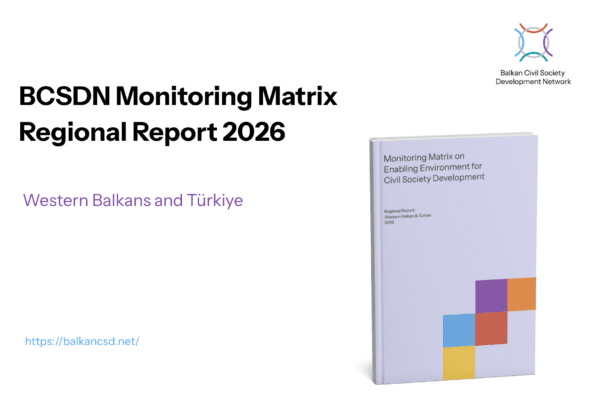
MONITORING MATRIX REGIONAL REPORT 2026
The Worst of 2025: Growing Restrictions and Persistent Barriers
The most concerning developments emerged in Serbia and Türkiye, where protests faced excessive policing, arrests and restrictions on peaceful assembly. In Serbia, CSOs were also subjected to police raids and intimidation, while in Türkiye, blanket protest bans and intrusive oversight further constrained civic freedoms. Legislative developments raised additional concerns, particularly in Bosnia and Herzegovina, where Republika Srpska adopted restrictive “foreign agents” legislation, and Montenegro, where proposed NGO legislation risked increasing state control.
These pressures were compounded by financial instability and persistent barriers to participation. The disruption of international assistance exposed organisations’ dependence on external funding, while unpredictable public support and disproportionate banking requirements further threatened their sustainability. Across the region, consultation mechanisms often remained formalities, offering civil society limited opportunities to influence policies and decisions.
The Best of 2025: When Civic Action Makes a Difference
Yet 2025 also brought important developments demonstrating that restrictions can be challenged and institutional cooperation improved. In Bosnia and Herzegovina, the Constitutional Court annulled Republika Srpska’s “foreign agents” law, while the country adopted its first state-level civil society strategy. In Montenegro, a proposed ban on road blockades was withdrawn following public opposition, illustrating the impact of collective civic action.
Positive developments were also recorded in Albania, where improved VAT exemption procedures addressed a longstanding obstacle for foreign-funded grants, and North Macedonia, where a new civil society cooperation strategy was adopted and the cooperation council reactivated. Judicial decisions in Kosovo and Türkiye provided further safeguards against restrictive measures, while sustained student-led mobilisation in Serbia demonstrated the strength of civic engagement and demands for democratic accountability despite growing pressure.
From Findings to Action: What Needs to Change?
The report calls for stronger protection of fundamental freedoms, accountability for excessive policing and attacks on civic actors, and safeguards against restrictive legislation. It also urges governments to ensure transparent, predictable and long-term public funding, remove disproportionate regulatory and banking barriers, and enable meaningful civil society participation in policymaking.
This requires more than formal consultation mechanisms: civil society must be involved early, its contributions considered, and cooperation strategies effectively implemented.
For the European Union, the report recommends giving greater weight to civic space conditions in enlargement assessments, reform priorities and financial assistance.
Progress should be measured not by laws and commitments alone, but by whether civil society can operate freely, access sustainable funding and influence public decisions.
Explore the full Monitoring Matrix Regional Report 2026 for detailed country findings, regional trends and recommendations.
This post was originally published on this site