

Elections are a vulnerable moment when citizens are exposed to manipulation and external influences
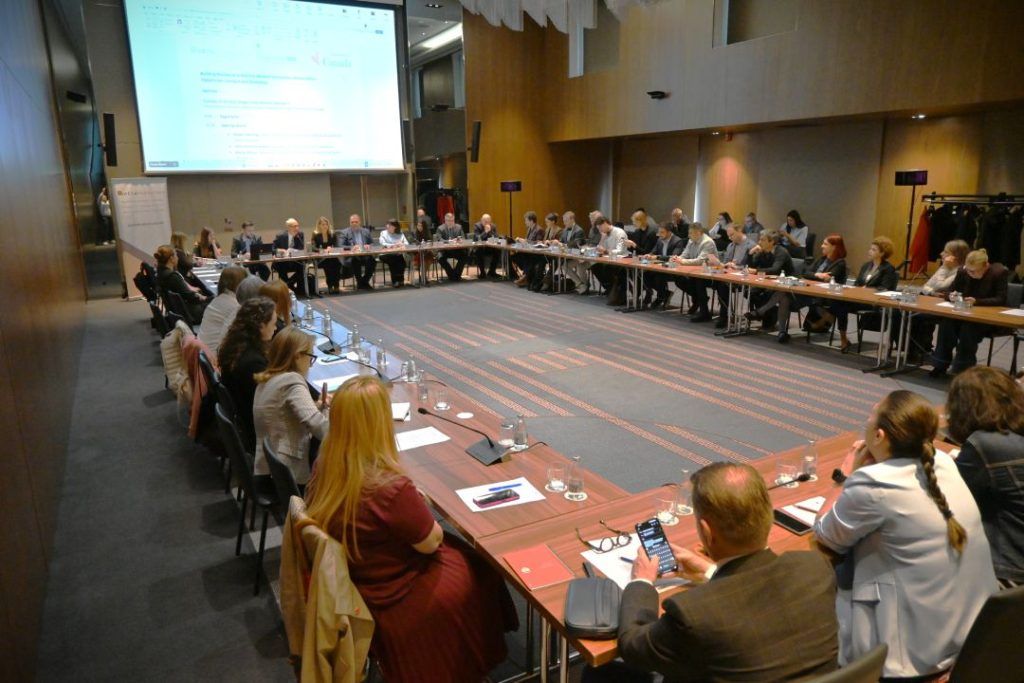
On 19 May, in Skopje, the Metamorphosis Foundation, in cooperation with International IDEA, organized the event “Building Resilience to Election-Related Information Manipulation,” dedicated to addressing foreign information manipulation and interference (FIMI), disinformation, and threats to electoral integrity. The event was implemented as part of the project “Combatting Electoral Foreign Information Manipulation and Interference (FIMI),” supported by Global Affairs Canada.
The event brought together representatives from institutions, regulators, international organizations, media, civil society organizations, and experts from the country and the region, with the aim of opening a strategic dialogue on strengthening the resilience of democratic processes and elections against disinformation and coordinated information influence.
At the official opening, speeches were delivered by Bardhyl Jashari, Executive Director of the Metamorphosis Foundation, Khushbu Agrawal from International IDEA, Mikael Atterhög from the Embassy of Sweden, Vilma Dambrauskienė, Ambassador of Lithuania, and Marija Miteva, Spokesperson of the Government of the Republic of North Macedonia. An online address was also delivered by Marie Sophie Peyre from the Directorate-General for Enlargement and Eastern Neighborhood of the European Commission.
In his address, Jashari emphasized that elections are a particularly vulnerable moment, when citizens are exposed to manipulation and external influences, and when disinformation aims to undermine trust in institutions, the media, and democratic processes. He stressed that countering FIMI does not represent a restriction of freedom of speech, but rather a protection of open and informed democratic debate.
According to Metamorphosis’ latest survey on the topic, 65 percent of citizens recognize the seriousness of the disinformation problem, while 74 percent expect institutions to respond with concrete measures, functional systems, and timely communication.
Marija Miteva, Spokesperson of the Government, noted that foreign interference and information manipulation represent a serious democratic and security challenge. She emphasized that the Government is working on a coordinated institutional approach, including a new cybersecurity strategy and the establishment of an inter-institutional working group to address disinformation campaigns.
Mikael Atterhög from the Embassy of Sweden noted that his country is also not immune to disinformation threats, and that societal resilience is especially tested during elections. He said that since 2021, Sweden has had a permanent election network made up of various institutions that participate in and share knowledge on the proper conduct of elections. He also emphasized that not only institutions, but every citizen can contribute to the process, which is why efforts are also focused on raising public awareness about the spread of disinformation.
During the discussions, it was also emphasized that EU candidate countries, including North Macedonia, should be more actively included in the European Democracy Shield, in order to jointly contribute to strengthening democratic resilience in Europe.
The panels included representatives from the State Election Commission, the Agency for Audio and Audiovisual Media Services, and the Ministry of Defence, as well as experts and representatives of international organizations, including the European Trust Alliance and the European Fact-Checking Standards Network.
Bojan Marichikj, President of the State Election Commission, stated that in the digital era electoral integrity depends not only on the physical security of the election process, but also on the ability of institutions to respond quickly to coordinated disinformation campaigns. According to him, insufficient regulation of the online space and weak institutional coordination represent serious vulnerabilities that are exploited by hybrid threats.
Goran Rizaov from the Metamorphosis Foundation emphasized that foreign malign influence most often exploits existing systemic weaknesses such as low trust in institutions, political polarization, low media literacy, and unregulated social media platforms, which creates a favorable environment for the spread of disinformation.
In the second part of the event, international experts discussed European experiences and mechanisms for addressing disinformation and hybrid threats. Rob van Beek from the European Trust Alliance spoke about the role of artificial intelligence and the importance of connecting the Western Balkans with European initiatives on media literacy and democratic resilience. Mindaugas Lašas from the Ministry of Foreign Affairs of Lithuania shared Lithuania’s experience in dealing with “non-military threats” such as disinformation and cyberattacks, while Clémence Longley from the European Fact-Checking Standards Network spoke about the need for rapid response mechanisms and support for fact-checkers in crisis situations.
The event concluded with a practical workshop and a simulation of an information attack during elections—the first such simulation organized in the country—where civil society representatives worked on scenarios for rapid damage assessment, public communication, and coordination with institutions in conditions of a disinformation crisis.

![[Aggregator] Downloaded image for imported item #52203](https://civicamobilitas.mk/wp-content/uploads/2026/10/Cover_MM-Albania-600x400-1.jpg)
![[Aggregator] Downloaded image for imported item #52158](https://civicamobilitas.mk/wp-content/uploads/2026/10/Is-Political-Interference-Addressed-in-the-Frameworks-of-the-Prosecutorial-Councils-in-North-Macedonia-and-Bosnia-and-Herzegovina-pdf-1-724x1024-1-e1792394173877.webp)
![[Aggregator] Downloaded image for imported item #52160](https://civicamobilitas.mk/wp-content/uploads/2026/10/Raising-the-Bar-on-Integrity_Aligning-North-Macedonia-and-Bosnia-and-Herzegovina-with-the-2026-EU-Anti-Corruption-Directive-pdf-1-724x1024-1-e1792393418465.webp)