

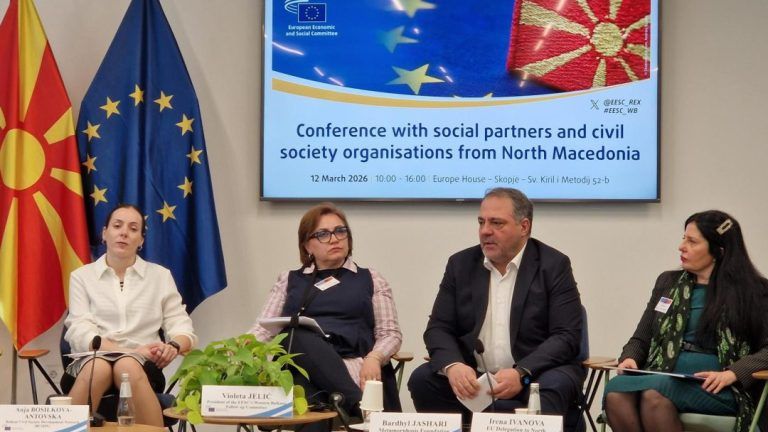
Jashari: Support provided by the EU in the fight against disinformation is very important
“We feel the consequences every day and we know how those who spread disinformation operate and what effect it has. That is why we must act and follow the EU’s lead. If we want citizens to trust state institutions and democracy, they must have accurate information. That is the only way,” emphasized Metamorphosis Director Bardhyl Jashari.
“Disinformation is not just a media issue, it is a challenge to our democracy and is increasingly becoming a security concern. That is why the support we receive from the EU in the fight against disinformation is very important,” said today Bardhyl Jashari, Executive Director of the Metamorphosis Foundation, at a Conference with social partners and civil society organizations from North Macedonia. As part of the conference, held at “Europe House,” there was a session dedicated to the civil sector, freedom of expression, and the fight against disinformation. The discussion focused on the role of civil society, the media, and institutions in strengthening democratic processes and countering the spread of disinformation.
In addition to Jashari, presentations were also given by Ionuţ Sibian, Vice-President of the Western Balkans Follow-up Committee of the European Economic and Social Committee (EESC), Irena Ivanova from the Delegation of the European Union to North Macedonia, Anja Bosilkova-Antovska from the Balkan Civil Society Development Network, as well as Ana Petrusheva, Director of BIRN Macedonia.
“Civil society organizations are often under attack and labeled as foreign agents. We operate in a hostile environment where there is no systematic or substantive way to participate in activities related to civil society, nor is there a model for how such participation should take place. As for the media sector, we run our own media outlets and work hard not only to provide quality journalism, but also to reaffirm the role of the media in a democratic society. I believe that, as media actors, we must reaffirm and emphasize this role, in order to help journalists adapt to new contexts—particularly in terms of how to use artificial intelligence (AI), how to integrate it into their daily work, and how to use data tools. If you are a professional journalist and your work is relevant, the only way to secure your place in all this noise is to become useful again,” Jashari emphasized.
Speaking about financial independence, he pointed out that there is no real market for the media, and that independent journalism faces political pressure.
“I would say that there is soft censorship. There are many media outlets in our region that operate with funding from businesses and governments. When it comes to disinformation, it is not just a media issue, it is a challenge to our democracy and is increasingly becoming a security concern. One of our more recent studies on the effects of disinformation showed that over 60 percent of citizens understand the consequences of disinformation, but 40 percent do not know how to deal with it. They erode citizens’ trust in institutions,” Jashari emphasized.
“We need to follow the EU with very concrete measures, meaning we should align our media framework and media literacy. The support provided by the EU for media literacy is very important. We already feel the consequences on a daily basis and we know how those who spread disinformation operate, as well as the effects they produce. That is why we must act and follow the EU’s lead. If we want citizens to trust state institutions and democracy, they must have accurate information. That is the only way,” Jashari emphasized.
Anja Bosilkova-Antovska pointed out that civil society actors and journalists who deal with sensitive issues and topics are increasingly becoming targets of attacks and negative campaigns. She emphasized that anti-gender rhetoric is increasingly used in public discourse in order to portray certain organizations as actors working against national interests. According to her, such narratives create a hostile working environment for civil society organizations and the media.
As an additional problem, she also pointed to so-called Strategic Lawsuits Against Public Participation (SLAPPs), which are used as a means of pressure against journalists and activists. Bosilkova-Antovska warned that a recent ruling against the Investigative Reporting Lab (IRL) is concerning, as it questions whether a journalist from a civil society organization can be considered a journalist at all. She described the establishment of a government working group tasked with developing legal solutions to protect against such lawsuits as a positive step.
Ionuţ Sibian assesed that the adoption of strategies and initiatives to support civil society represents a significant step forward. He emphasized that the European Commission recognizes the fourth sector as key to the protection of European values.
“The European Union is like a house with its own pillars, if those pillars are continuously undermined every day, eventually the house itself will collapse,” Sibian emphasized.
He also spoke about the importance of platforms for civic dialogue through which organizations from the region can participate in the processes of gradual integration into the EU. According to him, stronger mechanisms are also needed to protect civic space, and the European Commission is already assessing possible options in this regard. Sibian also warned about challenges related to funding, as a significant share of European funds is being redirected to support Ukraine.
Irena Ivanova from the EU Delegation to North Macedonia emphasized that civil society and the media should work together in defending freedom of expression and in the fight against disinformation. She pointed out that even within the EU, there is a noticeable shrinking of civic space, as well as a rise in disinformation and censorship in certain sectors.
“We are living in increasingly polarized societies, which is why media literacy is crucial,” Ivanova said. She stressed that digitalization can contribute to greater transparency and to unifying the voice of civil society organizations. However, she assessed that the country still lacks a stronger network and a more integrated approach within the civil sector.
Ana Petrusheva from BIRN warned that disinformation is cheap and spreads easily, especially in the digital age.
“Today, hundreds of news items can be created and shared daily, and anyone with a computer and internet access can present themselves as a journalist,” she said.
According to Petrusheva, the media market is highly polarized, and pressure from advertising often leads to self-censorship in media outlets, as newsrooms avoid critical reporting on companies that finance them. She emphasized that much of the investigative journalism in the country is funded through donor support, which has recently been decreasing due to the redirection of resources toward Ukraine.
“We are facing major challenges and we have to fight on multiple fronts,” Petrusheva said, adding that economic pressure on the media is only one part of a broader crisis facing the media sector.
![[Aggregator] Downloaded image for imported item #52203](https://civicamobilitas.mk/wp-content/uploads/2026/10/Cover_MM-Albania-600x400-1.jpg)
![[Aggregator] Downloaded image for imported item #52158](https://civicamobilitas.mk/wp-content/uploads/2026/10/Is-Political-Interference-Addressed-in-the-Frameworks-of-the-Prosecutorial-Councils-in-North-Macedonia-and-Bosnia-and-Herzegovina-pdf-1-724x1024-1-e1792394173877.webp)
![[Aggregator] Downloaded image for imported item #52160](https://civicamobilitas.mk/wp-content/uploads/2026/10/Raising-the-Bar-on-Integrity_Aligning-North-Macedonia-and-Bosnia-and-Herzegovina-with-the-2026-EU-Anti-Corruption-Directive-pdf-1-724x1024-1-e1792393418465.webp)