Screenshot

Publishing Information on the Public Service in North Macedonia: Why is Transparency and Accountability Important?

Institutions are transparent when they enable stakeholders to understand and recognise that they operate honestly. With a view to achieving transparency, an institution must provide information about its activities to stakeholders that are accurate, complete, and made available in a timely fashion. Transparency ensures accountability. The 2019 OECD Recommendation of the Council on Public Service Leadership and Capability presents 14 principles of a fit-for-purpose public service. It includes a principle related to developing “a long-term, strategic and systematic approach to people management based on evidence and inclusive planning that: is informed by an evidence-based assessment of skills needed and skills available to meet current and future core business requirements, using HR and workforce data for strategic and predictive analytics, while taking all necessary steps to ensure data privacy”.

In North Macedonia, the public has to be informed about official data and reports on the civil service and employees in the central state administration. This is a legal obligation deriving from the Law on Administrative Servants (LAS) and the Law on Public Sector Employees (LPSE). In the context of properly designing and implementing human resource management (HRM) policy, it is of the foremost importance that in-line authorities possess complete and reliable data about their human resources. This does not mean that all HRM information should be made publicly available, since there are certain types of information that may not be provided publicly, such as personal data. However, the lack of efforts for the promotion and dissemination of data on civil service may suggest that governments either do not recognise the importance of accountability or that they are concerned about potential public reactions to what can be seen as oversized and inadequately efficient administrations.

DOWNLOAD PDF

Продолжи со читање

  • Journalists Decode EU Institutions, Acquis, and Enlargement Policies

    On 16–17 October 2026, the European Policy Institute (EPI) organized the first training module under the project “Decode the EU – Communicating EU policies together” in Strumica. The two-day workshop brought together 10 journalists from diverse media outlets, aiming to strengthen analytical, evidence-based reporting on North Macedonia’s EU accession journey.The…

  • MoU with the British Business Association in North Macedonia

    🤝 Strong economies are built on strong partnerships. Finance Think and the British Business Association in North Macedonia signed a Memorandum of Understanding yesterday, laying the foundation for closer cooperation on issues of importance to the business community, policymakers and society. The partnership brings together the British Business Association’s extensive business network and Finance Think’s […]
    The post MoU with the British Business Association in North Macedonia first appeared on Finance Think.
    The post MoU with the British Business Association in North Macedonia appeared first on Finance Think.

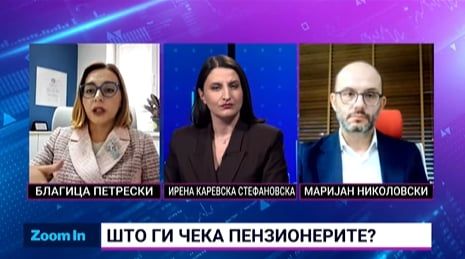
  • On pension matters, participation in Bloomberg

    🔴 What awaits future pensioners? 🟥 What kind of pension model do we need, and who will bear the burden of future reforms? 📌 Without measures, the deficit in the Pension and Disability Insurance Fund will continue to grow, and by the mid-2040s there will be fewer insured persons than pensioners, according to a study […]
    The post On pension matters, participation in Bloomberg first appeared on Finance Think.
    The post On pension matters, participation in Bloomberg appeared first on Finance Think.

  • Is Political Interference Addressed in the Frameworks of the Prosecutorial Councils in North Macedonia and Bosnia and Herzegovina?

    This policy brief examines the frameworks governing prosecutorial councils in North Macedonia and Bosnia and Herzegovina to assess whether their laws ensure adequate independence in line with European standards. The rule of law and an independent justice system are fundamental to the European Union’s enlargement process, particularly within the crucial Chapter 23. A cornerstone of […]
    The post Is Political Interference Addressed in the Frameworks of the Prosecutorial Councils in North Macedonia and Bosnia and Herzegovina? appeared first on EPI.

  • Raising the Bar on Integrity: Aligning North Macedonia and Bosnia and Herzegovina with the 2026 EU Anti-Corruption Directive

    This policy brief evaluates anti-corruption alignment and structural vulnerabilities in North Macedonia and Bosnia and Herzegovina against the EU’s Directive (EU) 2026/1021 on Combatting Corruption. Within the European Union’s “Fundamentals First” enlargement methodology, establishing an accountable administration, an independent judiciary, and robust anti-corruption enforcement is a primary condition for membership. Despite significant differences in their […]
    The post Raising the Bar on Integrity: Aligning North Macedonia and Bosnia and Herzegovina with the 2026 EU Anti-Corruption Directive appeared first on EPI.