Urgent harmonization of the regulatory framework in the Balkans with the Digital Services Act–crucial for the fight against disinformation
The lack of legal and institutional mechanisms to protect the digital space in the Balkans makes the region vulnerable to manipulation, disinformation, and foreign influence. While the European Union’s Digital Services Act (DSA) establishes clear rules for greater transparency and accountability of online platforms, countries in the region still lack a similar regulatory framework.
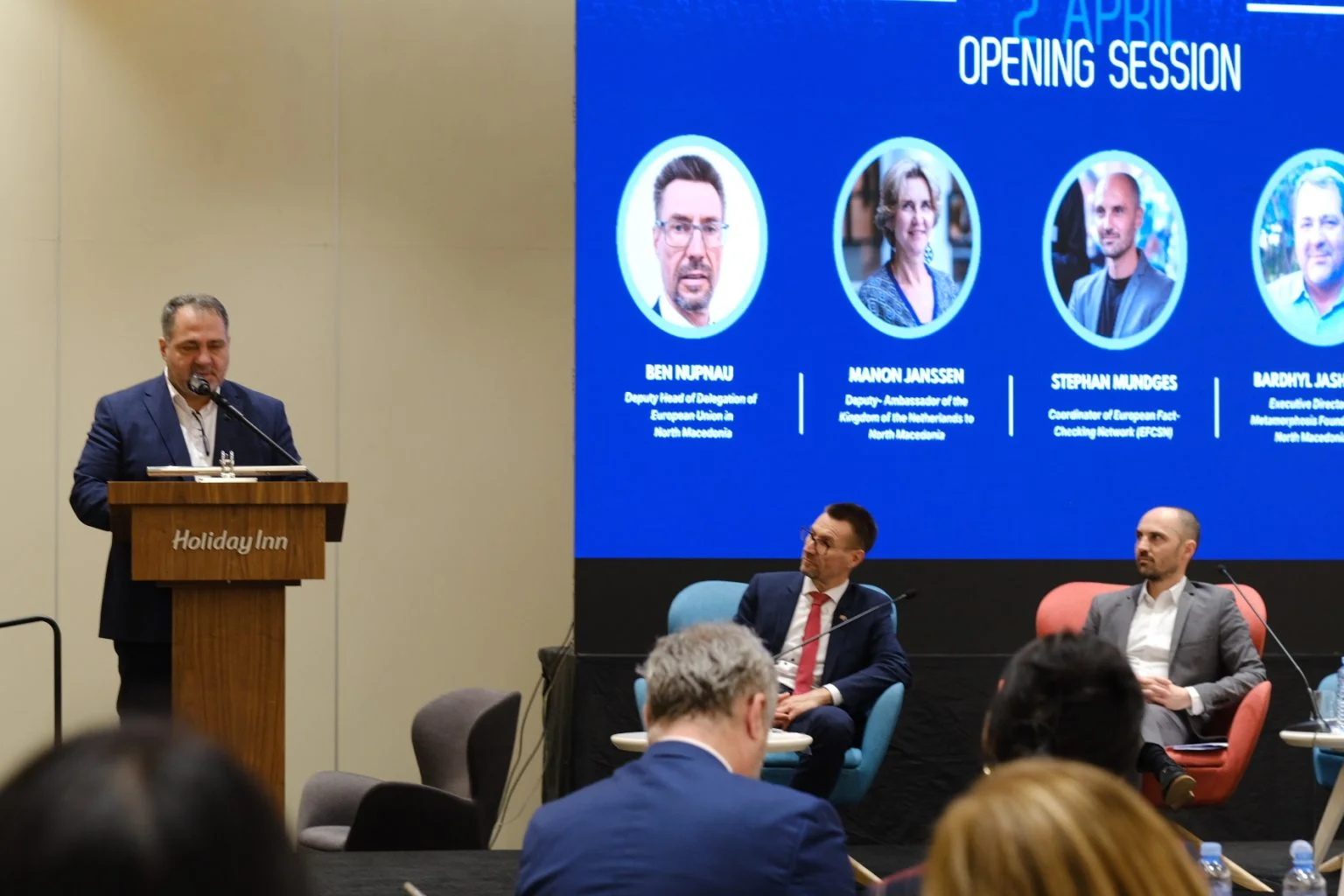
The collective fight against disinformation is not just about correcting falsehoods. It focuses on preserving our democratic societies in which citizens make decisions and debate based on arguments. The fight focuses on strengthening media literacy at all levels, making societies resilient to external influences and interference. Today, fact-checking is under attack, and with it, democracy. This was highlighted at today’s conference titled “Together for Truth: Whole-of-Society Approach to Safeguard Democracy,” held in Skopje and organized by the Metamorphosis Foundation in celebration of International Fact-Checking Day, April 2.”
The conference was opened by Ben Nupnau, Deputy Head of Delegation of European Union in North Macedonia, Stephan Mundges, Coordinator of the European Fact-Checking Standards Network (EFCSN), and the Director of the Metamorphosis Foundation, Bardhyl Jashari.
“Metamorphosis is an example in Macedonia and beyond in the fight against disinformation. With your work, you are fighting against the erosion of democratic values. In the EU, we have mechanisms to combat disinformation with the Digital Services Act and the European Media Freedom Act. The online platforms we have are transparent and independent journalism is spread through them. We are with you when it comes to greater protection of journalists and fact-checkers. This conference is an opportunity to exchange practices and strengthen our efforts to preserve democracy and independent media outlets,” said Nupnau, Deputy Head of Delegation of the European Union in North Macedonia.
Stephan Mundges, Coordinator of the European Fact-Checking Standards Network (EFCSN), stressed that it is everyone’s task to strengthen democracy and continue the fight against the spread of disinformation.
“To be lied to and manipulated is to not be free. We meet here in a time of crisis. Fact-checking is under attack, and with it democracy. These attacks come from the East, but they are also starting to come from the West. Political pressure from the United States is making major American technology companies withdraw from the fight against disinformation. Meta’s program is not perfect, but it is the best fact-checking program on a major social network. It does not remove content, but checks for truthfulness. About 95 percent of users who see those tags do not click on the post, because they do not want to see false content. If Meta stops using fact-checking, Europe will be more vulnerable, and the income of fact-checkers will decrease. Meta is not the only one withdrawing, but also TikTok, Microsoft, and Google,” Mundges emphasized.
He added that fact-checkers are under attack in the Western Balkans and that there are unfounded raids and investigations against them and that the situation is not great. Mundges highlighted the police raid on the offices of the civil society organization CRTA from Serbia, which is also a member of the EFCSN.
“What can we change? Fact-checkers will not disappear, we have a big project, with which we will work to strengthen our pan-European network for all relevant stakeholders, because the work of fact-checkers is invaluable and it remains to function independently of political influence,” added Mundges.
The Executive Director of the Metamorphosis Foundation, Bardhyl Jashari, spoke about the need for urgent harmonization of the regulatory framework of Balkan countries with the principles of the Digital Services Act.
“Western Balkan countries still lack the necessary legal, technical, and institutional safeguards to protect people’s rights online. Unlike the EU, we do not benefit from the protection offered by the Digital Services Act, yet we all live in the same digital space. This creates a dangerous gap in the security and integrity of the Internet in Europe. We therefore call for the urgent alignment of the regulatory framework of Balkan countries with the principles of the Digital Services Act and the creation of a strong regional framework for information integrity,” Jashari said.
He noted that citizens from the Western Balkans are significantly exposed to harmful and illegal content on the Internet and that disinformation is everywhere–infiltrating political discourse, undermining trust, and distorting reality.
“Meanwhile, social media platforms, especially the so-called big online platforms, continue to profit from algorithms and amplify disagreements and misinformation, while being largely irresponsible in our region,” Jashari added.
Soren Liborius, Chief Advisor at the European External Action Service (EEAS), gave a video address at the conference.
“Disinformation is a core problem that we need to continue to address. In 2015, the heads of EU member states and governments agreed that something had to be done to combat Russian disinformation. Then came the start of the war in Donbas, and all the activities that led to today’s aggression took place, and therefore it was decided that a team should be formed to combat Russia’s ongoing efforts to spread disinformation. The EEAS has a public platform on which we communicate our findings to the public, what are the trends that are present, and how they are related to political developments. We have also developed our own methodology. On the platform euvsdisinfo.eu, we have a database, available to the public, and there are also examples of how the Russian side spreads disinformation,” said Liborius.
The EEAS report on threats from foreign manipulation and interference in information was presented by Chiara Pacenti, Data Analyst, who spoke about FIMI and the threat on a global scale. She noted that Ukraine is the main target when it comes to Russian FIMI attacks, which aim to weaken Western ties, NATO, EU, G7.
Today’s all-day international conference focuses on the threats of disinformation, foreign manipulation and interference (FIMI), electoral integrity, fact-checking and cross-sectoral cooperation. In Tirana, an evening forum “Democracy Matters–Facts Matter” will be held, organized by the Faktoje Center. The forum will highlight the fact-checking landscape in Albania, as well as regional cooperation, and will honor journalistic excellence with the Fatos Baxhaku Award.
![[Aggregator] Downloaded image for imported item #43092](https://civicamobilitas.mk/wp-content/uploads/2025/12/media-lit-call-for-proposals-fotor-naslovna.png)
![[Aggregator] Downloaded image for imported item #43146](https://civicamobilitas.mk/wp-content/uploads/2025/12/10-1536x1152-1-1024x768-1-768x576.jpg)