

![[aggregator] downloaded image for imported item #39584](https://civicamobilitas.mk/wp-content/uploads/2025/09/raport-sanction-lists-e1757505448261.jpg)
REPORT: SANCTIONS LISTS EXPOSE CORRUPTION IN NORTH MACEDONIA BUT FAIL TO DELIVER RESULTS
International sanctions against politicians and business figures in North Macedonia have exposed corruption and triggered public debate but remain largely ineffective in curbing entrenched practices, according to a new study by the BIRC Institute.
The report, “Naming, Shaming, But Not Taming: The Impact of the Sanction Lists on the Politics and Economy of North Macedonia,” by analyst and journalist Xhelal Neziri, found that sanctions imposed by the United States, United Kingdom and European Union have had “limited and inconsistent” impact because they are not enforced domestically.
Since 2015, Washington has blacklisted several prominent figures, including former Prime Minister Nikola Gruevski, ex-intelligence chief Sašo Mijalkov, oligarch Jordan Kamčev and Struga mayor Ramiz Merko, citing corruption and abuse of power. More recently, former First Deputy Prime Minister Artan Grubi and ex-judge Enver Bexheti were sanctioned for allegedly influencing the judiciary to protect political allies.
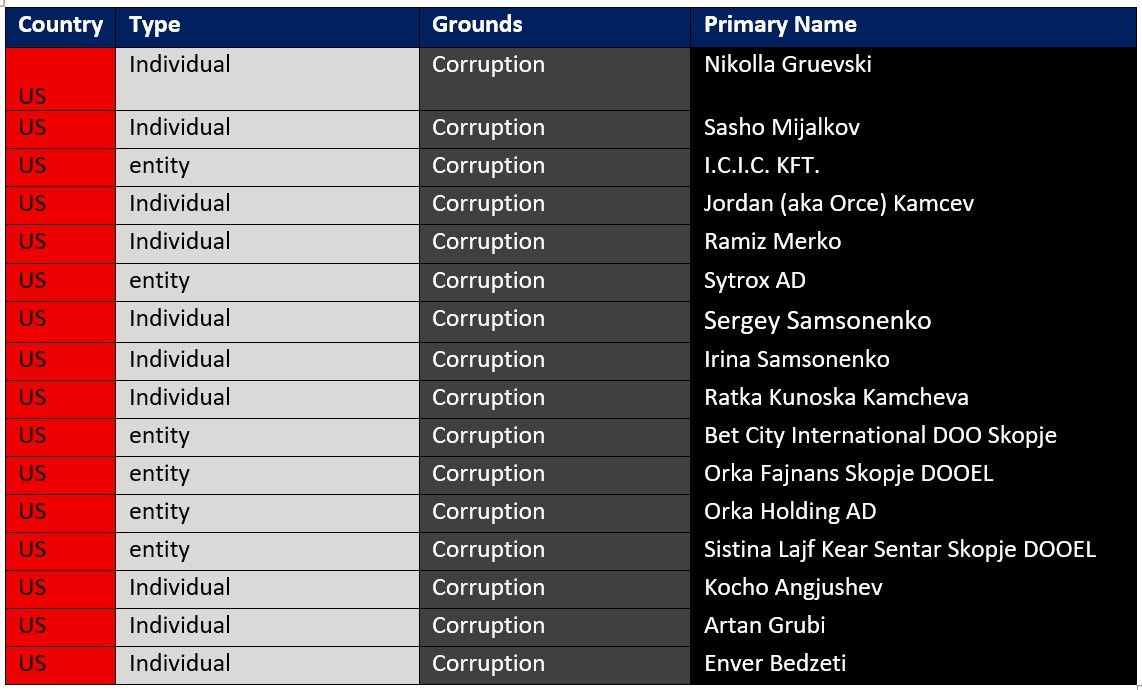
“Sanction lists confirm corruption and abuse, but without local enforcement mechanisms, their effect is more symbolic than practical,” the report said.
Neziri’s study, based on 12 expert interviews and open-source data, found that sanctions influence political careers more than economic activity. Blacklisted politicians often withdraw from public life or face diminished credibility, but their business networks remain largely intact. Companies linked to sanctioned individuals frequently continue operating by shifting ownership structures.
The report noted that reactions inside North Macedonia have been mostly declarative. Ruling and opposition parties use sanctions to attack rivals, while judicial institutions often speed up reviews only after international pressure. “Only after someone is blacklisted does the system start to move,” said Biljana Ivanovska, ex-head of the State Commission for the Prevention of Corruption, quoted in the report.
Academic Abdylmenaf Bexheti, a professor at South East European University, said sanctions lack a preventive effect because they are not clearly explained to the public. “Not much is known about the criteria of who can enter the blacklists. If they were promoted, then the lists would be more effective in preventing mistakes being made, either on the political or economic level,” he said.
Public perception of sanctions, the study found, is divided along political and ethnic lines. Ethnic Albanians, generally more pro-Western, view U.S. and EU sanctions as credible, while some ethnic Macedonians and nationalist groups dismiss them as foreign interference.
The report concludes that without reforms to strengthen judicial independence, enforce sanctions locally and tackle political clientelism, sanctions will remain a naming-and-shaming tool rather than a deterrent.
The study also urged changes in domestic law to ensure that sanctions carry weight inside the country. “To change the laws that regulate sanctions, in which case, in addition to the sanctions of the United Nations, the country is obliged to implement those of friendly countries and strategic partners such as the EU, the USA and the UK,” the report recommended.
“Corruption and party clientelism are so deeply rooted that sanctions alone cannot tame them,” Neziri wrote.
The BIRC Institute, based in Tetovo, released the study in September 2025.
The full report is available bellow:

![[Aggregator] Downloaded image for imported item #52203](https://civicamobilitas.mk/wp-content/uploads/2026/10/Cover_MM-Albania-600x400-1.jpg)
![[Aggregator] Downloaded image for imported item #52158](https://civicamobilitas.mk/wp-content/uploads/2026/10/Is-Political-Interference-Addressed-in-the-Frameworks-of-the-Prosecutorial-Councils-in-North-Macedonia-and-Bosnia-and-Herzegovina-pdf-1-724x1024-1-e1792394173877.webp)
![[Aggregator] Downloaded image for imported item #52160](https://civicamobilitas.mk/wp-content/uploads/2026/10/Raising-the-Bar-on-Integrity_Aligning-North-Macedonia-and-Bosnia-and-Herzegovina-with-the-2026-EU-Anti-Corruption-Directive-pdf-1-724x1024-1-e1792393418465.webp)