
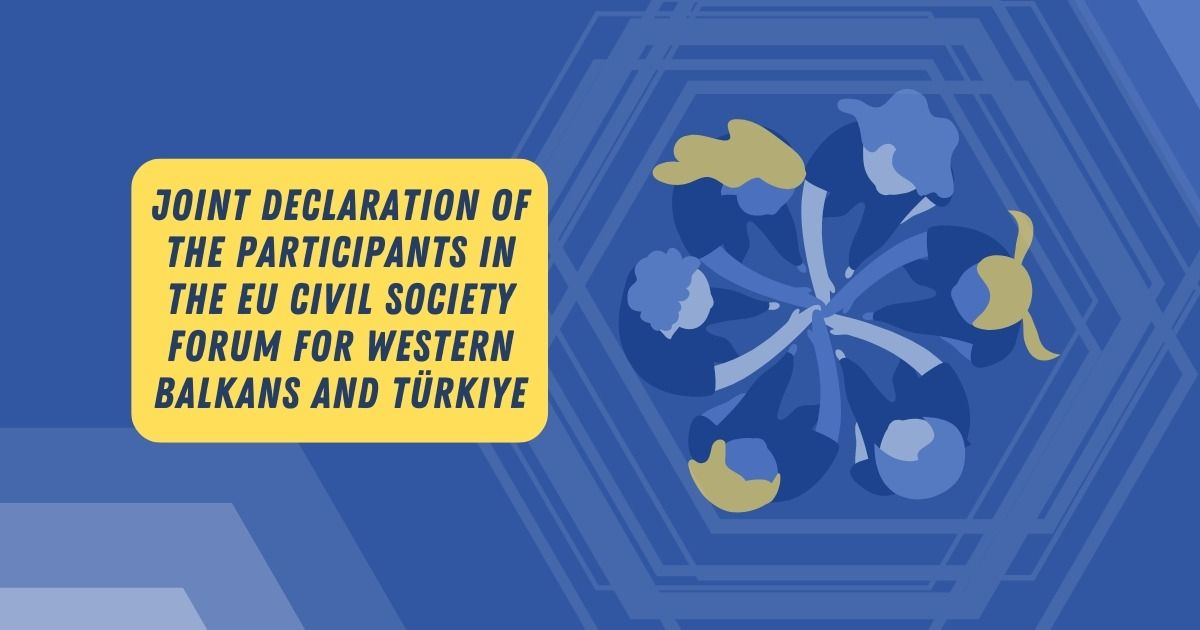
Joint declaration of the participants in the EU Civil Society Forum for Western Balkans and Türkiye
We, the representatives of civil society organizations and activists from the Western Balkans and Turkey, gathered at the EU Civil Society Forum held on 11-13 June 2024, in Belgrade, Serbia, hereby issue this joint declaration drawing from the discussions held at the Forum concerning the new Growth Plan for the Western Balkans.
The new Growth Plan for the Western Balkans represents a major new opportunity to incentivise EU-compliant reforms in the region, while also boosting the EU’s public image and overall support for EU accession. But this can only be achieved if the process of implementing the Growth Plan is transparent and inclusive, recognising the major stakes the entire societies of the region have in it – not least because of the 6 billion EUR of additional financial support attached to it.
The regulation on the Reform and Growth Facility, the constitutive part of the Plan, sets up an appropriate role of civil society organisations and social partners in the development of Reform Agendas. The Reform Agendas, prepared by each of the Western Balkan 6 governments, will be the basis for establishing, implementing monitoring and evaluating the reform progress tied to biannual payments of the new financial package. Thus, paragraph 6 of Article 11 (Submission of Reform Agendas) states: “The Reform Agendas shall be prepared in an inclusive and transparent manner, in consultation with social partners and civil society organisations.” Moreover, Article 13 (Content of the Reform Agendas) states that these documents should contain a summary of the consultation process conducted in their preparation. Such consultations, to be implemented “in accordance with the beneficiaries’ legal framework,” should include “relevant stakeholders, including beneficiaries’ parliaments, local and regional representative bodies and authorities, social partners and civil society organisations.” Reform Agendas should also indicate how the stakeholders’ inputs were reflected in their text.
Compared to the myriad of complex tasks that both the Commission and the WB governments must undertake to put the implementation of the Growth Plan in motion, these provisions concerning the role of national parliaments, civil society and social partners may seem like minor details. Yet, for these actors – largely marginalised in the EU accession process characterised by a strong “executive bias” – they are crucial. The duty to conduct consultations is enshrined in the Regulation, making it the letter of the law. As such, it must not be an optional activity, but a matter of rule of law observation for both the WB governments and the EU institutions.
The obligation to conduct consultations in the development of these key reform planning and prioritisation documents is a reform achievement in itself – a minimum standard that all involved parties should observe. This minimum standard applies more widely, across all EU support for the Enlargement region.
While we understand the challenge of ensuring quality Reform Agendas are developed promptly, we must not allow the consultation process to be compromised by haste. In the past, we have frequently observed the detrimental practice in our countries of using the EU accession process obligations and tight schedules as a reason to neglect consultation processes The European Commission has acknowledged our concerns regarding such practices.
Now is the time to align actions with commitments. If the European Commission aims to uphold the EU’s image as a protector of the fundamental values of democracy and a pluralistic society, it must demonstrate this commitment by insisting that the Western Balkan governments respect the legal provisions on consultations of draft Reform Agendas. We call upon the Commission to support us in this endeavour and to ensure accountability from our governments. The Commission holds the authority to assess and, if necessary, reject these agendas if the minimum prescribed criteria are not met (Articles 14 and 15 of the Regulation).
Initiating this process correctly is crucial. Breaching clear legal obligations at the outset will complicate rectifying such issues later during the implementation of this new support for the region’s EU accession efforts.
![[Aggregator] Downloaded image for imported item #51694](https://civicamobilitas.mk/wp-content/uploads/2026/10/1_cover-600x400-1.jpg)

![[Aggregator] Downloaded image for imported item #51442](https://civicamobilitas.mk/wp-content/uploads/2026/10/VACANCY_Comms-officer-600x400-1.png)
![[Aggregator] Downloaded image for imported item #51393](https://civicamobilitas.mk/wp-content/uploads/2026/10/share-default-768x403.jpg)