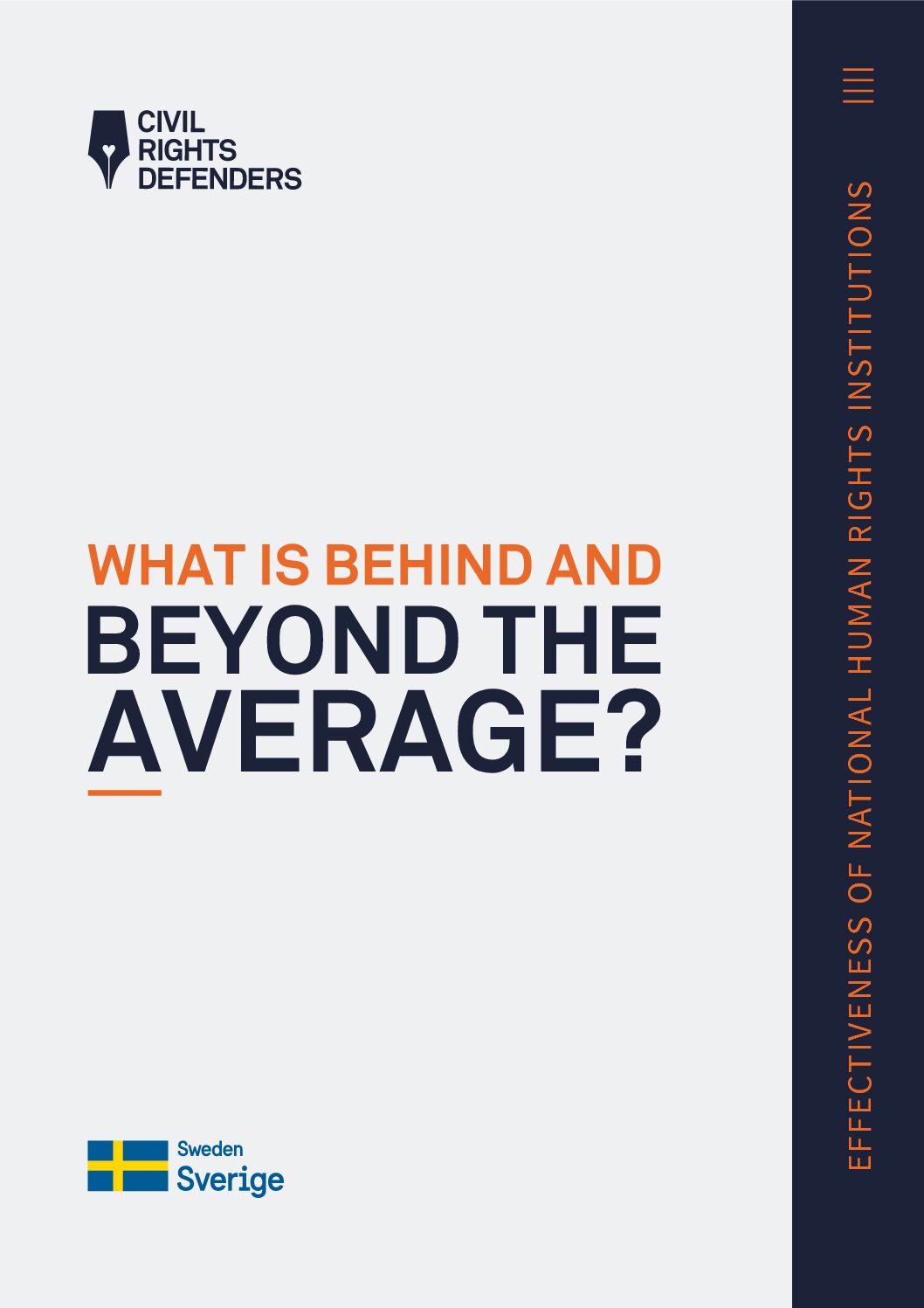
Effectiveness of NHRIs in Western Balkan countries: What is behind and beyond the average?
This regional report is the result of the research project which included independent institutions established by the state to protect and promote human rights in Albania, Bosnia and Herzegovina, Kosovo, Montenegro, North Macedonia and Serbia.
The research took place in the period from July – November 2019 and July – November 2020. It was first conducted in 2019 in Montenegro, North Macedonia and Serbia and then in 2020, it was expanded to Albania, Bosnia and Herzegovina and Kosovo. A comprehensive methodology for assessing and evaluating the effectiveness of national human rights bodies that enabled ranking and regional comparability was developed. Consequently, research was conducted by independent experts for Albania, Bosnia and Herzegovina, Kosovo, Montenegro, North Macedonia and Serbia, including data collection, analysis and ranking.
The six countries have established an ombudsperson as the main national human rights institution. In addition, specialised human right bodies that deal with non-discrimination/equality (EBs), data protection (SADP) and free access to information (FAI) – some of them with a double or triple mandate, have been created.
In Albania, besides the Ombudsperson – People’s Advocate (PA), there are two other NHRIs – the Commissioner for Protection against Discrimination and the Information and Personal Data Protection Commissioner.
In Bosnia and Herzegovina, the Ombudsperson has a triple-mandate and is also an equality body and freedom for access to information authority. Besides this institution, there is also the Personal Data Protection Agency.
In Kosovo, the situation is like the one in BiH. The Ombudsperson is a triple-mandate institution, also serving as an equality body and freedom for access to information authority. In addition, the National Agency for the Protection of Personal Data has been established.
From Montenegro, two double-mandate bodies are considered as NHRIs in the scope of this research: the Ombudsperson (also having the mandate of an EB) and the Agency for Personal Data Protection and Free Access to Information.
Four single-mandate bodies have been established in North Macedonia as NHRIs: the Ombudsperson, the Commission for Protection against Discrimination, the Commission for Protection of the Right to Free Access to Public Information and the Data Protection Directorate.
In Serbia, in addition to the Ombudsperson – Protector of Citizens (PC), the Commissioner for Protection of Equality and the Commissioner for Information of Public Importance and Personal Data Protection) have the position of an NHRI.
Effectiveness was assessed in four domains:
(1) Independence and ability to work without pressure,
(2) Availability of resources and capacities,
(3) Information, accessibility and cooperation with other relevant actors, and
(4) Mandate and powers.
The assessment was based on a previously defined set of indicators derived from relevant international standards.
Research results per country were synthesised in six country reports, elaborated by Armela Xhaho (Albania), Aida Malkic (Bosnia and Herzegovina), Edona Ahmetaj and Nat Avdiu (Kosovo), Jelena Djankic (Montenegro), Biljana Kotevska (North Macedonia) and Ivana Krstic (Serbia). Based on these reports, this regional report provides a comparative overview of the NHRIs in Albania, Bosnia and Herzegovina, Kosovo, Montenegro, North Macedonia and Serbia.
In this regional report, we present the methodology, research findings, as well as recommendations. The research findings are presented comparatively per each domain. This approach was taken as it was considered more appropriate to focus on comparative analysis of the subject matters, resulting in a more comprehensive presentation of the status quo, while also providing and discussing the results per country within the domain.
The post Effectiveness of NHRIs in Western Balkan countries: What is behind and beyond the average? appeared first on EPI.
![[Aggregator] Downloaded image for imported item #43795](https://civicamobilitas.mk/wp-content/uploads/2026/01/611149509_1571871173934400_3927165331577291092_n-2-768x512.jpg)