

Discussion: The youth in North Macedonia is not very well informed about the right to a healthy environment
The right to safe, clean, healthy and sustainable environment plays a key role in leading a healthy life, and this right is one of the most important for young people. Unfortunately, the environment is endangered starting from air pollution, unsanitary water up to garbage in various places around cities, and young people through various forms of activism and participation, try to protect it.
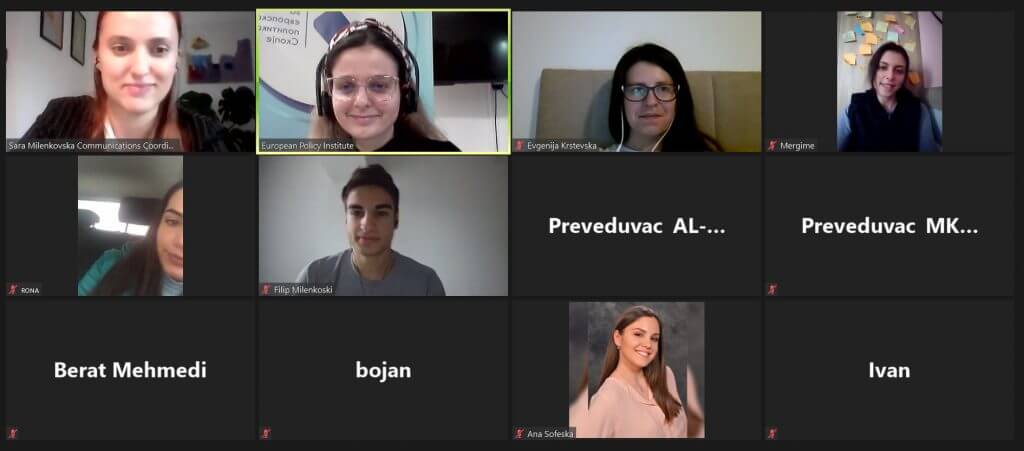
The discussion “Participation of young people in the promotion, protection and realization of the right to healthy environment as a human right”, that was held on 26 January, tried to open this topic about the different ways of how to maximize the youth potential in promoting and realizing the right to a healthy and sustainable enviroment as a basic human right.
The Aarhus Convention is one of the most important and powerful international documents and tools that serves young activists. In its pillars, the Convention stipulates that the public has the right to be informed – that is, by submitting a request for access to public information, young people are given the right to be informed about the state of the environment. However, the public institutions are the ones that have the duty to actively inform and involve the citizens in the decision-making process for protection of the environment. North Macedonia, as a country that has ratified and transposed in its legislation the international documents in this area, has undertaken the obligation to protect the environment and to enable the youth to be sufficiently informed and to include them in the decisions made regarding natural resource management.
“I believe that young people should focus their energy on forming more youth organizations that will actively appear in the public space and will take measures to protect the environment.”
In the discussion it was also pointed out that the youth councils, central or local, should be more actively involved in decision-making in the municipalities where they operate and they should have their representatives in the central, ie municipal councils where they will have the opportunity to influence decisions relating to environmental protection at the local level. It was emphasized that young people should be active, but also that they must be knowledgeable of law and legal acts, because that way it can directly affect the system and bring about change.
“Cooperation is needed between organizations that already have experience in lobbying and advocating for some environmental issues, for the strength and voice of young activists to reach out more to the stakeholders themselves.”
During the discussion, the participants also discussed various aspects of the topic, starting from how young people were brought up in their families to how are they educated in educational institutions; how to address the issue of environmental law from local to the central level; understanding how the decion-making process works at the national level. The topics of how (un) aware young people are about certain problems in society, specifically about the environment, certain solutions or obstacles and how they as young people can find the appropriate way to address the same issues were also conceived, were also discussed.

Young people emphasize that there should be personal responsibility when it comes to environmental protection and natural resources, and that the distrust of the authorities and their representatives when it comes to the future of the environment is growing, however, young people still expect them to be responsible. It is clear that although there is a certain desire for activism, still the topic of the environment is something that we can not solve individually, and that the whole community should strive to overcome this issue, be it institutional or systemic.
Environmental protection should be established in the curricula of primary schools, so that from an early age young people will become aware of the importance of preserving the environment. This was mentioned as a recommendation during the discussion because many young people are not interested or are not fully and properly informed about the issue.
Participants also shared their personal initiatives that they have taken, such as cleaning certain facilities in their schools; cleaning certain areas in their cities; participation in protests against air pollution; as well as creating videos for students to stimulate interest, but also to inform about how people affect the environment.
As part of the discussion, together with ten young participants from different cities aged 18 to 24, an expert and advocate for a healthy environment, Evgenija Krstevska, was invited. The discussion was moderated by Sara Milenkovska
The discussion was organized as part of the project “ACT Active citizenship action 2.0”, implemented by the European Policy Institute – Skopje with the support of the Center for Deliberative Democracy at Stanford University in the United States. The project is funded by the National Endowment for Democracy from the United States. This discussion, together with 4 other deliberative discussions with citizens on various topics across the country, will contribute to the development of the National Debate that is planned for 2022.
The post Discussion: The youth in North Macedonia is not very well informed about the right to a healthy environment appeared first on EPI.
![[Aggregator] Downloaded image for imported item #46020](https://civicamobilitas.mk/wp-content/uploads/2026/03/picture4-1.jpg)
![[Aggregator] Downloaded image for imported item #45513](https://civicamobilitas.mk/wp-content/uploads/2026/03/ace_5119-1-1024x683-1-768x512.jpg)