Conference 20 years of SAA: The Agreement is an essential document in regulating and developing relationships with the EU
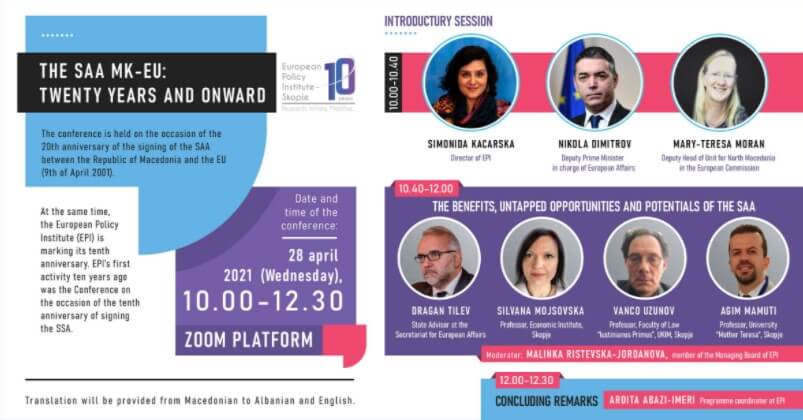
The Stabilisation and Association Agreement between Macedonia and the European Union offers a number of opportunities that are not systematically explained to the country’s businesses and industry, said Professor Silvana Mojsovska of the Institute of Economics at today’s MK-EU SAA conference.: Twenty years and Onward”, organized by the European Policy Institute.
She added that the Agreement is the key document that regulates the relations between the country and the European Union.
“Since the start of the implementation of the Stabilisation and Association Agreement, the liberalisation of the entry of Macedonian products onto the European market has been almost complete. This means that we can export duty-free, starting in 2001, and since 2011 this process is over, with the fact that now European products enter here duty-free,” said Professor Mojsovska.
The conference was held to mark the 20th anniversary of the signature of the Stabilisation and Association Agreement, as well as to mark the tenth anniversary of the establishment of EPI.
In her opening speech, EPI Director Simonida Kacarska said that the country has achieved a high level of compliance with European legislation, in particular as regards its stage in the accession process resulting from the Agreement.
“We would not be where we are compared to other countries of the region without the Stabilisation and Association Agreement, no matter how much we wanted it to be just a step towards negotiations,” Kacarska said.
The Deputy Prime Minister of the Republic of Northern Macedonia for European Affairs, Nikola Dimitrov, declared that his attitude towards the jubilee of the SAA is ambivalent because, on the one hand, this legal framework has helped us a lot, while on the other hand, it reminds us of lost time, lost generations and lost opportunities.
“We were the first to grasp this opportunity but we have not yet started accession negotiations. But regardless of the temptation to fall into this trap and feel as an unjust victim, I prefer to see what we can do to follow the path of no alternative, the European path, to succeed “, said Dimitrov.
The Deputy Head of the Northern Macedonia Unit in the European Commission, Marie Teresa Moran, emphasized that the biggest economic benefit of the Agreement is that over 95% of the country’s products can be imported into the EU duty-free. She added that the EU is currently working on the economic integration of the Western Balkans into the EU and for that purpose is the proposal for a Regional Common Market.
“Apart from the plan for economic recovery and the fight against KOVID-19, and the consequences of the pandemic, we have proposed the Regional Common Market to be integrated with the European Single Market. “This is not an alternative, but a stepping-stone for integration,” Moran said
At the panel discussing the benefits, untapped opportunities, and potentials of the Agreement, State Secretary at the Secretariat for European Affairs Dragan Tilev said that the Stabilisation and Association Agreement is the most important transformational project for the country.
“The Stabilization and Association Agreement paved the way, economically and politically, and laid the foundations for our current administrative and institutional structure,” Tilev said.
Successful EU integration is impossible without regional integration, emphasized the professor from the Iustinianus Primus Faculty of Law, Vanco Uzunov, and added that, however, that process must not replace EU integration.
“For smaller countries, such as Macedonia, regional co-operation has the capacity to improve economic performance and lead the country towards economic growth in the short and medium term,” Uzunov said.
Mother Teresa University professor Agim Mamuti said that the credibility and capacity of key economic institutions needed to be strengthened.
He also suggested that addressing the economic challenges, among other things, requires qualitative improvement of key segments of the investment climate and macroeconomic policies focused on macroeconomic stability, especially fiscal consolidation, ie debt reduction and budget deficit.
The speakers and participants of the conference analyzed the benefits and untapped opportunities, and potentials of the SAA in its relations with the EU and pointed out the future directions for the implementation of the Agreement.
![[Aggregator] Downloaded image for imported item #43795](https://civicamobilitas.mk/wp-content/uploads/2026/01/611149509_1571871173934400_3927165331577291092_n-2-768x512.jpg)