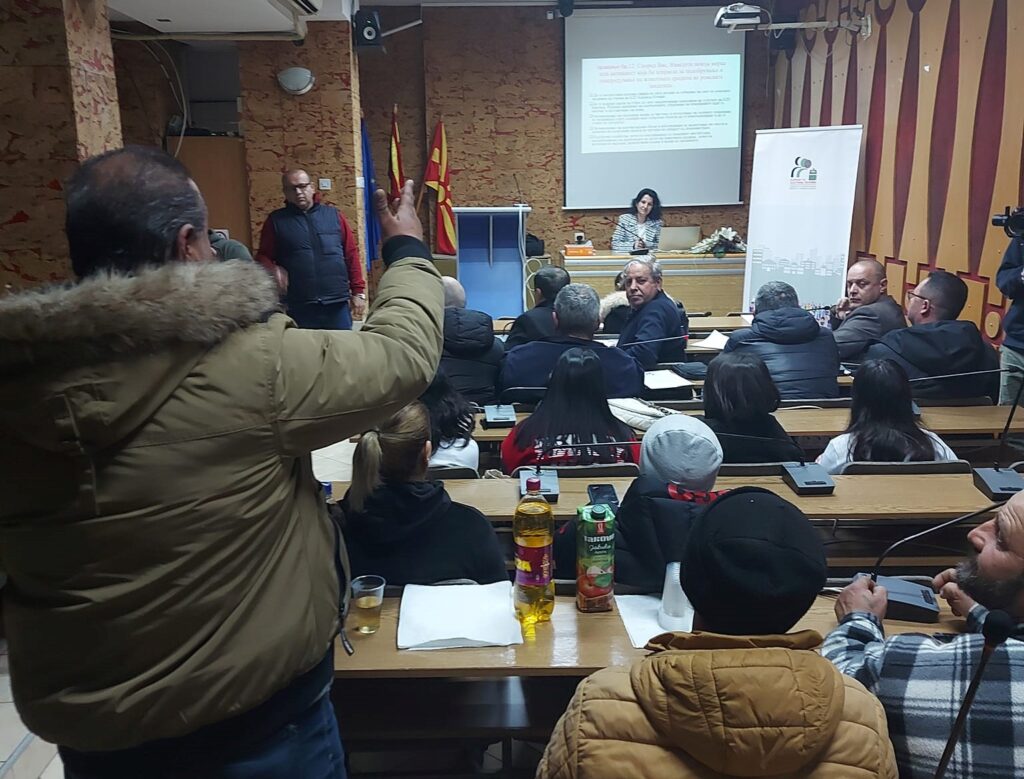
Citizens and representatives of local authorities discussed the environmental problems of the Roma community in Kochani
“Among other things, we must work to rasie the awareness of the citizens in the community, but it must be systematic and planned. Something must be done first so that it can be kept,” says Ajser Memedova, a young activist from Kochani and a participant in the public debate where the quality of the services received by the Roma community in this city was discussed.
The survey results were presented among the Roma population. The forum took place on January 17, 2023, on the premises of the Municipality of Kochani. Half of the surveyed citizens (52%) say there are no satisfactory living conditions in their neighborhood, with a majority of the respondents (60%) saying that they and their children also feel health consequences from environmental pollution. Citizens are self-critical and are recognized as responsible for environmental pollution. They are second on the list, just behind the Public Utility Company “Water Supply,” which many of the respondents consider not efficient in collecting waste. Despite this awareness, the answers to the question “Do you throw your domestic or construction waste at public places and pollute the environment?” are of concern. The exact number of citizens answered with “yes” and “no” (21%), a total of 35% do it sometimes, while 23% said that they do it only when they have to.
A total of 34 participants, including interested citizens, representatives of civil society organizations, but also the director of the utility company “Water Supply” from Kochani, managers from various sectors related to communal hygiene, officials from the Municipality of Kochani who work on environmental protection, municipal inspectors for communal works and the team of municipal utility wardens, discussed these results and the recommendations from the report. The discussion should be a reminder for the local authorities to fulfill the pre-election promises to the citizens, and the report should enable better planning of environmental protection activities.

“These activities are good because they allow us to publicly discuss our community’s problems. The environment is seriously endangered, living conditions are poor, and institutions are not paying enough attention to the situation,” says Jesian Zurapov, a citizen of Kochani, adding that he took the opportunity to ask representatives of the utility and the municipality when they take actions to improve the situation.
The participants agreed that this is a serious and good start for cooperation and identifying problems in the community.
The survey was conducted from 15 to 20 December 2022 and included 200 residents of Kochani from the Roma community. The survey and forum are part of the project “Initiative for better conditions and a better living environment in the Roma community in the Municipality of Kochani” implemented by the Center for Community Development.”Bright Future” from Kochani.
The implementation of this training is made possible by the project “Support to Electoral Reforms in North Macedonia” of the Government of Switzerland, implemented by the International Foundation for Electoral Systems (IFES), and the grants are administered by the Macedonian Center for International Cooperation (MCIC).
![[Aggregator] Downloaded image for imported item #43795](https://civicamobilitas.mk/wp-content/uploads/2026/01/611149509_1571871173934400_3927165331577291092_n-2-768x512.jpg)