1 breaking barriers.jpg

Breaking barriers: persistent gender gaps in sport revealed

A new analytical report from the “All In Plus: Promoting Greater Gender Equality in Sport” joint project highlights both progress and persistent disparities in gender equality across European sport. The report, published at a conference in the framework of the Luxembourgish Presidency of the Committee of Ministers, is based on data collected in 21 jurisdictions and provides a comprehensive analysis of gender equality in six key areas. It analyses the state of gender equality in leadership, coaching, officiating, participation from grass-roots to elite level, preventing gender-based violence, media/communication, and gender equality policies and programmes in sport.

A Call to Action

The “All In Plus” project underscores the urgent need for policy implementation, financial investment, and coordinated efforts across the sports sector. Despite some progress, gender disparities in leadership, participation, and media representation remain deeply rooted. The Council of Europe and the European Commission urge governments, sports organisations, and other stakeholders to adopt and enforce policies that ensure equal opportunities for women and men in sport.

Georges Mischo, Minister in charge of Sport in Luxembourg stated that “Gender equality in sport is not just a goal, but a fundamental right that we must tirelessly work towards. The findings of the All In Plus project highlight the strides that have been made as well as the significant gaps that still need to be addressed. This project is crucial in bringing to light the persistent disparities and providing clear insights and recommendations. It is imperative that we take these findings seriously and that the necessary changes are implemented to ensure that everyone, regardless of gender, has equal opportunities and representation in the world of sport.”

Normunds Popēns, Deputy Director-General of Education, Youth, Sport and Culture at the European Commission, stressed during the conference: “As we celebrate these achievements, we must also acknowledge that gender equality in sport is a complex and deeply rooted issue that requires ongoing commitment, collaboration, and innovation. It is now up to all of us to take the insights and recommendations generated by this project and transform them into concrete, lasting change.”

“The findings of this project serve as a wake-up call for the sports sector. While we see incremental progress, we must accelerate efforts to ensure that gender equality is not just an ambition but a reality,” said Matthias Kloth, Head of the Digital Governance and Sport Department at the Council of Europe.

Key Findings of the Report:

Leadership: women remain significantly underrepresented in decision-making roles. Only 12% of sports federations have a female President, and 29% have a female Vice-President or Board members. While 59% of sports organisations have taken action to increase women’s representation, disparities remain stark.

Coaching: women make up only 23% of registered coaches, with significant variations among countries. While Malta (40%), Switzerland (39%) and Sweden (34%) have relatively higher proportions of female coaches, some jurisdictions have sports federations that employ no female coaches at all. Only half of sports organisations have taken action to recruit more women into  coaching roles.

Officiating: women account for just 32% of sports officials, with numbers particularly low in Austria (8%). Only 47% of sports organisations have implemented measures to increase female representation in officiating.

Participation: women and girls represent only 31% of all sports federation members, with participation rates dropping significantly from youth to adulthood. Finland stands out as a leader in gender-balanced participation with 50%, while in many other jurisdictions women’s engagement in sport remains limited.

Preventing Gender-Based Violence (GBV): progress has been made, with the percentage of sports organisations having written policies increasing from 25% in 2019 to 39% in the latest data collection in 2023. However, only 33% allocate funds for GBV prevention, and victim support mechanisms remain underdeveloped with 37%.

Media representation: only 35% of sports organisations have taken steps to promote gender-balanced representation in the media, with Austria (65%) and Spain (59%) leading in this area. However, fewer than 30% of organisations have media guidelines for gender-sensitive representation.

Gender equality policies and programmes: while 67% of sports organisations include gender equality in their long-term plans, only 34% have written policies or action plans, highlighting a gap between commitment and concrete action.

https://www.coe.int/en/web/portal/-/breaking-barriers-persistent-gender-gaps-in-sport-revealed

Council of EuropeLuxembourg13 february 2025

This post was originally published on this site

Продолжи со читање

  • Promotion of Minorities’ Participation in Multilevel Governance

    The PACT project officially started in Brussels with a 2-day international conference and workshop
    On 10 and 11 March 2026, Brussels hosted an International Conference and Workshop entitled “Promotion of Minorities’ Participation in Multilevel Governance”.
    It brought together experts coming from different realities, with a common goal: sharing good practices on how to promote inclusive participation of under-represented minorities, people with migratory background, refugees, Roma and other marginalised communities in local decision-making processes.
    The Conference
    The event opened on the morning of Tuesday 10 March with 2 panels.
    The first one – entitled “Minority Participation in Multilevel Governance: EU perspectives” – was moderated by Mohammed Mustafa (ALDA – European Association for Local Democracy) who introduced the main EU policy developments in the areas of anti-poverty and anti-discrimination, and migration, setting the tune of the conversation with the speakers:
    Julie Pascoet (European Network Against Racism – ENAR) focused on the European Anti-Discrimination Strategy,  highlighting how much this tool is necessary (but also how far it is to address the needs of the moment), and how civil society networks  play a crucial role to bridge the gap between EU policy intentions and the lived experiences of marginalised communities.
    Fernando Vasco Chironda (European Anti Poverty Network – EAPN) tackled the EU Anti-Poverty Strategy, underlying that – by excluding migrant people from vulnerability frameworks – the strategy risks deepening marginalisation of those most affected, and that local authorities are those with the responsibility to ensure inclusive participation spaces and adequate resources for people.
    Mojib Atal (Migration Policy Group – MPG) focused on the Migrant Integration Policy Index, reporting a concerning stagnation in political participation across the EU, and highlighting how multilingual education could serve as a democratic tool by recognising linguistic diversity rather than privileging a single dominant language.
     

    The second panel – “From Welcoming to Active Participation: Challenges, Practices and Power” – was moderated by Maddalena Alberti (ADL Zavidovici) and had the goal to hear from experts who exchanged ideas, perspectives and best practices for the inclusion of underrepresented minorities at a local level.
    Anna Coulibaly (International Catholic Migration Commission – ICMC Europe) introduced the Community Sponsorship, a community‑led integration model where volunteers, supported by civil society and approved by governments, commit to hosting and supporting refugees for at least a year.
    Loubna Reguig (European Forum for Youth with Lived Migration Experience – VOICIFY) urged how self‑led organisations are essential to defend the political participation rights of young people with migrant backgrounds, since they create spaces where youth feel included, exchange knowledge and pool resources.
    Queenie Kessie (IOM Diaspora Advisory Board – DAB) showed how diaspora advisory structures can move beyond consultation and concretely ensure fair policies are good for migrant people and societies.
    Ismail Alkhateeb (PLACE Network) brought the organisation’s extensive experience to show that the inclusion of migrant people in local participatory processes can happen only when institutions and local communities jointly define problems, design solutions and test them at micro‑level.

    Conclusion
    Hosted by Amazone asbl (Brussels) and co-organised by ALDA (France), ADL Zavidovici (Italy), KMOP (Greece), Center for Intercultural Dialogue (North Macedonia), PLACE Network (France), Fons Català (Spain) and Konkáv Alapítvány (Hungary), the event saw the participation of public authorities, policy makers, organisations, media, underrepresented minorities united by the wish to learn on how working together is possible for a fair and equal European policy system.
    The initiative was part of the European-funded project PACT (Participatory Action for Transforming Communities) whose aim is empowering under-represented minorities in local communities in Europe.

  • Metamorphosis publishes research on the effects of disinformation and foreign influence on democratic processes

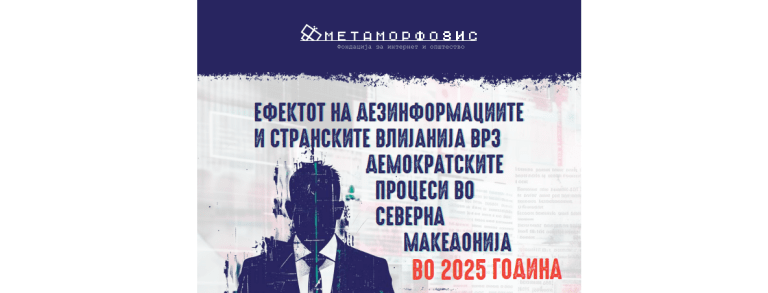
    The Metamorphosis Foundation has published the research “The Effect of Disinformation and Foreign Influences on Democratic Processes in North Macedonia in 2025,” which analyzes how disinformation and propaganda narratives affect public debate, trust in institutions, and citizen participation in democratic processes. The research combines an analysis of disinformation narratives and a survey of a nationally representative […]

  • On current economic topics, Blagica Petreski in Win-Win

    https://www.facebook.com/TVTelma/videos/2347874929012206
    The post On current economic topics, Blagica Petreski in Win-Win first appeared on Finance Think.
    The post On current economic topics, Blagica Petreski in Win-Win appeared first on Finance Think.

  • AJM Calls for Measured and Professional Communication with Journalists

    The Association of Journalists of Macedonia (AJM) is monitoring the public reaction following the communication between the Minister of Interior Panče Toškovski and journalist Frosina Fakova Serafinović from the media outlet Sloboden Pechat, during yesterday’s press conference, which was also …

  • Public call for participation in the co-creation of the National Action Plan for the Open Government Partnership 2026-2028

    Based on Article 3, paragraph (2), subparagraphs (5) and (6) of the Decision on the Establishment of the Council for Coordination and Monitoring of the 2024-2026 Open Government Partnership Process, No. 16-1662/1 of 02.05.2024, and the Decision on the Amendment of the Decision on the Establishment of the Council for Coordination and Monitoring of the […]
    The post Public call for participation in the co-creation of the National Action Plan for the Open Government Partnership 2026-2028 first appeared on Metamorphosis.

  • AJM and UNDP: Awards for Best Stories on Air Pollution

    The Association of Journalists of Macedonia (AJM), in cooperation with the United Nations Development Programme (UNDP) and with financial support from Sweden, today presented the awards for the best journalistic stories of 2025 on the theme: “Tackling Air Pollution – …