
What are the candidates talking about in the 2025 local elections? #6
WEEKLY REVIEW #6 [20-26 October 2025]
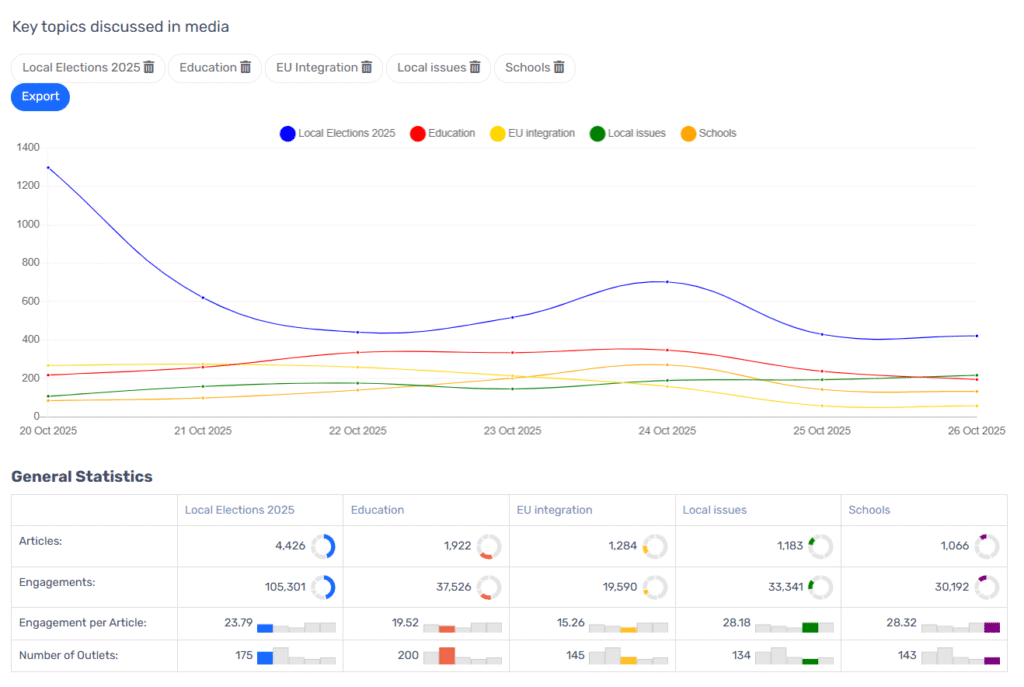
Even after the conclusion of the election process, the elections continued to dictate the media agenda. Although the number of publications was somewhat lower than in previous weeks, public interest remained high. With more than 4,400 media texts and 560 posts on social networks, the media space remained active — but with a visible change in tone: from pre-election mobilisation toward post-election analysis, accountability and governance.
What are the candidates in the local elections talking about?
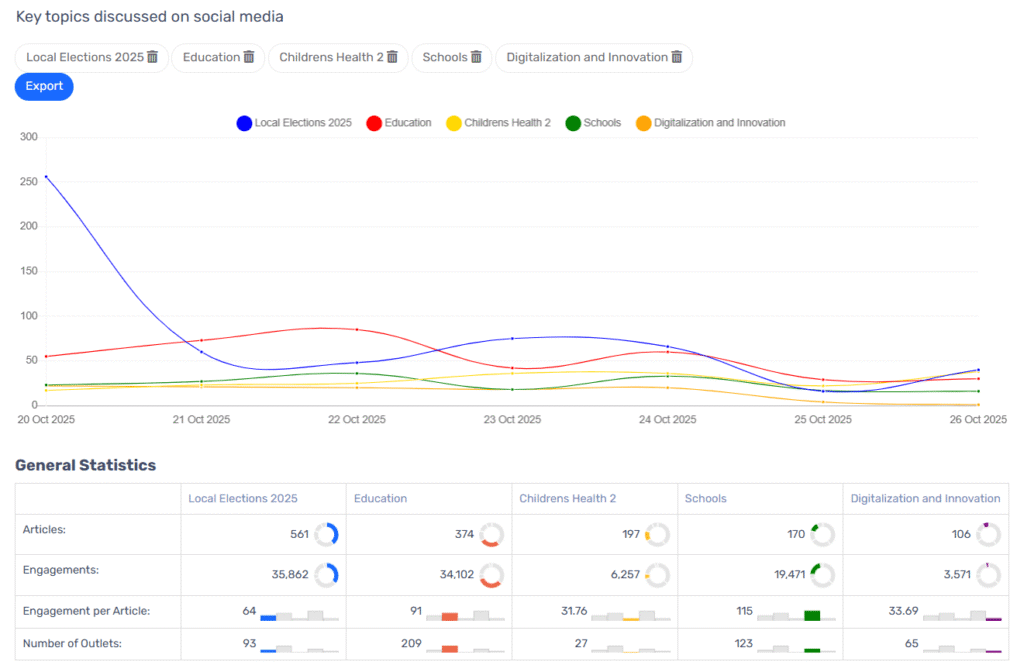
Attention gradually shifted from electoral competition to questions of governance. Topics such as education, local self-government and public services again took centre stage in the conversation — but this time with a different tone: not as promises, but as expectations of the new local authorities.
Education confirmed itself as the most persistent axis in public debate, followed by discussions about children’s health and the digital transformation of municipal services.
What stands out in this period is the transition from electoral rhetoric to themes related to accountability and institutional integrity. Public interest in accountability in the management of public institutions was revived, prompted by cases linked to misuse of office and corruption. This change indicates that citizens are not only following political processes, but also expect concrete results, transparency and accountability in the everyday work of institutions.
In the media space a pronounced change of focus is noticed — from mass electoral coverage to deeper analyses and commentary on how announced policies are being implemented. Social networks, meanwhile, remain a space for faster and more emotional responses to current events. Content that speaks about the quality of public services, child safety and local improvements proves to be most influential in building public perception.
What really drives citizens?
In parallel, the dynamics of communication on digital platforms are changing. Short videos and immediate messages continue to get the most response, indicating that the audience demands concise and visually attractive forms of communication. This confirms the trend of redirecting public interest toward content that is more emotional and easier to share, as opposed to classic political statements.
What happens with topics concerning civil society?
Even after the end of the first round of elections, transparency, accountability and the funding of civil society are not on the agenda. Topics of digitalisation are mentioned, but almost exclusively as “faster administration” and “e-services” — not as tools for public oversight, open data or monitoring of procurements.
While local issues, education, schools, local government and public transport dominate, topics such as digitalisation and innovation appear only marginally — and when they are mentioned, it is almost always in the context of service modernisation, not open data, transparent tenders or civic oversight.
This gap is critical for civil society organisations: newly elected mayors are already creating their agenda for the next four years. Without proactive insertion of these topics — by linking them to concrete cases of inefficiency, corruption or environmental problems — they risk remaining marginalised throughout the whole mandate.
Where is the discussion taking place?
Analysis of platforms again shows that TikTok is the most effective channel for mobilisation — with an average of 583 interactions per post, far above Instagram (157) and Facebook (106). Politicians who invested in short, emotional video formats achieved disproportionately high reach compared to those who relied on traditional formats.
Although hate speech remained at a moderate level, it is still present, especially in the online space where visibility is greatest. Analyses show that aggressive comments are more often directed at less visible personalities or at those who are connected with sensitive topics. This raises the question of the need for a more systematic approach to moderating and protecting public discourse from digital aggression.
Methodology
The data in this review come from comprehensive monitoring of public discourse implemented via the Pikasa Analytics platform, which combines automated tracking with advanced content analysis of online media and social networks.
Civica Mobilitas is a project of the Government of Switzerland implemented by MCC Macedonia, NIRAS from Denmark and FCG Sweden. The opinions and positions expressed in this publication do not reflect the position of the Government of Switzerland.