
Over €200 million annually for state aid – a need for greater transparency and control
Over €200 million per year is allocated to state aid in North Macedonia, but these funds are dispersed across multiple institutions, making them difficult to track and manage. According to data from the Commission for Protection of Competition, state aid amounted to €206 million in 2023 (around 1.5% of GDP), while in 2024 it reached €235.2 million, or 1.52% of GDP.
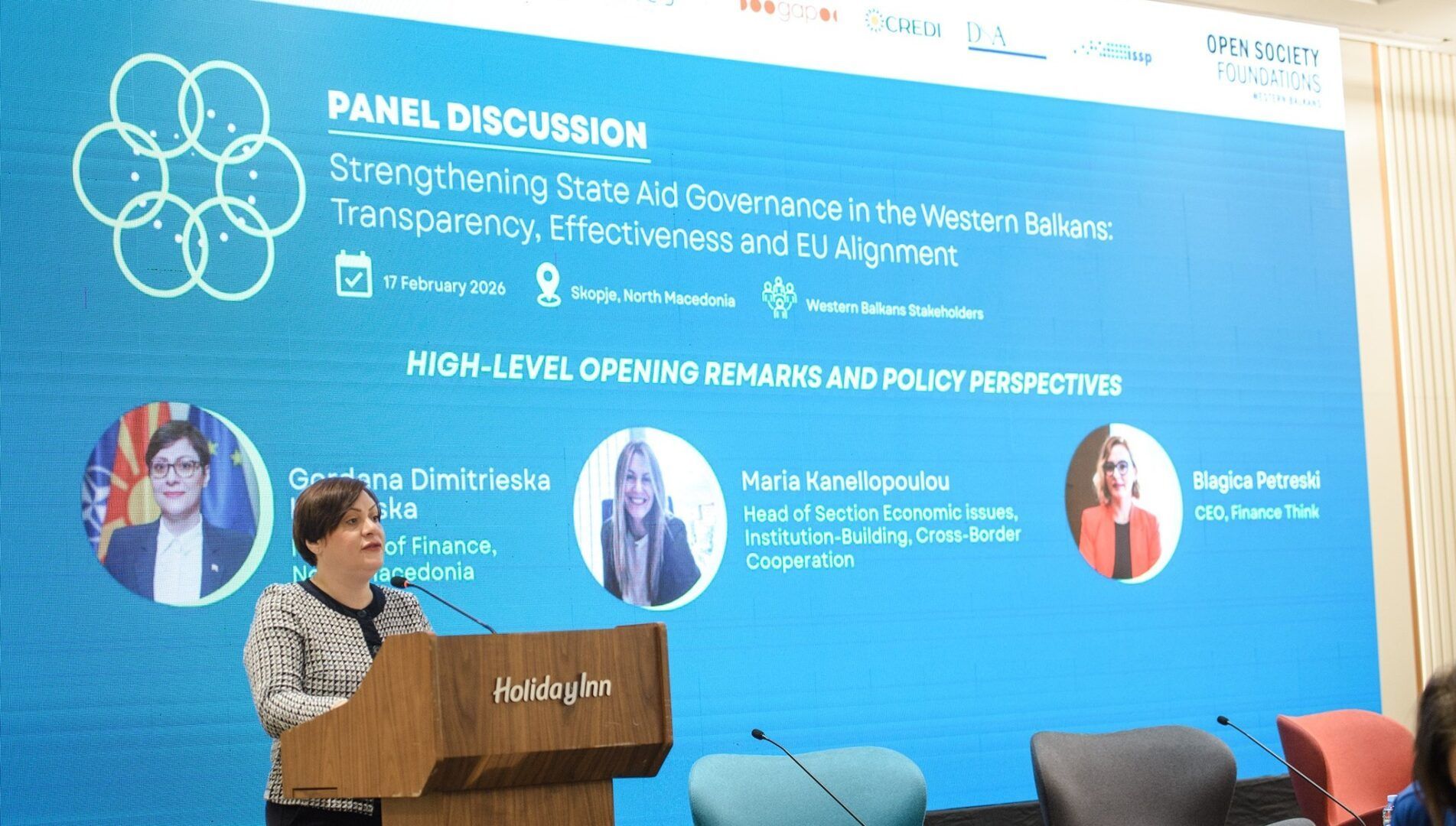
These issues were at the center of the regional panel discussion “Strengthening state aid governance in the Western Balkans: transparency, effectiveness and EU alignment”, organized by Finance Think, which brought together more than 40 representatives of institutions from Western Balkan countries. The conclusion was clear: there is a pressing need to establish a central state aid register that would enable greater transparency, better coordination, and more systematic measurement of the effects of different programs.
The Minister of Finance, Gordana Dimitrieska-Kochoska, emphasized that this is a substantial fiscal amount that must be treated as an investment rather than a burden:
“State aid must not represent a burden on public finances, but rather an investment in competitiveness and sustainable growth. According to data from the Commission for Protection of Competition, state aid amounted to €206 million in 2023, or around 1.5 percent of GDP, while in 2024 it reached €235.2 million, or 1.52 percent of GDP, which underscores the need for a high level of accountability and transparency.”
The Executive Director of Finance Think, Blagica Petreski, pointed out that there is currently a lack of micro-level data on which companies receive state aid, from which sectors, and for what purposes, limiting the quality of policy design.
“Our recommendation is to establish the central state aid register as soon as possible, as there is a wide range of programs being offered. This would not only increase transparency, but also allow for more detailed measurement of effects. When planning the introduction of a specific measure or program, an impact evaluation of potential effects is essential, and once implemented, the measure should be evaluated to avoid repeating past mistakes where large amounts of funds were spent without tangible results. State aid is one of the most underestimated topics, given that budgetary allocations under this heading reach up to 2 percent of GDP in some years, particularly during crisis periods.”
The post Over €200 million annually for state aid – a need for greater transparency and control appeared first on Finance Think.
This post was originally published on this site
![[Aggregator] Downloaded image for imported item #48830](https://civicamobilitas.mk/wp-content/uploads/2026/06/mno-1024x532-1-768x399.png)
![[Aggregator] Downloaded image for imported item #50483](https://civicamobilitas.mk/wp-content/uploads/2026/09/Lorik.jpg)