

Building a Resilient and Trusted Information Ecosystem Requires Collective Action
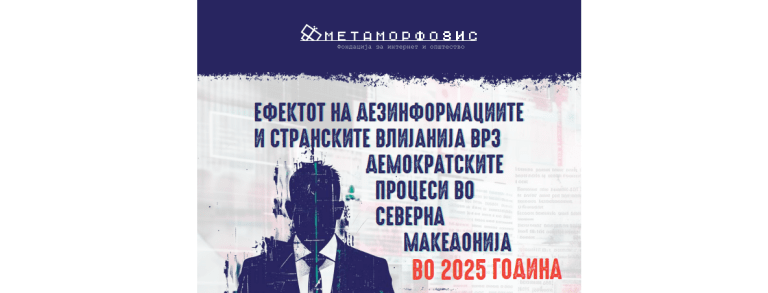
Disinformation, information manipulation, and foreign influence (FIMI) continue to erode public trust, deepen social divisions, and weaken North Macedonia’s democratic processes and EU aspirations. Without decisive and coordinated action, the information manipulation industry will keep evolving, outpacing regulation and exploiting systemic vulnerabilities.
This was the central message of today’s validation meeting in Skopje, which focused on the draft report “Enablers and Incentives of Election-Related FIMI in North Macedonia.” The event brought together representatives of public institutions, media, civil society, and international organizations to review the findings and strengthen the report through participatory dialogue.
In her opening remarks, Khushbu Agrawal from International IDEA highlighted the broader scope of the initiative:
“This report by our partner Metamorphosis is part of a larger project on FIMI supported by Global Affairs Canada. While it’s not the first report on the topic in the country, we are trying to create a ‘one-stop shop’ that consolidates all relevant knowledge and research related to electoral FIMI in North Macedonia, particularly the vulnerabilities and incentives that enable it to take root and thrive”, said Agrawal.
Goran Rizaov, Program Manager for Information and Media Integrity at Metamorphosis and co-author of the report, presented the methodology developed by International IDEA, based on distinguishing enablers and incentives of FIMI.
“Despite other things, we also aimed to explain how gender-based disinformation, the use of AI, and global linkages are leveraged to manipulate information in an election context. Political polarization, often along ethnic or interethnic lines, as well as systemic corruption, weaken institutional resilience. Implementation of electoral reforms is poor, and misuse of public resources remains widespread”, said Rizaov.

Despina Kovachevska and Matej Trojachanec, researchers from Metamorphosis, and also co-authors of the report presented the insights on societal enablers and social networks, with additional focus on gender narratives and AI-generated disinformation.
Kovachevska emphasized the use of fear-based messaging targeting women and LGBTI+ communities:
“We’ve seen narratives claiming that if North Macedonia joins the EU, children will be turned transgender, or girls will be forced to dress like boys. In pro-Russian disinformation, Ukrainian women are portrayed as heroes staying to fight, while men are shown as cowards fleeing. When attacking President Zelensky, disinformation often targets his wife and her alleged spending. There’s a broader theme of contrasting the ‘traditional mother’ with the ‘Western woman’—single, selfish, and even demonized through religious narratives”, Kovachevska said.
“These gendered narratives build on fear: fear of vaccines, fear of the West, fear of ‘moral decay’. Low media literacy, which is in decline, allows such manipulative content to flourish,” she added.
Rizaov also spoke about the fragility of the media landscape:
“Independent outlets are nearly unsustainable. There’s an illusion of pluralism due to the high number of media outlets, but in reality, they are often politically or commercially aligned. Copy-paste journalism dominates mainstream media. If all you’re doing is copying content, manipulation can easily slip through—especially if it originates from a powerful center of influence”, said Rizaov.
Trojachanec explored how social media algorithms and generative AI are shaping the disinformation ecosystem:
“The platforms amplify extreme content based on user behavior. While we haven’t yet seen deepfakes targeting local politicians, we’ve identified AI-generated videos promoting fake medicines, often using voices cloned from well-known doctors. These are mostly adapted from Bulgarian-language templates, making them relatively easy to detect. Still, the use of AI in this context remains limited—for now.”
The event concluded with a set of policy recommendations aimed at public institutions, the media sector, tech platforms, and civil society. These focus on improving legislation, media independence, digital transparency, and public awareness, while calling for stronger cross-sectoral cooperation and alignment with EU regulatory standards.
This post was originally published on this site![[Aggregator] Downloaded image for imported item #46020](https://civicamobilitas.mk/wp-content/uploads/2026/03/picture4-1.jpg)


![[Aggregator] Downloaded image for imported item #45513](https://civicamobilitas.mk/wp-content/uploads/2026/03/ace_5119-1-1024x683-1-768x512.jpg)