When Saving Becomes Political Responsibility
“Saving at state level does not mean giving up expenditures, but rather rationalizing them and channelling them to policies that create an added value – education, health, infrastructure and innovations”, says Blagica Petreski, the Executive Director of Finance Think, concisely explaining the essence of public finance: “The government should save on inefficiency, and not on future.” It is on the World Savings Day (31st October), when the world speaks about financial literacy and rational use of resources that she reminds that money – be it personal or public – should not only be saved, but also used responsibly.
At time of inflation, when the citizens face price increase, and the promises for higher salaries and pensions often sound like an easy solution, it is especially important that they have access to correct and reliable data. The Economic Compass provides the real direction.

“Inflation is a macroeconomic indicator that the citizens feel directly via price increase, but they do not always understand its movers and reasons. Therefore, we use the Economic Compass to timely follow these occurrences, we indicate the risks and we stimulate a corrective mechanism with the policy makers, while the citizens are informed with checked and understandable data. And we have already noticed that this mechanism functions – we indicated the risks of higher inflation already in the first quarter, and during the summer the policy makers adjusted their rhetorics on the potential reasons and announced correction of the measures. This shows that timely information can really have an impact on improved policy making and expectations management”, explains Petreski.
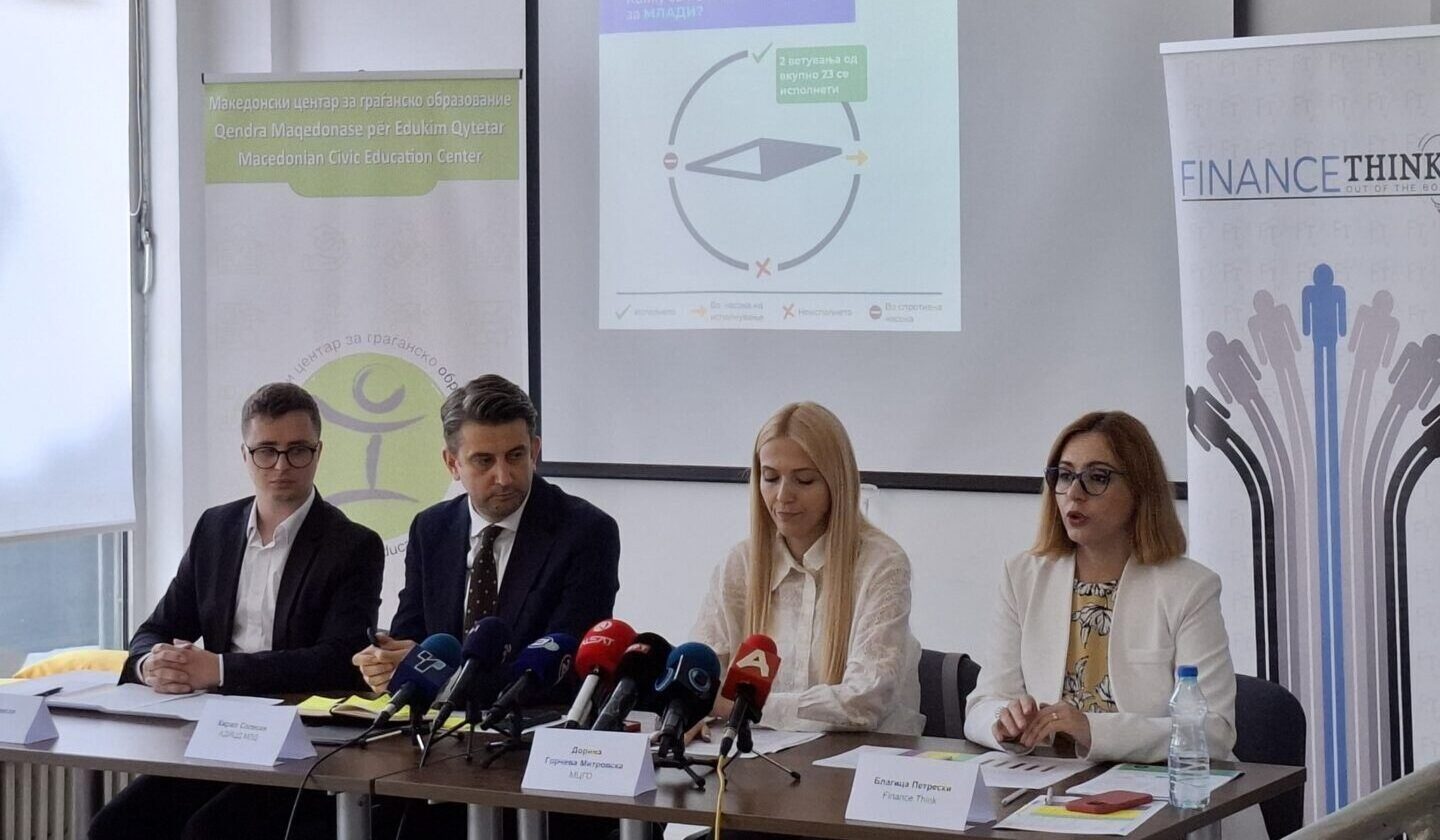
The Economic Compass is a digital tool that monitors the implementation of 139 government promises in five crucial areas – socio-economic, education, health, youth policies and gender equality. The new version of the platform is an upgrade of the previous Economic Compass, which monitored only economic promises in the period od 2020 to 2024, and now it has been transformed into a comprehensive monitoring framework for the period of 2024-2028.
It helps the citizens understand what is really being implemented, and what has remained but a paper promise,” adds Petreski. The most recent data from June show that so far 18 measures (13%) of the promises have been fully implemented, 51 promises (37%) are ongoing, and the biggest progress can be seen in education, while the biggest gap is in health and gender equality. The availability of public services is a priority number one for the citizens, when it comes to improving the quality of life. Although there are adopted strategies, its implementation in the field is limited, with insufficient human resources and slow institutional changes.

Petreski stresses that the real challenge are not the numbers, but the approximation between the promises and the real need of the citizens. Finance Think research shows that the citizens mostly ask for better care for the elderly, available special health care, quality public transport and more practical teaching in education. According to Petreski, “when the political measures do not respond to these priorities, then public funds are not used effectively. The goal of the Compass is to change this – to inform the public, increase the interest in real priorities and create a better basis for rational policies”.
Besides this, the platform has also become an important data source for the media, analysts, experts and institutions who already use it as a reference source when creating analyses and preparing for programmes. “Even institutions have recognized it as an internal tool for measuring the progress and comparing policies throughout the years, which has additionally confirmed its practical value and credibility”, stresses Petreski.
Economic Compass has created conditions for accountability and stimulated a dialogue between the public and institutions. She also adds that: “the process is slow, but when the data is available, can be checked and is visually“ clear, the trust in the institutions grows.

Thee symbolic message of this year’s World Savings Day – “This is not a savings account” is applicable both in economy and politics. The citizens should not save their expectations, nor should the political parties save their promises as deposits. Real frugality does not mean giving up on expenditures, but rather channelling them to investments that create long-term value – in education, health, infrastructure and innovations. “In public finance it means implementation of fiscal consolidation, decreasing budget deficit and consistent respect of fiscal rules, in order to maintain the stability of public finance. Our analyses has shown that effectiveness is lost when the promises are not approximated to the real priorities of the citizens,” adds Petreski.
The trust in economic policies, she says, is more sensitive than the trust in the baking system. “The growth of the deposit mass shows that the citizens have high trust in the banks, but the economic trust depends on the predictability and effectiveness of the measures. The Economic Compass contributes to objective measuring of that trust via facts and indicators.”
This process of increased accountability and transparency is possible thanks to the project “Citizen Oversight: Bridging the Gap between the Policy Promises and Delivery in Four Development Areas” that Finance Think implements together with its partners Macedonian Civic Education Center (MCGO), Youth Educational Forum (YEF), Macedonian Medical Society and 360 Degrees with the support of the Swiss Government via Civica Mobilitas.
At the World Savings Day, the message sent by these organizations reminds that: saving does not mean being quiet or postponing decisions, but it means acting reasonably, transparently and responsibly. The Economic Compass symbolizes precisely this value, frugality as accountability. Every indicator, figure and analysis is a reminder that public funds is not to be kept, but to be spent smartly, and political promises are not deposits but rather obligations towards the citizens.
In the end, the Economic Compass is not only a tool to follow figures. It is a reminder that within a civil society that wants to progress, saving does not mean refraining, but being wise in using resources from every aspect, be it financially, institutionally and humanely.




![Sre]ni praznici(2)](https://civicamobilitas.mk/wp-content/uploads/2025/12/sreni-praznici2-768x432.jpg)