Trust in Civil Society – Citizens’ Views
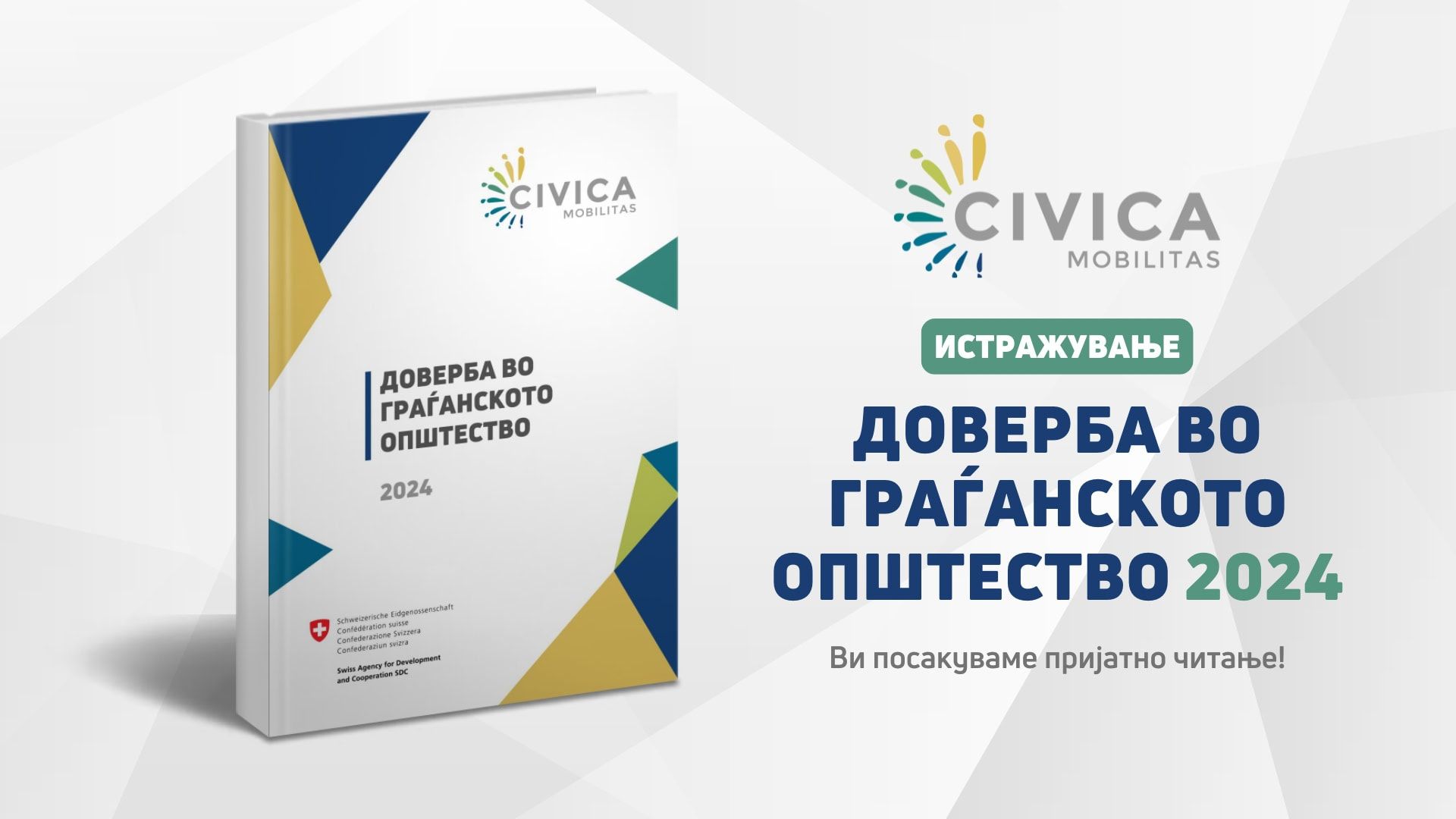
The Macedonian Center for International Cooperation (MCIC) has implemented its regular survey of trust in the civil society. In 2024, the index of trust in the civil sector reached 42.9%, which is an 8.2 percentage points drop compared to 2021. The trust in civil society organizations is 39.4%, with a significant difference among various groups. The highest trust is noted with the young people aged 18 to 29 (51.8%) and with ethnic Albanians (45.6%), while the people older than 65 and the Skopje region inhabitants have the lowest trust (18.6% and 25.2% respectively). The society has the highest level of trust in churches and religious communities (70.8%), while the trust in other civil society stakeholders varies, from 41.7% in informal groups to 30.0% in employers’ organizations.
The research has shown that the people surveyed have different views with respect to the role of CSOs. Every fourth person surveyed (25.1%) sees the organizations as stakeholders that work for the public interest, while 60.4% think that they act to fulfil the personal interests of individuals. Additionally, 58.3% of the people surveyed believe that CSOs are organised and financed by foreign countries and their foundations in order to serve foreign interests, while 24.2% think that they have been established to serve the common public good. The perception of the relationship between the political parties and CSOs is mostly critical. 49.5% of the people surveyed think that parties claim the views of the CSOs when it suits the former, while 33.4% believe that the parties establish organizations that they use as their loudspeakers.
With respect to their contribution to the society, the biggest percentage of the citizens think that CSOs have a role in the public policy creation (45.1%) and societal influence (44.8%). However, the majority does not recognize the active role of the CSOs in informing, education, service provision, or meeting urgent social needs. The trust in CSOs also varies per thematic areas. The highest trust is with those who are active in the area of women or gender equality (46.5%), social welfare (44.1%) and education (43%), while the lowest trust is with the organizations that work on democracy and rule of law (27.2%) and interethnic relations (29.3%). Compared to 2021, trust has decreased in all areas, and the biggest drop is in the area of democracy and rule of law, where trust has dropped from 48.1% to 27.2%.
The research was conducted via a field survey at a national representative sample of 1,000 people. The sample population framework was people older than 18, and the representativeness criteria were: sex, ethnic affiliation, age, place of residence and regions. The collected data were processed with response frequency and ratio. The data have a 95% level of reliability and a +/-3% margin of error. The survey was conducted in the period of 20th April to 25th May 2024. For MCIC, the survey was conducted by M-Prospect.
This post was originally published on this site
![[Aggregator] Downloaded image for imported item #43092](https://civicamobilitas.mk/wp-content/uploads/2025/12/media-lit-call-for-proposals-fotor-naslovna.png)
![[Aggregator] Downloaded image for imported item #43146](https://civicamobilitas.mk/wp-content/uploads/2025/12/10-1536x1152-1-1024x768-1-768x576.jpg)